

This LMS glossary defines the 45 learning management system terms you'll hear while buying or running one, grouped by the decision each one affects. Each entry explains the term, and the 28 full entries add who on your team needs to know it and a question to ask your vendor.
Why this guide? Because vendors use this LMS terminology in demos, often assuming everyone already knows it. (Now you will, and you'll be the one asking which version of SCIM they support.)
Buying? Start with content standards and integrations. Running one? Head to compliance and reporting, or to extended enterprise if you train customers and partners. For learning design and measurement terms, see our companion eLearning glossary.
What are the core LMS platform terms?
Core platform terms describe what the system is and how many audiences it can serve from one place. Get these straight first, and you'll be able to quickly decide whether a vendor's platform fits the programs you run and the problems you're trying to solve.
What is an LMS?
Answer: A learning management system (LMS) is software that delivers training, tracks who completed it, and reports on the results. It's the system of record for what your people learned and when.
Why your CFO cares: One platform means one contract, one set of training records, and one place to look when someone asks what all that training spend bought.
Ask your vendor: "What can't your LMS do without a third-party add-on?"
Go deeper: How Absorb LMS works
What is an LXP?
Answer: A learning experience platform (LXP) is a learner-driven layer that recommends content and lets people browse and search for what they want to learn. An LMS assigns and tracks, and an LXP suggests and invites.
Why your learners care: Some people like to browse. An LXP gives them something closer to a streaming queue.
Ask your vendor: "Where do your recommendations come from, and can we add our own content sources?"
Go deeper: The best learning experience platforms
What is an LCMS?
Answer: A learning content management system (LCMS) is a tool for creating, storing, and reusing training content, often down to single modules or pages. The LMS delivers courses, and the LCMS is where your team builds and maintains them.
Why your content team cares: When one policy changes, they update one module, and every course that uses it picks up the change.
Ask your vendor: "Can we reuse one module across courses and update it in one place?"
Go deeper: LMS vs. LCMS
What are multi-tenant portals?
Answer: Multi-tenant portals are separate learner experiences, each with its own branding, catalog, and users, running inside one LMS. Employees, customers, and partners each see their own version, and admins manage all of them from one account.
Why the admin who'd otherwise run five LMSs cares: One login, one set of reports, and no copying the same course into four systems.
Ask your vendor: "Can each portal have its own branding, catalog, admins, and reports?"
Go deeper: Multiple learner experiences in one LMS
What is a white-label LMS?
Answer: White labeling means putting your logo, colors, and domain on the LMS so learners see your brand throughout. A white-label LMS looks like your product, even though a vendor built it.
Why your marketing team cares: A customer academy at vendorname.example.com quietly advertises somebody else.
Ask your vendor: "Can we use our own domain, email templates, and mobile app branding?"
What is a learning portal?
A learning portal is the website or app where learners log in to find courses, track progress, and see what's due. It's the front door of the LMS, so check how it looks on a phone.
What is a learning path?
A learning path is a set of courses in a planned order, such as onboarding weeks one through four. Paths can unlock the next course once a learner finishes the last one.
What is a course catalog?
A course catalog is the list of courses learners can browse and enroll in on their own. Admins control who sees what, so a sales rep and a nurse can see two very different catalogs.
What is a content library?
A content library is a collection of ready-made courses, often licensed from outside publishers, that you add to your LMS. It covers common topics like soft skills and workplace safety. Your team saves its build time for the training only you can make.
Which content standards decide what will play in your LMS?
Acronyms that decide whether the course plays.
Content standards are the agreements that let a course you build in one tool launch, run, and report results in your LMS. Ask about them in the first demo, because they decide whether your existing course library moves with you.
What is SCORM?
Answer: SCORM (Sharable Content Object Reference Model) is a set of technical standards for packaging eLearning courses so they run in a compliant LMS and report completions and scores. The US Department of Defense's Advanced Distributed Learning (ADL) Initiative developed it. The versions you'll see are SCORM 1.2 and SCORM 2004, including its 4th Edition.
SCORM support is common, but it varies by version, so check before you migrate.
Why your content team cares: Years of courses are probably sitting in SCORM packages. Patchy version support means re-exporting them one by one.
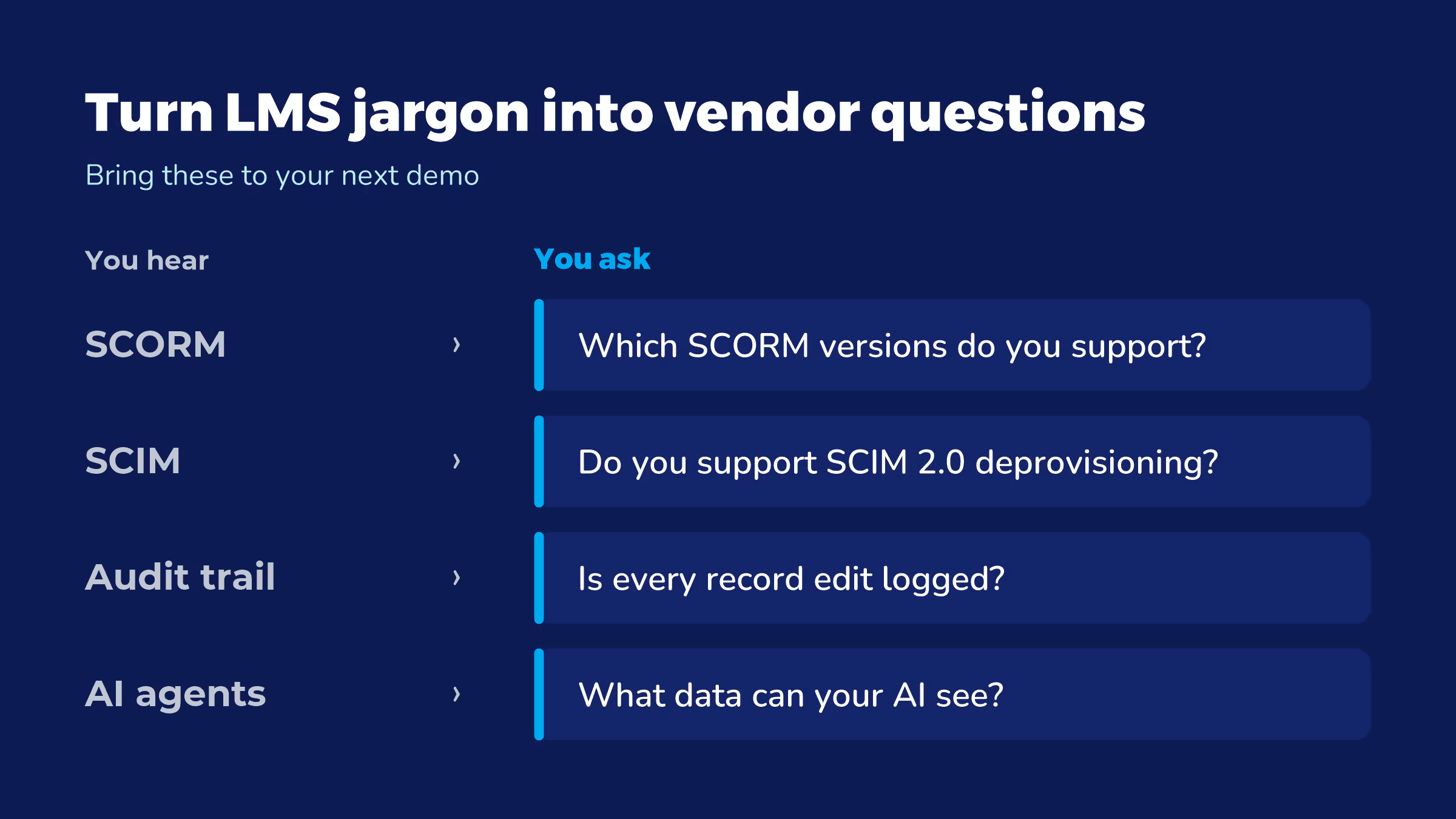
Ask your vendor: "Which SCORM versions do you support, and how do you handle resume data when a learner leaves mid-course?"
Go deeper: What is SCORM? and SCORM support in Absorb LMS
What is xAPI?
Answer: xAPI (Experience API) is a specification for recording learning experiences as simple statements, such as "Maria completed the forklift simulation," and sending them to a learning record store. Its previous name was the Tin Can API, and the current version is xAPI 2.0.
Why your compliance owner cares: xAPI can capture training that happens outside the LMS, like a simulation, a mobile app, or a hands-on checklist. That puts the proof in one place.
Ask your vendor: "Do you have a built-in LRS, and can we export xAPI statements to our own systems?"
What is cmi5?
Answer: cmi5 is a profile for using xAPI with an LMS. It sets rules for how the LMS launches a course and records the results, so you get xAPI-style tracking with a SCORM-style course structure.
Why the team planning its next course library cares: The cmi5 specification gives you a modern path for LMS-launched courses built on xAPI. If your library is SCORM today, ask how the vendor supports both before you plan a migration.
Ask your vendor: "Do you support cmi5 launch, and which version?"
What is an LRS?
Answer: A learning record store (LRS) is a server that receives, stores, and provides access to learning records that systems send with xAPI. An LMS manages courses and learners, and an LRS keeps the records, wherever they came from.
In Absorb LMS, xAPI data goes to a built-in LRS.
Why your data team cares: If the LRS can export, training data can sit next to sales or safety data in your own reports.
Ask your vendor: "Is your LRS built in or separate, and can we send its data to our data warehouse?"
What is LTI?
LTI (Learning Tools Interoperability) is a 1EdTech standard that connects outside learning tools, like a virtual lab or video platform, to your LMS without a separate login. The current version is LTI 1.3 with LTI Advantage.
What is AICC?
AICC is an older content standard that came from the aviation industry. You'll mostly meet it in legacy course libraries, so it matters when you're migrating old content.
Which integration terms should you ask about before you buy?
Where IT starts paying attention.
Integration terms describe how your LMS shares people and data with your other systems. Bring IT to this part of the demo to check what the integrations will require before you set an implementation timeline.
What is an LMS API?
Answer: An API (application programming interface) is a set of rules that lets other software read data from your LMS and take actions in it, like creating users or pulling completions. Most modern LMS APIs are RESTful, which means they work over standard web requests.
Why the developer who inherits this cares: A good API syncs data on its own. Nobody exports another CSV at 4:55 on a Friday.
Ask your vendor: "Is your API RESTful, what are the rate limits, and is there a sandbox to test in?"
Go deeper: Absorb LMS APIs and webhooks
What is SSO?
Answer: SSO (single sign-on) lets people log in once with their company credentials and reach the LMS without a separate password. Your identity provider, the system IT already uses to manage accounts, handles the login.
Why your help desk cares: "I forgot my LMS password" is a ticket that stops existing.
Ask your vendor: "Which SSO protocols do you support, and does SSO work for external learners too?"
Go deeper: Absorb LMS integrations
What is SAML SSO?
Answer: SAML (Security Assertion Markup Language) is an XML-based framework for exchanging security information between an identity provider and an app. Many SSO setups use it to tell the LMS that a person is who they say they are.
Absorb supports single sign-on technologies including SAML 2.0 and LDAPS (OpenID Connect/OAuth).
Why your IT security team cares: Passwords stay inside your identity provider, and access shuts off in one place.
Ask your vendor: "Do you support SAML 2.0, and can we test it in a sandbox before go-live?"
What is SCIM provisioning?
Answer: SCIM (System for Cross-domain Identity Management) is an IETF standard for managing user identities across systems. With SCIM provisioning, your identity provider creates, updates, and removes LMS accounts for you, so the LMS roster matches the company roster.
Why IT cares: When someone leaves the company, their access should leave the same day, with nobody needing to remember to delete them.
Ask your vendor: "Do you support SCIM 2.0 provisioning and deprovisioning from our identity provider?"
Go deeper: LMS implementation checklist
What is HRIS integration?
Answer: HRIS integration connects your HR information system to the LMS so new hires, role changes, and departures flow in automatically. Those updates can then trigger enrollments, like onboarding for a new hire or manager training after a promotion.
A CRM integration does the same job for customer data, and it's covered below.
Why your HR ops lead cares: Nobody uploads the new-hire spreadsheet every Monday.
Ask your vendor: "Which HRIS systems do you connect to natively, and how often does data sync?"
Go deeper: HR and LMS integration benefits
What are LMS webhooks?
Answer: Webhooks are automated messages an LMS sends to another system the moment something happens, like a course completion or a new registration. An API waits to be asked, and a webhook speaks up on its own.
Why your operations team cares: A completion can update a CRM record or notify an account manager, with nobody checking for it.
Ask your vendor: "Which events can trigger a webhook, and what happens if the receiving system is down?"
What is a CRM integration?
A CRM integration connects your customer relationship management system to the LMS so customer and partner training shows up next to account data. Sales and success teams can see who's trained before the renewal call. More in our LMS and CRM integrations guide.
What is MCP?
MCP (Model Context Protocol) is an open-source standard for connecting AI applications to external systems, like an AI assistant reaching into your LMS. Anthropic created it and donated it to the Agentic AI Foundation under the Linux Foundation. With Absorb Aura, you can connect Absorb to your team's AI assistant through MCP.
What does it take to stay audit-ready?
Proof beats good intentions.
Audit-ready means you can show who completed which training, when, and that they acknowledged it, without a week of spreadsheet archaeology. These are the terms compliance owners use most.
What is a training audit trail?
Answer: A training audit trail is a time-stamped record of every training action, such as enrollments, completions, score changes, and admin edits. It shows what happened, when, and who did it.
In FDA-regulated industries, for example, rules for electronic records call for secure, computer-generated, time-stamped audit trails. Ify Anazia, Absorb's Senior GRC Analyst, sums up the standard.
"Standardized, centralized, and traceable: that's what audit-ready looks like."
Why your auditor cares: They'll ask for the log. A good audit trail produces it in minutes.
Ask your vendor: "Can an admin edit a completion record, and is that edit logged?"
Go deeper: Automated compliance reporting
What is recertification?
Answer: Recertification is required retraining on a set schedule that keeps a certification or credential valid. Annual safety refreshers and two-year license renewals are common examples.
Why the employee whose license expires Friday cares: An LMS that enrolls them two months early saves everyone a very awkward Monday.
Ask your vendor: "Can recertification auto-enroll learners before their credential expires and remind their managers?"
What is attestation?
Answer: Attestation is a learner's recorded acknowledgment that they read, understood, or agree to follow a policy. It's usually a checkbox or e-signature at the end of a course or document. The LMS saves it with a time stamp.
Why your legal team cares: "We trained them" holds up better with "and they signed off that they understood it" attached.
Ask your vendor: "Can learners e-sign an attestation, and does it show up in the audit trail?"
What are automated enrollment rules?
Answer: Automated enrollment rules assign training based on details like role, location, department, or hire date. When someone's details change, the rules enroll them in whatever the new role requires.
Mike Avery, Absorb's VP of Product Enablement, has seen how fast the variations pile up. For harassment prevention training alone, separate supervisor and employee requirements plus state-specific rules multiply the versions.
"This can lead to over 20 course permutations to track, update, and maintain."
Why the admin who'd otherwise sort those by hand cares: Rules do the sorting, so they can retire the spreadsheet of who needs what.
Ask your vendor: "Do enrollment rules re-run automatically when someone changes role or location?"
What is certification management?
Answer: Certification management is tracking who holds which certifications, when each was issued, and when it expires. Good systems issue certificates automatically and flag renewals before they lapse.
Why your compliance owner cares: A list of upcoming expirations beats finding one during an inspection.
Ask your vendor: "Can managers see which of their people are about to expire?"
Go deeper: Training certification tracking
What is compliance training?
Compliance training is required training that keeps employees in line with laws, regulations, and company policy, like harassment prevention, data privacy, or workplace safety. The LMS assigns it, tracks it, and proves it happened. More on compliance training in Absorb LMS.
What is a CEU?
A CEU (continuing education unit) is a standard measure of continuing education. One CEU equals 10 contact hours of participation in an organized learning experience, according to IACET.
What is due-date tracking?
Due-date tracking shows when each assigned course must be finished and who's falling behind. Good systems send reminders before the deadline and escalate to managers after it.
What terms matter when you train customers and partners?
Training people who don't report to you.
Extended enterprise terms cover training for people outside your org chart, like customers, partners, and members. Customers and partners can skip optional training, so give them courses that answer questions they already have.
What is extended enterprise?
Answer: Extended enterprise is training for audiences beyond your employees, such as customers, partners, resellers, franchisees, or association members. It usually runs in the same LMS through separate portals.
Why your partner manager cares: Partners who know the product can sell it and support it, and they call less often to ask how it works.
Ask your vendor: "Can external audiences have separate portals, branding, and reporting?"
Go deeper: Extended enterprise LMS and the guide to extended enterprise
What is customer education?
Answer: Customer education is structured training that helps customers adopt your product and get value from it. It ranges from a few onboarding courses to a full customer academy with certifications.
Why your customer success lead cares: Well-trained customers stay loyal, and loyal customers are less likely to churn.
Ask your vendor: "Can we connect course activity to account data in our CRM?"
Go deeper: Customer education with Absorb
What is selling courses?
Answer: Selling courses means charging for training through ecommerce built into the LMS, with pricing, payments, discount codes, and bundles. Associations, training companies, and software vendors use it to turn training into a revenue line.
Why whoever owns that revenue line cares: If checkout is clunky, nobody makes it to lesson one.
Ask your vendor: "Which payment processors and pricing models do you support?"
Go deeper: Selling your courses
What is ticket deflection?
Answer: Ticket deflection means support requests customers never file because they found the answer themselves. The answer might come from a course, a knowledge base, or help content. It's one of the clearest ways to tie customer education to cost.
Laura Malloch, Absorb's Manager of Customer Enablement, explains where self-service fits.
"A knowledge base primarily supports customers in the moment. They're trying to solve a specific problem or unblock themselves quickly."
Why your support lead cares: Every deflected ticket is a call nobody had to take.
Ask your vendor: "Can we compare course completions against support ticket volume?"
What is partner enablement?
Partner enablement is training that gives resellers, channel partners, and integrators what they need to sell and support your product. It often includes certifications partners must hold to keep their status. More on partner enablement.
What is product adoption training?
Product adoption training teaches customers to use specific features, often timed to a release. It works best when the course goes live the day the feature ships.
What is customer onboarding?
Customer onboarding is the training a new customer gets in their first weeks, built to get them using the product with confidence, fast. It often runs as an automated learning path in a customer portal.
What is member education?
Member education is training an association offers its members, often tied to certifications, CEUs, or professional standing. It can be a member benefit, a revenue source, or both. More on association training.
What do reporting and AI features in an LMS do?
Numbers that answer back.
Reporting terms turn training activity into evidence. AI terms describe features that now draft courses, map skills, and answer questions inside the platform.
What is an LMS dashboard?
Answer: An LMS dashboard is a screen of at-a-glance charts and numbers on training activity, such as enrollments, completions, overdue courses, and scores. Most LMSs offer separate dashboards for admins, managers, and learners.
Dr. Andrea Fort, Manager of Learning and Development at Capio Partners, an Absorb customer, describes what changed once reports started running on their own.
"Now, I schedule reports to go out automatically, so I'm not the only one using the data."
Why the one-person L&D team cares: Scheduled reports reach managers every week, and nobody sends a single "can you pull that report?" email.
Ask your vendor: "Can we schedule reports to go out automatically, and can admins enroll people right from a report?"
Go deeper: Absorb LMS reporting and analytics
What is AI course generation?
Answer: AI course generation is AI that drafts a course outline, lessons, and quiz questions from source material you provide, like a policy document or slide deck. You review and edit before anything goes live.
In Absorb, Aura Create "drafts an outline and builds the content, using what you gave it."
Why your content team cares: A first draft that arrives fast can move a policy course from next quarter's backlog to this week's list.
Ask your vendor: "What source material does the AI use, and can we edit everything it drafts?"
Go deeper: Absorb Aura
What is skills inference?
Answer: Skills inference is AI that estimates what skills people have from their activity and data, like courses completed, job roles, and work history. It gives you a skills picture without asking every employee to fill out a survey.
Absorb Skills applies a related idea to content, with skills auto-tagging that automatically identifies relevant skills for any course uploaded to your LMS.
Why the talent lead who keeps hearing "what skills do we have?" cares: An inferred skills map is a starting point that people can confirm or correct.
Ask your vendor: "What data does your skills model use, and can people see and correct their own skills?"
Go deeper: Absorb Skills
What are AI agents in an LMS?
Answer: AI agents in an LMS are AI tools that answer questions and complete tasks for admins and learners, like building a report or finding the right course. In Absorb Aura, for example, Aura Create builds course drafts, and Aura Rehearse lets people practice real conversations with an AI counterpart.
For Dr. Fort's team, what the AI could see mattered most.
"Knowing that [Absorb's AI] is only pulling from what we give it[, not searching the internet,] quelled a lot of [the resistance]."
Why your security reviewer cares: The first question about any AI tool is what data it can reach.
Ask your vendor: "What data can your AI see, and can we restrict it by team?"
Go deeper: Absorb Aura
What is learning analytics?
Learning analytics is measuring and analyzing training data to see what's working, for whom, and what to change. Dashboards show the numbers, and analytics explains them. More in what you need to know about LMS analytics.
What are AI recommendations?
AI recommendations suggest courses to each learner based on their role, history, and what similar learners took. In Absorb Aura, smart recommendations learn what works for each person on your team.
Which LMS terms get mixed up most?
Same aisle, different shelf.
These five comparisons sort out LMS terms that sound alike in a demo.
What's the difference between an LMS, an LXP, and an LCMS?
An LMS delivers and tracks assigned training, an LXP helps people discover learning on their own, and an LCMS is where content gets built and reused.
Term | What it does | When you need it |
|---|---|---|
LMS | Assigns, delivers, tracks, and reports on training | You need records, compliance proof, or one home for training |
LXP | Recommends and curates content for self-directed learning | Your learners want to explore beyond required courses |
LCMS | Builds, stores, and reuses content at the module level | Your team maintains lots of content that changes often |
If you need completion records, start with an LMS; add an LCMS if your team later needs to reuse modules across courses. More in LMS vs. LCMS.
What's the difference between SCORM, xAPI, and cmi5?
SCORM packages courses to run in an LMS, xAPI tracks learning anywhere it happens, and cmi5 applies xAPI tracking to courses an LMS launches.
Term | What it does | When you need it |
|---|---|---|
SCORM | Packages a course and reports completion and score to the LMS | You have existing eLearning courses or buy off-the-shelf content |
xAPI | Records learning statements from any source in a learning record store | You track simulations, mobile apps, or on-the-job learning |
cmi5 | Sets rules for LMS-launched courses that report through xAPI | You're building new courses and want richer tracking inside an LMS |
xAPI can record a simulation run or a field checklist, which SCORM was never built to see. If your library is SCORM and you want xAPI tracking, check how the LMS supports each before you plan a migration.
What's the difference between SSO and SCIM?
SSO controls how people log in, and SCIM controls whether their account exists in the first place.
Term | What it does | When you need it |
|---|---|---|
SSO | Lets people use their company login to reach the LMS | Always, if your company has an identity provider |
SCIM | Creates, updates, and removes LMS accounts from your identity provider | You have frequent hires, role changes, or departures to keep in sync |
SSO opens the door. SCIM keeps the guest list current.
What's the difference between a certification and a CEU?
A certification shows someone met a defined standard, and a CEU measures how much continuing education they completed.
Term | What it does | When you need it |
|---|---|---|
Certification | Confirms a person passed a course, exam, or skills check, often with an expiry date | Roles that require proof of competence or a license |
CEU | Counts continuing education, with one CEU equal to 10 contact hours | Professionals who must earn credits to keep a license or membership |
What's the difference between customer education and customer training?
Customer training usually means teaching people to use a product. Customer education is the broader program around it, from onboarding to best practices and certification.
Term | What it does | When you need it |
|---|---|---|
Customer training | Teaches specific product tasks and features | A customer needs to learn a workflow or a new release |
Customer education | Runs an ongoing program, often a branded academy, across the customer lifecycle | You want training tied to adoption, renewals, and fewer support tickets |
Plenty of teams use the two terms interchangeably. A team may start with task tutorials, then add onboarding courses and certifications.
Next time a vendor drops "SCIM" mid-demo, you'll have the follow-up ready, and you don't need to memorize all 45 terms either. Pick the five or six that affect your rollout, paste their "Ask your vendor" questions into your RFP, and watch which vendors answer with specifics. If Absorb LMS is on your list, bring those same questions and see how it handles your content, integrations, and audiences.
Frequently asked questions about LMS terms
What does LMS stand for?
LMS stands for learning management system, software that delivers, tracks, and reports on training. It's the first of many LMS acronyms you'll hear, and the sections above cover the rest.
Which LMS terms should buyers learn first?
Start with SCORM, xAPI, SSO, SCIM, audit trail, and extended enterprise. Those six decide whether your content moves over, whether IT signs off, whether compliance can prove training happened, and whether you can train people outside the company.
How is an LMS glossary different from an eLearning glossary?
An LMS glossary covers the platform itself, including standards, integrations, compliance features, and reporting. An eLearning glossary covers how people learn and how you measure training, from microlearning to ROI models. Our companion eLearning glossary has those terms.