






Learning and development comes with a lot of vocabulary, and this eLearning glossary puts 31 important LMS terms in one place, in plain words. From ADDIE and VILT to the shiny, new AI terms that seem to surface monthly, this is your one-stop spot for common LMS words and phrases.
Learning terms are grouped by the job you do. The main entries say who feels the impact and what to try next.
If you're new to L&D, start with the formats, then skip ahead to proving training works. Platform terms like SCORM and LXP live in our companion LMS glossary.
Which eLearning formats should you know?
Same lesson, different outfits.
The eLearning formats to know are self-paced, synchronous and asynchronous, blended, instructor-led (ILT), virtual instructor-led (VILT), mobile, and microlearning. They differ by timing, place, and size, and most training programs mix several.
What is self-paced learning?
Self-paced learning lets each person move through a course on their own schedule, with no live session to attend. It suits busy or spread-out teams. The tradeoff is follow-through, so pair it with due dates and reminders.
What are synchronous and asynchronous learning?
Synchronous learning happens live, with everyone present at the same time in a room or on a video call. Asynchronous learning happens on each learner's own time, through recorded lessons, courses, and discussion boards. Most programs use both, and our guide to synchronous and asynchronous learning covers when to pick each.
What is blended learning?
Blended learning combines online learning with live, instructor-led sessions in one program. A common pattern is self-paced modules for the basics, then a live session for practice and questions. Our full article on blended learning has more examples.
What is instructor-led training (ILT)?
Instructor-led training is a live session where a trainer teaches a group, usually in person. It works best for hands-on skills and topics that need discussion. Our instructor-led training article covers how to plan sessions people remember.
What is virtual instructor-led training (VILT)?
VILT is live training that an instructor leads over video. The trainer and learners meet at the same time from different places. It saves travel, though it needs shorter segments and more interaction to hold attention on a screen.
What is mobile learning?
Mobile learning is training you can take on a phone or tablet. It reaches frontline, field, and retail workers who rarely sit at a desk. Short lessons, readable text, and offline access matter most.
What is microlearning?
Microlearning breaks training into short lessons, usually a few minutes each, that focus on one skill or idea. It works well for refreshers and quick help on the job. Our microlearning guide shows how to build it.
Which terms come up when you build a course?
Blueprints before brilliance.
ADDIE and authoring tools are the instructional design terms that come up in almost every course build. ADDIE is the design model you follow, and the authoring tool is where you build.
What is ADDIE?
ADDIE is an instructional design model whose name stands for Analyze, Design, Develop, Implement, and Evaluate. It grew out of instructional systems work for the US military, including a five-phase model Florida State University built for the armed services in 1975. In the Design phase, teams usually produce a storyboard, a screen-by-screen plan of the course before anyone builds it.
Why your project sponsor cares: skipping Analyze is how teams ship a polished course for the wrong problem. You can run ADDIE in short loops, and the order still holds.
Try this: before your next build, write one sentence naming the on-the-job behavior the course should change. That's your Analyze phase in miniature.
What is an authoring tool?
An authoring tool is software for building eLearning content, such as interactive lessons, quizzes, and videos. You create the course in the authoring tool. An LMS is where you deliver and track it, which our LMS glossary defines.
Which terms shape how people learn and grow at work?
Brains leak. Plan accordingly.
The forgetting curve and learning in the flow of work explain how people hold on to what they learn. Onboarding, upskilling, reskilling, continuous learning, gamification, and succession planning cover how they keep growing.
What is the forgetting curve?
The forgetting curve shows how quickly memory of new information fades without review. Hermann Ebbinghaus first measured it in experiments he published in 1885, timing how much less effort it took him to relearn lists of nonsense syllables. In his results, most forgetting happened in the first hours and days, then slowed.
A 2015 study replicated his curve, also with one person, one of the study's own authors. Workplace training is richer material, so treat the curve as a warning about timing and skip the exact percentages.
Why learners forget by Friday: in Ebbinghaus's data, the steepest drop came soon after learning, which is when most training gets zero follow-up. As Chris Ball, Absorb's Technical Product Manager, puts it, "Repetition isn't a failure of the first explanation, it's just how learning works."
Steal this: test a two-minute microlearning refresher the day after training and another a week later. Then compare quiz scores with a group that skipped them.
What is learning in the flow of work?
Learning in the flow of work means getting a short answer or lesson inside the tools people already use, at the moment they need it. It's what Josh Bersin calls a new paradigm for corporate training, a phrase he popularized in 2018.
Why your busiest people care: they won't leave a customer call to open a course. A 90-second answer where they're working gets used. A 30-minute module gets bookmarked forever.
Try this: find the question your team asks most often in chat, and put a two-minute answer one click from where they ask it.
What is employee onboarding?
Employee onboarding is the process of getting new hires ready to do their jobs, from paperwork and tools to role skills and culture. Good onboarding shortens time to proficiency. Our onboarding guide includes a full checklist.
What is upskilling?
Upskilling teaches people new skills so they get better at the job they already have. A support rep learning a new product line is upskilling. See how it compares with reskilling below.
What is reskilling?
Reskilling teaches people the skills for a different job, often because their current role is changing or going away. A warehouse worker training to become a logistics planner is reskilling.
What is continuous learning?
Continuous learning is the habit of building skills a little at a time, all year. It depends on easy access to short content and managers who make time for it. Our continuous learning article covers ways to make time for ongoing skill building.
What is gamification?
Gamification adds game elements like points, badges, and leaderboards to training to encourage people to start and finish. It works best when the rewards point at the skills you care about. Our gamification article has examples.
What is succession planning?
Succession planning identifies the people who could step into key roles and builds their skills before those roles open. Training records and skills data show who's ready now and who needs more time.
What do AI terms in learning mean?
The robots have job titles now.
The core AI terms in learning are generative AI, AI tutors, AI coaching, and adaptive learning. They create content, answer questions, coach behavior, and adapt each person's path. Vendors use these words loosely, so pin them down before your next demo.
What is generative AI?
Generative AI is AI that creates new content, such as text, images, audio, or video, based on patterns in the data it learned from. The US National Institute of Standards and Technology describes it as models that emulate input data to generate synthetic content. L&D teams use it to draft course outlines, quiz questions, and summaries.
Why your compliance lead cares: an AI draft can sound confident and still be wrong.
Steal this: add a human review step to every AI-drafted course before it reaches learners.
What is an AI tutor?
An AI tutor is an AI assistant that answers a learner's questions and explains concepts one-on-one, at the learner's pace.
In a 2025 Harvard trial, college physics students using a custom-built AI tutor made more than double the learning gains of peers in an active learning class, in less time. That was one undergraduate course, so pilot any tool with your own learners.
Why your night-shift learners care: they get an answer at 11 p.m. without waiting for a trainer.
Ask your vendor: "What sources does the tutor draw from, and can we limit it to our own content?"
Dr. Andrea Fort, Manager of Learning and Development at Capio Partners, describes the payoff of AI that draws on approved content. "For our employees, AI delivers accurate, approved information within their flow of work. It reduces their need to place customers on hold, escalate issues, or go manually searching through resources," she said.
What is AI coaching?
AI coaching gives people feedback on how they perform a skill, such as a sales pitch or a tough conversation, and suggests what to do differently. An AI tutor answers questions about content. An AI coach responds to what you do.
Why your sales manager cares: reps can practice the hard call 10 times before a real customer hears it once.
Try this: pick the one conversation new hires dread most and make it your first coaching scenario.
What is adaptive learning?
Adaptive learning changes what each learner sees based on how they perform, skipping what they already know and adding practice where they struggle. Two people can take the same course and follow different paths.
Why your veteran employees care: nobody with 10 years on the job wants to sit through the basics again.
Ask your vendor: "What signals change a learner's path, and can admins see why it changed?"
What is AI roleplay?
AI roleplay lets learners practice a conversation with an AI character who plays a customer, patient, or employee, then get feedback. Absorb's version is Aura Rehearse. Our roundup of AI roleplay software compares the options.
Our LMS glossary defines AI course generation and skills inference, and explains what AI agents do.
How do you prove training is working?
Your CFO skips straight to this part.
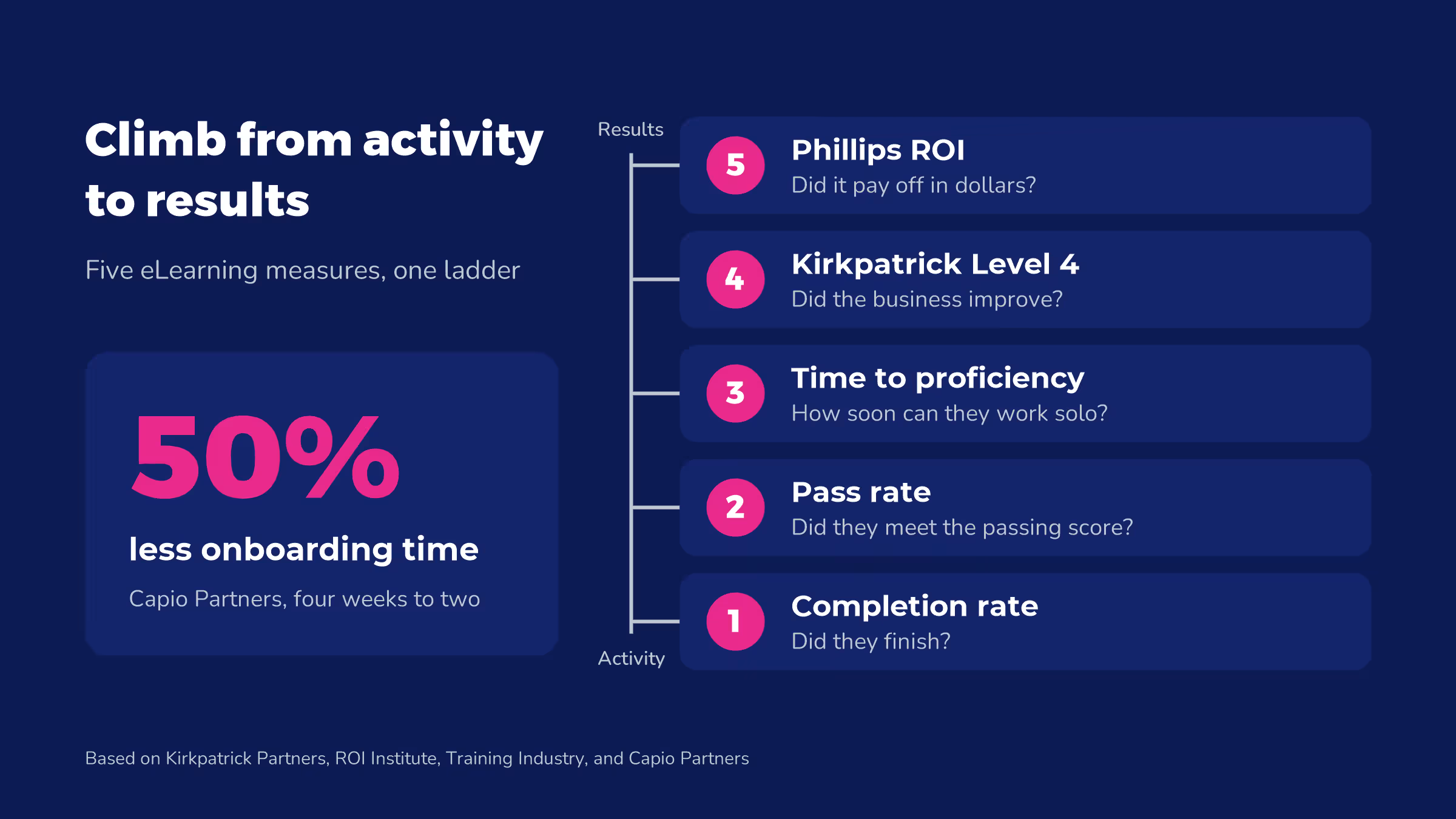
You prove training works by moving from activity measures, like completions, to results, like faster ramp-up and return on investment. The seven terms below run in that order. Start with the measures you can calculate today.
What is training completion rate?
Training completion rate is the share of enrolled learners who finish a course. To calculate it, divide completions by enrollments and multiply by 100.
Why your VP wants more than this: a high completion rate shows people finished, and it says little about whether they can do the job. Dr. Fort named the gap. "The real issue was that we used to measure training activity rather than job proficiency," she said.
Try this: track completion rate as a health check, and pair it with a proficiency measure like time to proficiency, below.
What is pass rate?
Pass rate is the share of learners who meet the passing score on an assessment. A low pass rate can point to a hard test, unclear content, or a real skill gap, so check which questions people miss.
What is time to proficiency?
Time to proficiency is the time someone needs to reach acceptable performance in a new role or skill. For a new hire, it's how long until they can do the job without someone checking their work.
Why your new hires care: the sooner they're capable, the sooner the job stops feeling like a test. Shorter onboarding is a related signal worth tracking alongside it.
At Capio Partners, Dr. Fort's team cut onboarding time in half and saw managers view new hires as more ready. "Our results have been phenomenal with a 50% reduction in our onboarding time, from four weeks to two weeks, while improving our learner confidence, preparedness, and manager perception of readiness," she said.
Steal this: pick one task every new hire must do alone, and measure the days from their start date to the first time they do it without help.
What is a skills gap analysis?
A skills gap analysis compares the skills your people have with the skills their roles need, so you can train for the difference. It usually combines assessments, manager input, and job requirements.
Why your budget owner cares: it points training dollars at real gaps, so you stop paying to teach what people already know.
Try this: pick one role, list its five must-have skills, and ask managers to rate each person on them. Our guide to AI skills gap analysis covers how to assess those gaps.
What is the Kirkpatrick model?
The Kirkpatrick model is a four-level framework for evaluating training. Its four levels are Reaction, Learning, Behavior, and Results, a structure Dr. Donald Kirkpatrick introduced in the 1950s. Each level asks a harder question, from "Did they like it?" to "Did the business improve?"
Why your CEO cares: Level 4 asks whether training improved business results.
Steal this: for your next program, write the Level 4 result first, then work backward to the behaviors and lessons that lead to it.
What is the Phillips ROI model?
The Phillips ROI model, which ROI Institute calls the ROI Methodology, adds a fifth level to training evaluation, return on investment (ROI). ROI compares a program's monetary benefits with its costs.
The method also asks you to isolate the program's effect from other influences, so training doesn't get credit for a sales spike caused by a price cut. To calculate ROI, divide net program benefits by program costs, then multiply by 100 for a percentage.
Why your CFO cares: ROI puts the program in dollars, right next to what it cost.
Try this: run one high-cost program through the formula before budget season. Absorb's ROI calculator gives you a starting estimate.
What is training ROI?
Training ROI is the return a training program produces compared with what it costs. The Phillips ROI model above gives you a formal way to calculate it.
Which learning terms get mixed up most?
Sound-alikes, finally sorted.
The learning terms people mix up most are Kirkpatrick and Phillips, upskilling and reskilling, ILT and VILT, and blended and hybrid learning. Each pair answers a different question, and mixing them up in a meeting is how a five-minute update turns into a 30-minute debate.
What is the difference between the Kirkpatrick and Phillips models?
Kirkpatrick tells you whether training worked. Phillips adds whether it paid off in dollars.
Use Kirkpatrick for most programs. Add the Phillips fifth level when someone needs a dollar figure.
What is the difference between upskilling and reskilling?
Upskilling builds skills for the job someone has now. Reskilling prepares them for a different job.
Our upskilling and reskilling article covers how to plan both.
What is the difference between ILT and VILT?
ILT happens in a room, and VILT happens on video. Both are live and led by a trainer.
What is the difference between blended and hybrid learning?
Blended learning mixes online and in-person activities across a program. Hybrid learning usually means some learners join a live session in person while others join remotely at the same time. Our article on hybrid and blended learning walks through the difference.
How can you turn eLearning terms into training results?
We need less jargon and more proof.
Start with one training program. Track its completion rate and one measure of job proficiency, such as the days until a new hire completes a task without help. Share both with your leaders next quarter to show progress beyond course activity.
Absorb LMS brings the formats and measures in this eLearning glossary together. You can deliver self-paced, live, and mobile training, and Absorb Aura answers learner questions and runs roleplay practice.
Built-in reports track completion and assessment results, so you can pair them with your proficiency measure and give leaders a clearer view of how training is working. See how Absorb LMS works.
FAQ about eLearning terms
What does eLearning mean?
eLearning means using electronic devices and digital tools to learn or teach skills and knowledge, through online courses, video, mobile lessons, or virtual classrooms. The US Department of Education's ERIC thesaurus files eLearning and online learning under electronic learning.
Computer-based training is an older, related term. For platform terms, see our LMS glossary.
What are the types of eLearning?
The main types of eLearning are self-paced learning, synchronous (live) and asynchronous (on-demand) learning, blended learning, instructor-led and virtual instructor-led training, mobile learning, and microlearning. The formats section above defines each one.
What does L&D stand for?
L&D stands for learning and development, the team or function that builds employees' skills through training, coaching, and on-the-job growth. L&D teams design programs, run onboarding, and show leaders whether training improves performance.
What is the 70-20-10 rule?
The 70-20-10 rule is a guideline for developing leaders and managers. It says leaders learn 70% from challenging assignments, 20% from developmental relationships, and 10% from coursework and training. The Center for Creative Leadership drew it from its research into how executives learn.
To apply it, pair each course with a stretch assignment and a mentor or manager check-in. As Devan Graham, Absorb's Senior Human Resources Business Partner, put it, "Sending someone to a course is the 10%, valuable but not sufficient on its own."


