


Continuous learning is the ongoing process of building new skills and knowledge throughout a career (and life!), whether that happens in a certification course or in the debrief right after a project goes sideways. As technology and job requirements change faster than most training calendars can keep pace, treating learning as a single onboarding event no longer keeps anyone current.
It takes many forms. Formal training like courses and workshops, and informal learning like coaching from experienced colleagues, hands-on problem-solving, or an insightful conversation at the right moment are all examples.
For employees specifically, being on a mission to learn and grow means stronger performance, smoother transitions between roles, and higher day-to-day satisfaction. For organizations, it builds a culture that keeps innovating instead of stalling.
This article covers what continuous learning means in practice, why it matters now, and practical strategies for individuals and organizations.
What is continuous learning?
Continuous learning, sometimes called lifelong learning, is all about finding ways to grow intellectually, emotionally, and professionally. It includes things like formal education, certifications, and informal methods like self-directed research, reading, and on-the-job training.
It's easy for continuous learning programs to drift into collecting skills for their own sake — more courses, more certifications, more completions — without ever circling back to why any of it matters.
"Skills became a means that forgot its end."
—Saravana Sivanandham, Absorb's Chief Product and Marketing Officer (from eLearningIndustry.com Q&A)
More and more content consumption isn't the point. It's reconnecting every learning investment back to the business (or personal) outcome it was supposed to serve in the first place.
Continuous learning is about committing to personal and professional development with purpose. It means expanding your skills and embracing adaptability. Continuous learning supports improved performance, equips you to tackle new challenges, and helps you achieve your goals. Ultimately, it's about cultivating a curious mind, welcoming new experiences, and always looking for ways to grow.
Here are a few examples of continuous learning in action:
- Formal education: Completing an MBA while working full-time
- Self-led learning: Watching tutorials on coding languages to transition into a tech role
- Professional certifications: Acquiring a Six Sigma certification to improve project management skills
- Mentorship: Learning from a mentor to gain industry-specific insights
- Microlearning: Taking short, focused courses through content libraries like Skill Pill
No doubt, continuous learning is valuable. And there are some key characteristics of the continuous learner you can check against yourself and your team.
Key characteristics of a continuous learner
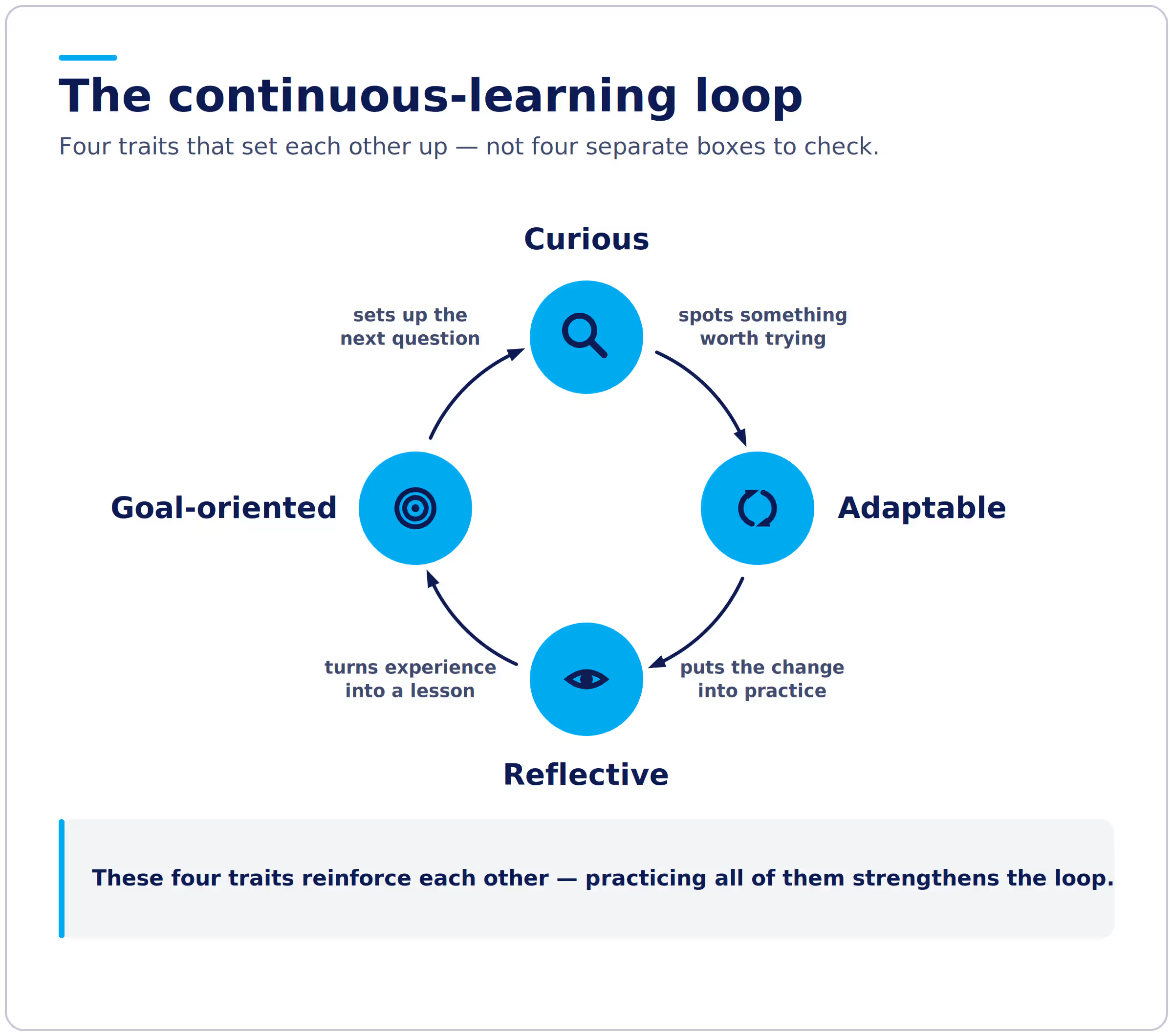
Continuous learning is a mindset: actively seeking out growth instead of waiting for it to arrive. That mindset shows up in four defining traits.
- Curious — Continuous learners seek out opportunities to grow rather than waiting for them to appear, often driven by a natural curiosity: a desire to explore new ideas, ask questions, and challenge the status quo.
- Adaptable — They treat change as the default, not the exception, and pick up new skills and technologies as they emerge. That flexibility keeps them relevant in a shifting world.
- Reflective — They analyze their experiences, identify areas for improvement, and refine how they learn. That self-awareness lets them optimize for growth.
- Goal-oriented — They set specific learning objectives to track progress, stay motivated, and keep moving on their learning journey.
The importance of continuous learning
With technology and industries shifting faster than ever, continuous learning is essential for both individuals and organizations to thrive.
Here's why continuous learning is so important:
Adapting to a changing workplace
Automation, AI, and technologies like predictive analytics are reshaping industries and creating new job categories. The skills and knowledge needed for many jobs are evolving. By actively engaging in continuous learning, individuals and companies can adapt and stay competitive.
Developing resilience and adaptability
Continuous learning strengthens resilience. It equips us with the skills and knowledge to navigate challenges, embrace new opportunities, and recover from setbacks. It also encourages a growth mindset, where obstacles become opportunities for learning and development.
Fostering personal growth and fulfillment
When we pursue new knowledge and skills, we expand our horizons and gain a deeper understanding of ourselves and the world. This can lead to increased self-confidence, a sense of purpose, and greater fulfillment in life.
Benefits of continuous learning
Continuous learning isn't just about personal growth; it has a tangible impact on your career and earning potential. Here's how:
The impact of continuous learning for individuals at work
Earning potential increases
Besides personal and professional fulfillment, continuous learning correlates with career momentum. LinkedIn's 2025 Workplace Learning Report found that 91% of learning and development professionals agree continuous learning is more important than ever for career success, and LinkedIn's own platform data shows that employees at companies with strong career development support see higher promotion rates than employees at companies without it. Eighty-four percent of employees go a step further, saying learning adds purpose to their work — tying the payoff to daily engagement, not just eventual promotions.
Career advancement opportunities
Learning new skills can open doors to promotions, new roles, and even career changes. For instance, an employee who learns data analysis could move into a data-driven marketing role, paving a new career path.
Improved job satisfaction
Continuous learning can boost job satisfaction. You'll feel more competent, confident, and engaged in your work by gaining new skills and knowledge. This can lead to greater accomplishment and a stronger connection to your role.
Enhanced employability
In a competitive job market, employers value people who are adaptable, learn quickly, and contribute new ideas. Continuous learning keeps you current with industry trends and skills, making you a more attractive candidate.
Personal growth and development
Continuous learning goes beyond job skills; it’s about personal growth, too. Exploring new knowledge and interests broadens your horizons, deepens self-awareness, sparks creativity, and opens the door to a more fulfilling life.
The impact of continuous learning for organizations
In many ways, organizations that embrace, encourage, and provide continuous learning opportunities reap benefits, too.
Improved employee engagement and retention
When organizations invest in continuous learning opportunities, they show their commitment to employee growth and development. This leads to increased engagement, motivation, and loyalty. Retention is where this shows up most directly. LinkedIn's 2025 Workplace Learning Report found that 88% of organizations are concerned about employee retention, and providing learning opportunities is the top strategy they're using to address it.
Increased productivity and innovation
A workforce that's constantly learning and developing is more productive and innovative. Organizations boost productivity and create an environment where employees excel.
Enhanced company reputation
Organizations that prioritize continuous learning are seen as attractive employers. A strong learning culture boosts a company's reputation, attracts top talent, and strengthens its employer brand.
Stronger succession planning
Lastly, by providing continuous learning opportunities, organizations can identify and develop future leaders. This ensures a smooth transition of knowledge and expertise, minimizes disruptions, and maintains organizational continuity.
Investing in continuous learning offers significant rewards for both individuals and organizations.
How organizations keep continuous learning going
Individual habits only go so far without an organization behind them. When leaders protect time for learning, content stays current, and managers clear the road, continuous learning stops depending on willpower. We break down the frameworks, governance, and measurement behind that in our guide to building a continuous learning culture.
Actionable strategies for continuous learning
Continuous learning requires proactive effort and a commitment to growth. Below are practical strategies for individuals and organizations to embrace lifelong learning.
For individuals
1. Set clear goals
Define what you want to achieve through your learning. Are you aiming for a specific skill, knowledge in a particular field, or career advancement? Setting clear, measurable goals will provide direction and motivation. For example, instead of just aiming to "learn more about data analysis," set a goal to "complete a data analysis certification course within the next three months."
2. Use technology to integrate learning into daily routines
Learning shouldn't be confined to formal training sessions. To embed continuous learning into the organization, it needs to become an integral part of daily routines. In practice, this could mean setting aside time during meetings for idea sharing, encouraging employees to spend some work hours skill building, or adding learning modules into existing workflows.
Continuous learning becomes even more achievable when you provide learners with flexible access through a mobile learning app. Mobile learning apps let people, including frontline workers, to learn on the go. Absorb Infuse brings training directly into the tools employees already use.
3. Read widely
Cultivate a habit of reading books, articles, and industry publications relevant to your field. Staying informed about the latest trends and innovations will keep your knowledge current. Subscribe to newsletters, follow thought leaders, and join online communities to stay connected.
4. Seek feedback
Ask for feedback from mentors, colleagues, and supervisors on your performance and areas for improvement. Embrace constructive criticism as an opportunity to grow. Regularly seeking feedback can accelerate your learning.
5. Network
Expand your learning network by joining professional organizations, attending industry events, and connecting with people in your field. Engaging with peers and experts provides opportunities to learn from their experiences and gain new perspectives.
For organizations
1. Invest in training programs
Prioritize employee development by allocating resources to training programs. This could involve budgeting for workshops, online courses, and conference attendance. Investing in employee training enhances their skills and demonstrates a commitment to their growth.
2. Use technology
Use technology to simplify learning experiences. Explore AI-driven learning platforms that recommend relevant courses and resources. Use virtual and augmented reality tools to create immersive learning experiences when appropriate.
3. Measure progress
To keep your continuous learning initiatives effective, use reporting and analytics to track course completion, measure skill growth, and make data-driven improvements. Recognizing learning achievements can motivate employees.
4. Promote cross-training
Encourage employees to learn skills from different departments through cross-training programs and job rotations. This fosters collaboration and allows employees to develop a broader understanding of the organization.
Common questions about continuous learning
1. What’s the difference between lifelong learning and continuous learning?
While both terms emphasize ongoing education, lifelong learning refers to a broader, personal commitment to acquiring knowledge. Continuous learning often focuses on professional growth within a specific context, such as the workplace.
2. How can I find time for continuous learning?
Prioritize learning by scheduling dedicated time, integrating learning into daily routines, and using bite-sized microlearning modules for quick, impactful sessions.
3. What role does technology play in continuous learning?
Technology facilitates access to learning opportunities through:
- eLearning platforms
- Virtual workshops
- AI-driven tools that adapt to individual learning needs
The case for the continuous learner
Continuous learning is essential. Whether you're advancing your career or helping your organization stay competitive, continuous learning is key to long-term success.
By seeking out opportunities to grow and adapt, you open the door to reaching your full potential. Remember, continuous learning is a journey, not a destination. It's about cultivating a curious mind, embracing new experiences, and always striving to improve.
So, take the initiative. Set learning goals, explore new resources, connect with others, and never stop growing. The rewards of continuous learning are immense, both personally and professionally.
For organizations, improve your workforce with Absorb LMS. Our platform provides the tools and resources to foster a culture of growth. Use features like Absorb Analyze for deep insights, custom dashboards, and reporting capabilities to refine your continuous learning strategies.