


.jpg)


LMS vs LCMS : What's the difference?
An LMS handles who's learning what and whether they finished. An LCMS handles how that content itself gets built and used in the first place.
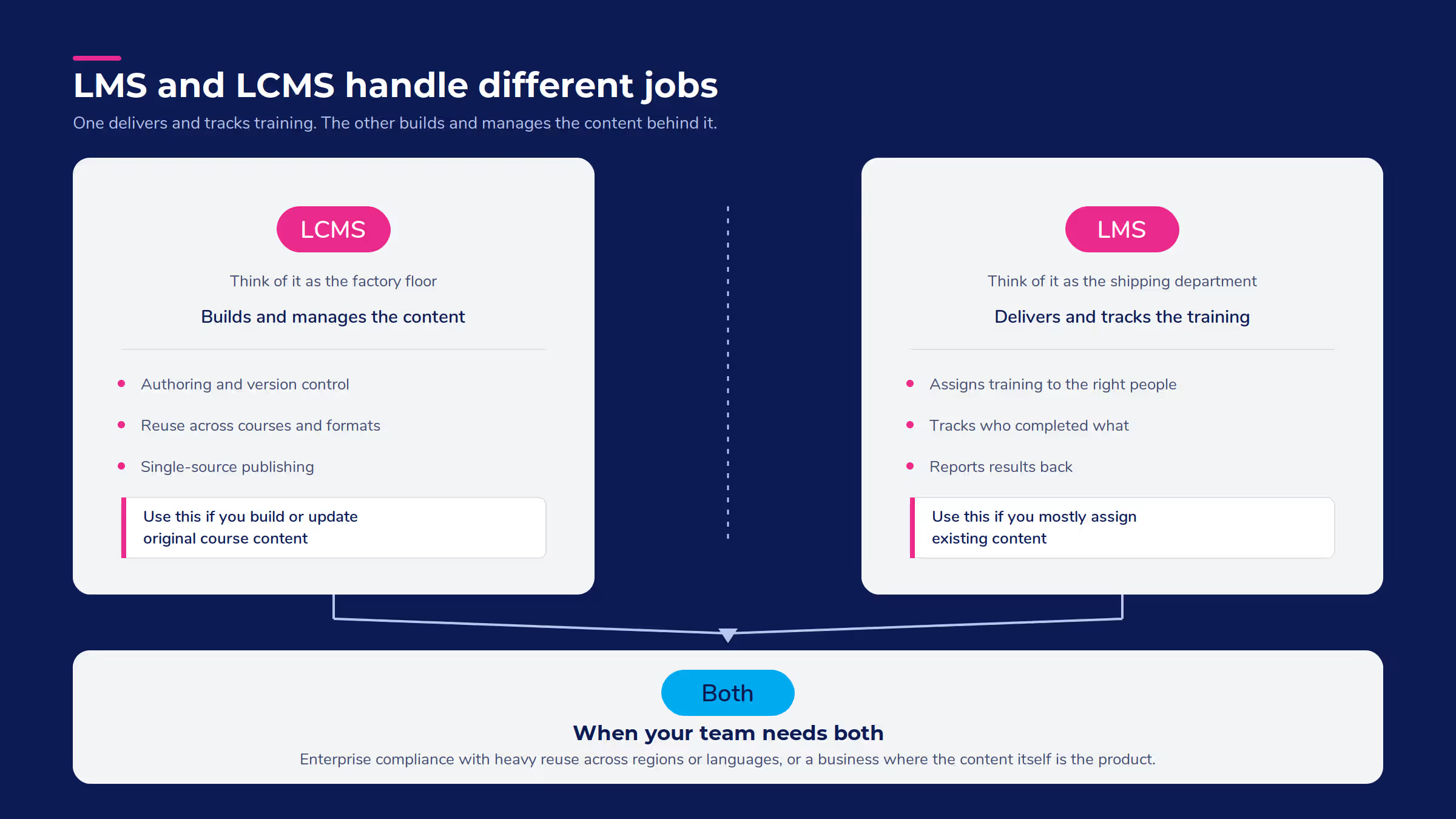
Picture a factory where one team builds the product and keeps the warehouse stocked, while another team loads the truck, gets it to the right address, and collects a signature proving it arrived. If you're an L&D or IT lead and you'll be sitting through a vendor pitch, it's helpful to go in knowing whether you need the LCMS (the factory floor), and LMS (the shipping department), or a solution that does both.
What's an LMS?
The shipping department, minus the forklift
An LMS, short for learning management system, is software that assigns training, delivers it to learners, and tracks who completed it, reporting back on the results. If your team needs to know who's finished mandatory compliance training, how a new hire's onboarding is going, or which courses get completed versus abandoned, that's LMS territory.
LMSs are the more established, more widely adopted half of this pair. Training Magazine's 2025 Training Industry Report found that 89% of organizations now use an LMS, essentially flat from 90% the year before, with adoption highest among large and midsize companies. That near-universal use is why LMS comes up first in most buying conversations, before anyone mentions LCMS.
An LMS plays the shipping department's role, getting things to the right people and keeping a paper trail proving it happened. What it typically isn't built to do well is create original course content from scratch; that job belongs to the factory floor, not the loading dock.
What is an LCMS?
The factory floor, no hard hat required
A learning content management system, or LCMS, is software built for creating, storing, and managing learning content, from courses and modules to assessments and media. It's built so that content can be authored once and reused across multiple courses, formats, or audiences. Any learning content management system comparison to an LMS comes down to one contrast — an LMS assumes the content already exists and focuses on delivering and tracking it, while an LCMS is where that content gets built.
This is the layer instructional designers and content teams live in day to day. Core LCMS capabilities include collaborative authoring, content reusability, version control, and single-source publishing. Reusability means building a module once and reusing it in five different courses instead of rebuilding it five times. Single-source publishing means packaging one piece of content so it can be deployed and tracked across systems, using standards like SCORM and xAPI. ADL, the initiative that created and maintains these standards, describes SCORM as the model built to make courseware interoperable with learning management systems. xAPI is the newer specification for representing and reporting learner experience data more flexibly. Its core specification was formalized as an IEEE standard in 2023 (IEEE 9274.1.1-2023), and related companion work extending it for session-based learning is still in progress at IEEE.
If an LMS is the shipping department, an LCMS is the factory floor behind it. It's the machinery, the raw materials, and the assembly work that never leaves the building but that shipping can't function without.
Already know you need learning to drive your business forward? Book a demo.
The core differences between LMS and LCMS
Same warehouse, different job titles
Strip away the marketing language and an lcms vs lms comparison turns out to be a comparison of two different jobs, not two versions of the same one. The table below lays it out plainly.
What it's built to do | LMS | LCMS |
Primary job | Deliver, assign, and track training | Author, store, and reuse learning content |
Who manages it day to day | L&D, HR, or compliance administrators | Instructional designers and content teams |
What breaks without it | No record of who completed what, or whether training is even happening | No efficient way to build, update, or reuse course content at scale |
Neither system is a smaller or lesser version of the other. LMS and LCMS are built for different jobs. That's why the LMS vs. LCMS comparison can feel confusing.
Are LMS, LCMS, and CMS the same thing?
Spoiler, a website CMS won't get you there
No. A general content management system, or CMS, isn't built for learning at all. A CMS, like the kind running a company website or blog, manages content publishing broadly, covering pages, posts, and media, but it has no concept of a learner, a course completion, or a certification record.
Those are what an LMS and an LCMS are built around, so if you've landed here wondering whether your website CMS can double as a training platform, the answer is no. You'd still need an LMS, an LCMS, or both.
Which one does your team need?
Do you build or distribute content? Or both?
.avif)
Most competitor content on this topic skips straight to "get both, and we sell both." But the real answer depends on what your team is doing day to day.
If your team mostly assigns existing training content, like off-the-shelf compliance courses or vendor-provided certifications you're not building from scratch, an LMS is likely enough on its own. You need to know who took what and whether they passed, but you might not author much of that content yourself.
If your team regularly builds and updates original course content in-house, an LCMS, or an LMS with real authoring capability built in, becomes worth the investment. Think new product training every quarter, or internal processes that keep evolving and need consistent-looking content across dozens of modules. Building that same kind of content over and over in disconnected documents or slide decks, with no system for reuse or version control, is exactly where an LCMS pays for itself.
If you're running an enterprise compliance program with heavy content reuse, you likely need both. Picture the same core training translated a dozen ways across regions and business units, updated centrally the moment a regulation changes. An LCMS handles authoring, localization, and version control. An LMS handles assignment, completion tracking, and the audit trail regulators ask for.
If you're running a content-heavy course-selling business, where the content itself is the product, you're LCMS-first, with an LMS layered on for delivery, learner accounts, and often commerce.
An LMS alone doesn't solve a content-authoring problem. If your team's real bottleneck is building and updating course material efficiently, no amount of reporting and tracking in an LMS will fix that, since that gap is specifically what LCMS-side capability closes.
Can you use an LMS and an LCMS together?
Usually, and it's the standard setup
Yes, and for many organizations, running both is standard operating procedure, not an exception. An LCMS handles building and packaging the content, the way a factory floor builds and packages product. An LMS handles assigning it, tracking who completed it, and reporting the results, the way a shipping department gets that product out the door and confirms it landed. One system builds the parts. The other delivers and monitors them, running as two connected operations instead of one metaphor.
In practice, this doesn't always mean buying two entirely separate products. Absorb Create generates courses from a short description or outline, then publishes them directly into Absorb LMS or exports them in SCORM, xAPI, or HTML5 for reuse elsewhere, giving a team real authoring and reuse capability without standing up a fully separate LCMS. Whether that's enough depends on how deep your content needs run; heavier, more complex authoring workloads may still call for a dedicated LCMS alongside an LMS.
The bottom line
One question beats all the feature tables
The difference between an LMS and an LCMS comes down to which half of the job is delivering and tracking training, and which half is building the content behind it. Most teams need to know which half is their bottleneck right now, because a feature table only gets you so far when you're weighing lms vs lcms.
Start with the decision framework above, and let what your team spends its time doing point you toward LMS, LCMS, or both. If that points you toward an LMS, look for one with built-in authoring capability first because it can cover a surprising amount of ground before you need a dedicated LCMS.
Frequently asked questions
What's the difference between LMS and LCMS?
An LMS delivers, assigns, and tracks training, reporting on completion. An LCMS is where that training content gets authored, stored, and reused. One manages learners; the other manages content.
Is an LCMS the same as a CMS?
No. A general CMS manages content publishing broadly, like a website. It has no concept of learners, course completions, or certification tracking. Those are the features both an LMS and an LCMS are built around.
Do I need both an LMS and an LCMS?
It depends on whether your team mostly assigns existing content, in which case an LMS is likely enough, or regularly builds and updates original course content, especially at scale or across languages, in which case an LCMS earns its place alongside an LMS. See the decision framework above for specific scenarios.


.jpg)
.avif)