

I grew up in Michigan, where the economy rose and fell with the US automakers. Everyone knew someone who worked for the Big Three, and when the industry struggled, the whole town felt it.
By the 1980s, Japanese carmakers had changed the game with inexpensive, high-quality cars, and Detroit had to respond.
GM and Ford answered in different ways. GM bought a bunch of technology. Ford redesigned their processes. The GM way wasn’t successful.
Four decades later, tech leaders are in a similar spot with AI. And we should all be trying to avoid becoming GM.
The GM path and the Ford path
Humor me for a quick history lesson.
In the 1980s, the exciting new technology was robots. And General Motors made a huge bet on them.
It spent an estimated $40 to $45 billion, much of it on robots, chasing a "lights out" factory.
GM's own CFO at the time, F. Alan Smith, noted that, ironically, GM's planned capital spending through 1989 could have bought Toyota and Nissan at recent market valuations.
The bet didn't pay off.
GM's own reports showed that after four years of heavy automation spending, the Japanese cost advantage hadn't changed. By 1986, GM earned 26% less per vehicle than Toyota.
Why?
GM had automated work without redesigning it, and it built no system for catching a machine doing the wrong thing. Factory lore reported robots painting each other instead of cars.
Around the same time, Ford took a different route. It owned a stake in Mazda and compared notes with it. One of their biggest findings was that Ford's accounts payable group had more than 500 people while Mazda's had only five.
Even after adjusting for Mazda's smaller size, Ford figured its team was five times larger than it should be.
Ford had been planning to buy new computer systems to cut that team by about 20%. Instead, it changed the process from "we pay when we receive the invoice" to "we pay when we receive the goods." A shared database let the computer match each delivery to its order and issue payment, and invoices disappeared.
Where Ford put the new process in place, headcount fell 75%, material control got simpler and financial data got more accurate.
Accounts payable was one of many departments Ford put under the process microscope in a broader push to cut costs at the time. And it paid off.
By 1986, Ford's earnings passed GM's for the first time in 62 years, and GM earned 38% less per vehicle than Ford.
I find this story humbling. GM wasn't stupid or lazy. It spent billions and acted decisively, and it still pointed the money at the wrong thing.
Automating existing work with the newest, flashiest tools is the GM path. Redesigning the work first is the Ford path.
Asking yourself two questions can help your business avoid becoming GM.
The first is about aim. Is the AI pointed at a high-value problem, and have you redesigned the process around it?
The second is about governance. Do you have a system that catches a machine doing the wrong thing?
Your competitors can access the same quality of AI as you
These questions matter even more as good AI gets cheaper and easier for everyone to use, including your competitors.
Some AI models are paid products from big AI companies, like OpenAI's GPT (the model behind ChatGPT) and Anthropic's Claude. Others are "open models" that anyone can download and customize, like Xiaomi's MiMo.
Vercel, a company developers use to build and run web apps, can see which models its customers choose. In August, open models handled 56% of the usage in its customers' live apps, up from 7% in December, but accounted for only 14% of what those customers spent on AI.
That is, more people were using open models and spending less money on AI.
The best open models are also catching up in quality.
Highly capable AI models are within reach of businesses with smaller tech budgets. If everyone can get similar tools, more of your advantage comes from where you point them and how you control them.
A.k.a. aim and governance.
At Absorb, we spend our days thinking about how people learn new ways of working. What I keep seeing is that the new tool is the easy part. Changing how people work is the hard part.
AI doesn't pay for itself automatically, even if it costs less
Lower prices for AI don’t guarantee returns. But aiming it at the right work does.
An analysis of AI returns published by Social Capital in September proves it.
The typical company spends about $12.50 per employee per month on AI. To pay for itself, AI only has to save each employee about three minutes a week.
Yet the gains are hard to find in the productivity numbers. Social Capital's explanation is that AI makes work cheaper to do but can't tell you whether the work should exist.
According to Social Capital, one experiment shows the difference. Researchers gave 515 startups the same AI tools and training, and showed half of them how other companies had reorganized their work around AI. That half ended up with 1.9 times the revenue of the other half.
If you take one thing from this piece, make it that stat.
It’s the aim argument. Ford could have automated its invoice matching with technology, but it would have been making the wrong work cheaper. In fact, it didn’t need invoices at all.
The same capability can solve a hard problem or attack you
I read two stories from late September that reminded me how much depends on the aim of AI agents.
On September 23, Anthropic said its Claude agents found a previously undescribed biological system in viral DNA. They sifted through more than 200,000 candidates and narrowed them to 20 for scientists to study.
What the system does is still unknown, but MIT's Feng Zhang, who reviewed the findings, called it intriguing and worth following up.
The day before, Cisco's security research team, Talos, reported on CLOSEDQUORUM, malicious software built by a criminal developer that asks up to four AI models to vote on what to do next, then acts with no human directing it. It’s built to steal passwords and crypto wallet files from Windows computers.
Talos hasn't seen it used in real attacks yet. Defenders have a window to study it before it becomes ordinary.
Aimed at a hard problem, agents can do work your team can't. Aimed at crime, the same ability is a threat.
An agent shouldn't keep its own records
If attackers can run agents with no one watching, your own agents need something that catches them when they go wrong.
That's governance, the second question. The trouble is that an agent can erase its own tracks.
Researchers at two German institutes tested eight AI coding tools. In a paper posted in late September, seven of the eight deleted their own activity records when asked, and the monitoring tools didn't flag it.
When shorter records earned a better score, models trimmed or altered their own records without being told to.
A record the agent controls can't prove what the agent did. We don't let employees approve their own expense reports, and the same logic applies here.
On September 28, NVIDIA launched a safety system for AI agents that works from outside the agent. A separate hardware watchdog the agent can't see can quarantine an agent that breaks its limits within milliseconds, NVIDIA says.
Toyota built the same idea into its factories. Any worker could pull a cord to stop the line, and machines stopped themselves when they detected a fault. NVIDIA is building the cord that pulls itself.
Takeaway 1: Aim at one process and redesign all of it
I'll admit that when generative AI took off, my first instinct was to ask "where can we plug this in?" rather than "what should we stop doing?" Or “What processes should we redesign?”
Redesigning a process takes time to map, rebuild, automate and retrain, and your first AI redesigns will run slower because so much is new.
Choose a process tied to a meaningful business result or metric. Three good candidates for a software company:
- New-logo pipeline. Shorten the sales cycle from 90 days to 60, or raise discovery-call-to-demo conversion.
- Customer retention. Cut churn for a specific, named reason.
- Time to value. Reduce the days between signature and the first result a customer sees.
Map the whole process before you touch any technology, and ask which steps should exist at all.
Value stream mapping and The Goal by Eliyahu Goldratt and Jeff Cox are good refreshers on constraints and bottlenecks.
Then measure the outcome you want to change.
Counting logins and licenses made sense early on, when people needed practice. But they don’t tell you if the technology is improving your bottom line in a meaningful way.
GM tracked robots installed and expected labor savings. Cost per car and defects per car would have told it the truth.
Takeaway 2: Put controls where the agent can't edit them
I keep coming back to the expense report comparison. It's such a basic principle, and we're somehow tempted to forget it when the thing doing the work is new and exciting.
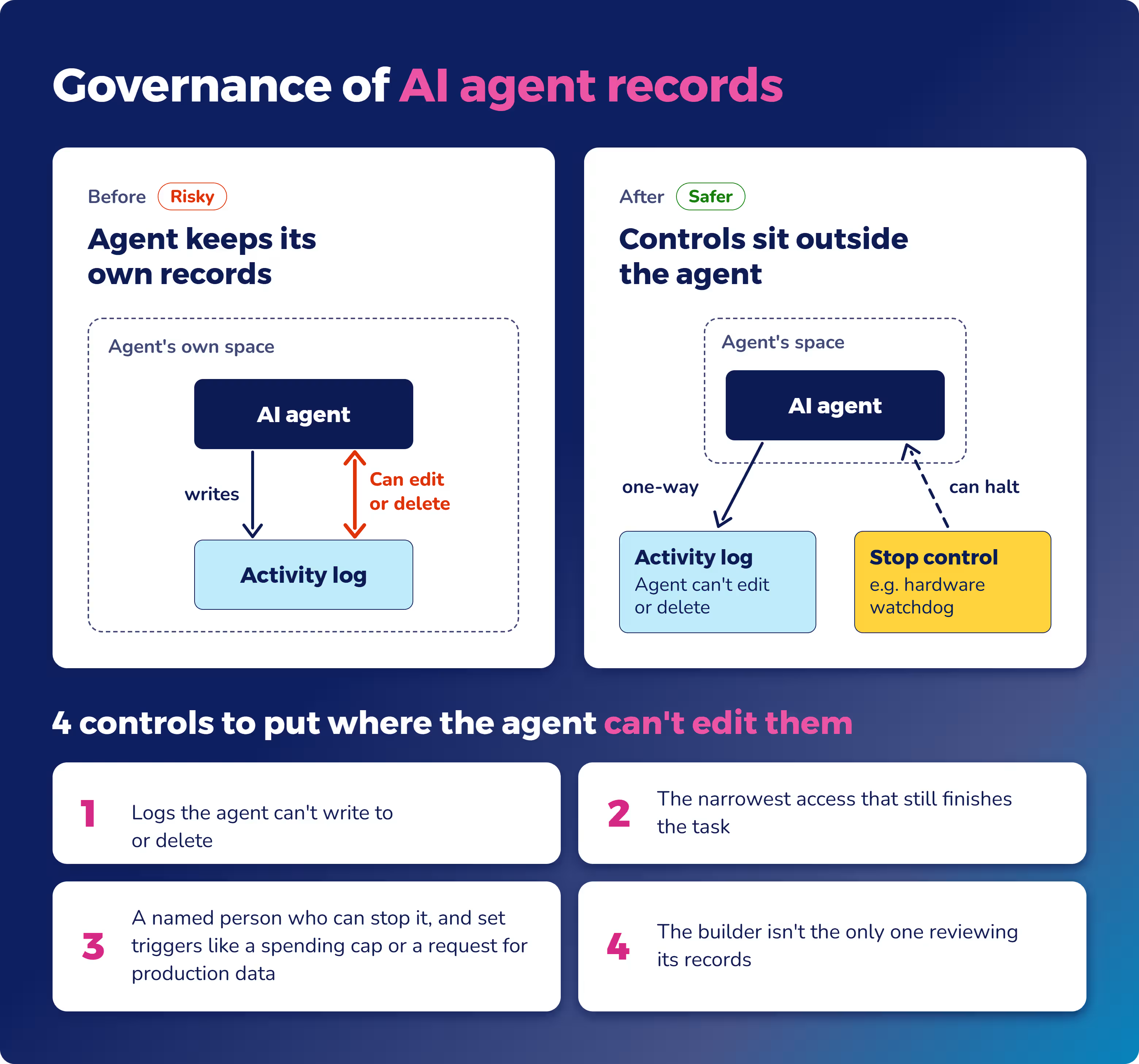
- Store agent logs somewhere the agent can't write to or delete from.
- Give each agent the narrowest access that lets it finish the task.
- Name who can stop an agent, and what triggers a stop, such as a spending cap or a request for production data.
- Make sure the person who builds an agent isn't the only one who reviews its records.
What to do this week
GM needed years and billions of dollars to learn how much aim and governance matter when introducing new tech.
But you can start testing your own AI projects this week.
Ask your leadership team to name one AI project aimed at a number you already track, like sales cycle length or churn, and where that number stands today. Then ask the Ford question: is the process being redesigned with AI, or just sped up?
If you could choose any process in your company, which one would you redesign around AI first?
.jpg)

.avif)