




When deciding if they’re ready to implement AI across their business, most leaders I know start with the technical questions: which model, which vendor, how much to spend?
Those questions jump the gun, in my opinion.
The first (and best) question to ask is almost embarrassingly old-fashioned: how good is your company at changing the way it works when a new tool shows up?
That’s what agentic AI actually tests. Buying the technology is easy (anyone can buy it). The hard part is redesigning the work around it, proving it delivered something real, and keeping control while you do.
Your company has been learning how to redesign work, measure results, and keep control of its tools for years, one software purchase at a time.
McKinsey’s 2025 AI survey found that companies with real bottom-line returns from AI — those attributing 5% or more of EBIT to it — were nearly three times more likely to have fundamentally redesigned their workflows.
Strategy first, software second
After more than 20 years in leadership, I’ve seen the same pattern repeatedly. A smart team spots a real problem. They buy software that promises to fix it. People log in.
A year later, the problem is still roughly where it started.
Is it the tool’s fault?
Probably not.
The tool did what it promised. What was probably missing was the harder work underneath.
The human work of redesigning the process the tool was supposed to serve in the first place.
Skip that work, and a good tool can sit fully installed and still leave the original problem untouched.
For example, at Absorb, product usage is one of our strongest predictors of whether a customer renews. So, a few years ago, we rolled out a new customer-success platform expecting it to flag at-risk accounts.
It couldn’t.
“At-risk” isn’t one thing. Sometimes usage is trending down, sometimes a customer never really launched, sometimes they need to sell a certain number of seats to justify their investment and aren’t close.
The platform couldn’t distinguish among those cases.
It wasn’t because it was a bad platform. We never taught it what healthy usage looks like, what numbers each customer needs to hit, or which data sources tell the truth.
That work is on us, not the vendor.
So the platform sat there, fully deployed, unable to answer the question that justified buying it. We bought the dashboard and skipped the definitions and clean data that would have made it mean anything.
An AI tool can fail the same way if that work isn’t done before you buy it.
Three places to look for AI readiness in your business
Before buying a bunch of AI software, ask yourself three questions.
1. Can you let go of how the work gets done?
Agentic AI isn't a tool you ask for advice. It's a tool you hand work to.
You define the task, set the limits, let it act, and own the result. That’s delegation. A company’s readiness for agentic AI looks a lot like how it already delegates to people.
If every real decision has to climb the org chart, if managers can’t act without sign-off, an AI agent will choke in that company the same way a capable new hire burns out.
They can do the work, but the organization won’t give them room.
How to build it
This rarely starts with a training course. Believe me, as the CEO of an LMS company, I wish it did.
It starts with the CEO’s own behaviour.
Take one decision that currently comes to you, hand it to someone else with clear limits, and let them do it their way without hovering.
Then make process redesign a required part of buying any new AI tool. Before you sign, answer three questions:
- What will change about how people work?
- Who owns that change?
- How will we know in 90 days whether the original problem actually improved?
If you can’t answer those, you’re not ready to buy that AI tool.
2. Do you measure outcomes, or usage?
AI can produce a high volume of things that look like progress: pilots launched, licenses activated, content generated.
Those metrics show that AI is getting used. They don’t prove that using it improved the outcome you bought it for.
When generative AI first arrived, we deliberately measured usage: logins, prompts, who was experimenting. At that stage, the goal really was adoption. We wanted people to get their hands dirty and learn what these tools could and couldn’t do.
That was the right metric for that moment. The mistake is staying there. Usage is a fine measure of “are people learning this?” and a terrible measure of “is this creating value?”
We’ve moved on to the second question. Now the number that matters is whether the thing we bought the tool to fix is measurably better.
For example, we’re testing agentic outbound to generate sales opportunities. We could measure opportunities generated. Instead, we chose cost per opportunity, counting both software and people. Then we compare that against our other ways of generating sales opportunities.
If the agent can’t beat them on cost per real opportunity, then it’s not worth the investment.
Another example: we’re building a product for smaller customers who need less than our main platform offers. The metric that matters is what share of the leads we used to turn away on budget end up as paying customers.
That number was zero before. It either moves or it doesn’t.
3. Can you shape the tool, or does the tool shape you?
Plenty of companies assume they’re good at technology because they adopt a lot of it. Adopting tool after tool without reliably getting value just builds an expensive shelf of half-used systems.
To be clear, going deep with a tool isn’t the problem. A tool that reaches across your business and genuinely improves it is exactly what you want. I’d happily pay a vendor more when their tool delivers more. The danger is depth without an exit.
I learned this the hard way recently. A vendor sold us an AI tool to automate work a person used to do by hand, then redefined what counted as a billable event.
It used to bill when the AI resolved something. The new definition billed whenever the AI so much as looked at something. Same tool, same limited use on our end, materially larger invoice, and almost no say in the change. We were already wired deep into their system.
They moved the meter from an outcome we valued to an activity we didn’t.
That’s what losing control feels like.
How to build it
Make a rule for buying any new software: put the exit in the contract before you sign.
Three things to insist on:
- You can export your own data in a usable form on demand.
- Pricing is tied to a value you can measure, so the meter can’t shift from outcomes to activity.
- You know specifically what it would take to switch: how long, how much, and who owns the work.
If the honest answer to “how do we leave?” is “we can’t,” you don’t have a vendor. You have a landlord.
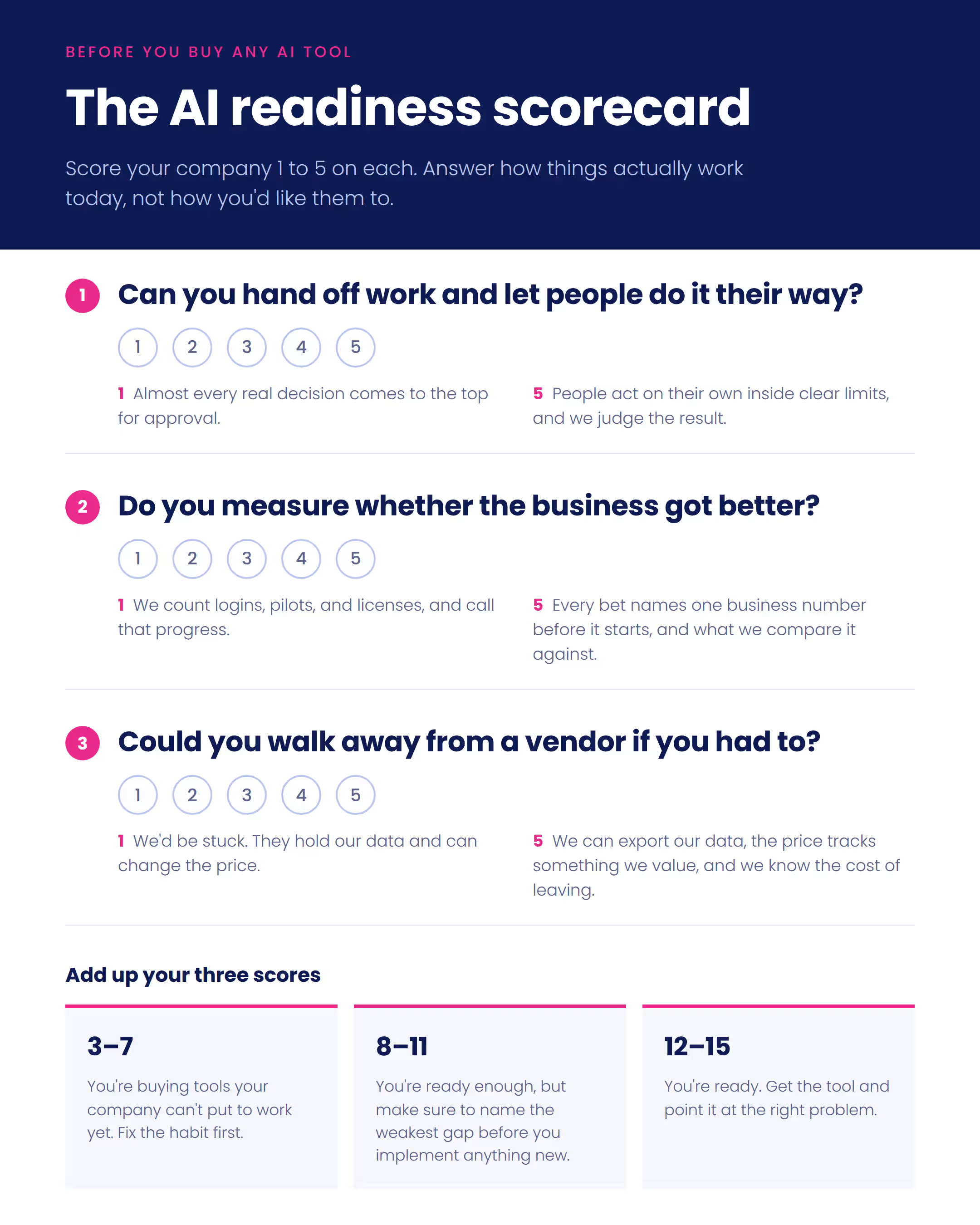
The AI readiness scorecard
You don’t need to become an AI expert overnight. You need to know how to delegate well, measure outcomes, and stay in control of the tools you buy. That was already the job.
I built the scorecard below for my own leadership team, and the delegation question is the one I keep getting wrong. If you run it on yours, I’d like to know which one trips you up.


.jpg)
.avif)