


.jpg)

Learning management system examples for manufacturing, healthcare, and hospitality
A learning management system (LMS) example is a platform that delivers, tracks, and reports on training, and the right one looks different by industry. Healthcare systems use one to track credentials across hundreds of clinics, manufacturers use one to train shift workers on the floor, and hospitality chains use one to onboard staff across hundreds of locations.
"There is no silver-bullet 'global LMS' that is ideal for all scenarios," says John Leh, founder and lead analyst at Talented Learning. And those three real industry examples of healthcare, manufacturing, and hospitality show why that is.
What's a learning management system?
A learning management system is software that delivers training content, tracks who completed it, and reports on the results. (You might also see this called learning management software.)
The benefits of a learning management system show up in a few places. New employees get productive faster because training is consistent and trackable, not scattered across spreadsheets and hallway conversations. Compliance teams can prove, on demand, who completed what and when, instead of scrambling before an audit. And because reporting is centralized, a training leader can see — and more importantly prove — what's working.
What separates the different platforms is how well they fit a specific industry's training pressures.
Types of learning management systems
Four broad types cover most of what you'll run into.
- Academic LMS platforms support schools and universities, built around courses, grading, and semester-based enrollment.
- Corporate LMS platforms support internal training like onboarding, compliance, and upskilling for a company's own employees.
- Extended enterprise LMS platforms train people outside the organization, like customers, partners, or resellers, often alongside internal training in the same system.
- Association LMS platforms deliver continuing-education and certification programs to an organization's members.
Most companies buying an LMS today need a corporate platform that can also stretch into extended-enterprise use, training customers or partners without a second system. Absorb LMS is built for that overlap.
That overlap is why the next section is organized by industry instead of type. A hospital, a factory, and a restaurant chain all need a corporate-grade LMS, but what “grade” means shifts depending on which one you're running.
LMS examples by industry
Generic "best LMS" lists rarely account for how different one industry's training problem is from another's. A hospital worries about credentialing. A factory worries about safety. A restaurant chain worries about how fast it can get a new hire ready for a shift. Real companies in three demanding industries show how this plays out, with named platforms and real, sourced outcomes.
This isn't an exhaustive industry list. Retail, financial services, and higher education all have their own version of this same problem but manufacturing, healthcare, and hospitality are three of the toughest training environments to get right, which makes them an excellent test of whether a platform holds up under pressure.
1. LMS for Manufacturing
Manufacturers train a workforce that's often spread across multiple plants and shifts. A missed safety module is a real injury risk. The LMS for manufacturing has to reach frontline workers reliably and prove they completed the training that keeps them safe.
Absorb LMS, Cornerstone, and SAP Litmos are all built with manufacturing in mind. Absorb LMS runs training at scale for distributed plants. Cornerstone is widely used by manufacturers that need heavy regulatory compliance tracking. SAP Litmos is built for frontline and deskless workers.
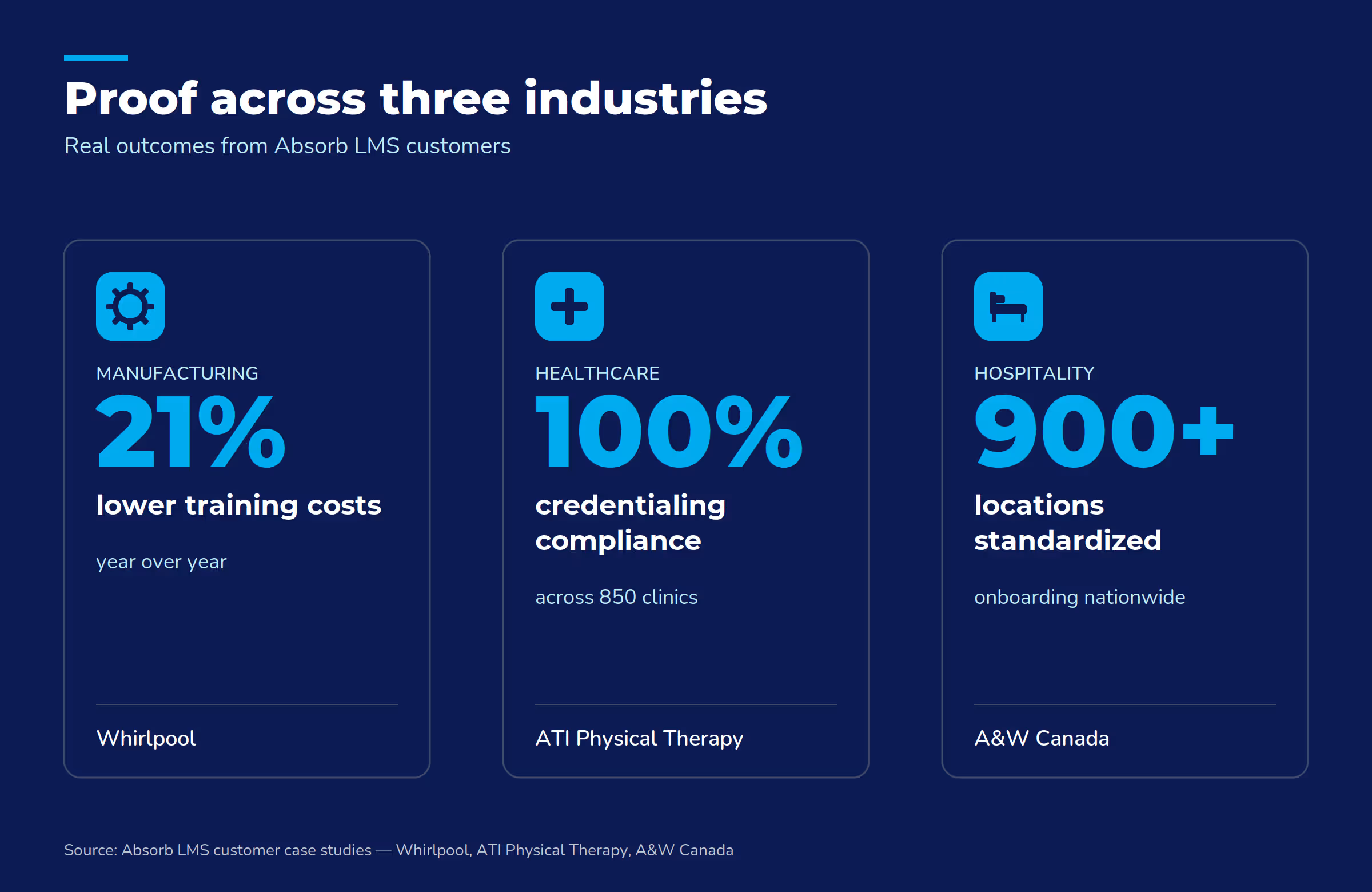
Appliance maker Whirlpool used Absorb LMS to cut training costs by 21% year over year. It also improved First Call Completion by 14% and customer satisfaction by 8.2%. Equipment manufacturer The Toro Company saw more than three-quarters of its learners enroll within six months of launching Absorb LMS.
For manufacturing, we see a common rollout mistake, and that's using a platform that designs training like every worker sits at a desk. Shift workers need short, mobile-first modules they can finish between machine cycles, not a 40-minute course that assumes a quiet office. Build for the floor, not the office, and completion follows on its own.
For more on choosing an LMS for this industry, see Absorb's guide to the best LMS for manufacturing and manufacturing onboarding software.
2. LMS for Healthcare
Healthcare training runs on proof. Regulators and accreditors want evidence that every clinician completed the right training, holds a current credential, and did it on schedule, at every clinic or facility.
Absorb LMS, HealthStream, and Relias are the platforms healthcare organizations turn to most often. HealthStream is built around clinical compliance for healthcare organizations. Relias focuses on compliance training for post-acute care and behavioral health compliance training. Absorb LMS is a strong general-enterprise option for health systems that need credentialing rigor without a healthcare-only platform.
ATI Physical Therapy used Absorb LMS to reach 100% compliance for dry-needling credentialing across 850 clinics. It also saw zero adverse events over six consecutive months and a 7.7% increase in net patient revenue.
“When auditors come in and different departments are all speaking the same language, using the same risk definitions, the same metrics, the same reporting formats, that unified picture is a significant advantage,” says Ify Anazia, Absorb's Senior GRC Analyst. “It signals that compliance training is embedded across the organization, not siloed in one team. Standardized, centralized, and traceable, that's what audit-ready looks like.”
The failure mode in healthcare rarely looks like a missing course. It looks like a credential that expires because nobody automated the renewal reminder. Across 850 clinics, a manual tracking spreadsheet isn't a reliable system.
If you're digging deeper into healthcare solutions, Absorb also has guides to healthcare credential management and healthcare employee onboarding.
3. LMS for Hospitality
Hospitality has a lot of turnover. A restaurant or hotel chain hires constantly, trains people fast, and needs every location doing it the same way, whether that's one property or nine hundred.
Absorb LMS and Schoox both build dedicated solutions for hospitality and restaurant training. Schoox focuses specifically on hospitality and restaurant training. Absorb LMS pairs hospitality-specific tools with the broader enterprise features a growing chain eventually needs.
Restaurant chain A&W Canada used Absorb LMS to standardize training across more than 900 locations nationwide.
The trap in hospitality is designing onboarding for someone who'll stay two years, when plenty of new hires won't make it past two months. A nine-hundred-location chain doesn't need a longer onboarding course. It needs a shorter one that gets someone productive on day one.
Dig deeper with Absorb's guides to onboarding for hospitality and hotel housekeeping training.

How these platforms compare
The right LMS to bring you the most value depends on your industry. This table breaks down what each platform is best for.
Platform | Best for | Notable strength |
1. Absorb LMS | Companies that need one system for both internal and customer-facing training | Combines enterprise depth with industry-specific tools for manufacturing, healthcare, and hospitality |
2. Cornerstone | Large manufacturers with heavy regulatory needs | Strong compliance tracking for regulated manufacturing environments |
3. SAP Litmos | Manufacturers with a deskless, frontline workforce | Mobile-first design built for frontline and deskless workers |
4. HealthStream | Hospitals and health systems | Purpose-built for clinical compliance and credentialing |
5. Relias | Clinical and behavioral health organizations | Deep library of healthcare-specific compliance content |
6. Schoox | Restaurant and hospitality chains | Built specifically for hospitality and restaurant training |
If your company spans more than one of these industries, say a healthcare system that also runs a manufacturing-style equipment-maintenance program, prioritize whichever platform matches your biggest compliance or safety risk first, then check that it can flex to cover the rest.
Is Google Classroom a learning management system?
Google Classroom handles assignments and communication well for a K-12 or higher-ed classroom. But it wasn't built for certification tracking, compliance reporting, or credential management. Those are things a corporate or healthcare LMS has to do by default.
If you need to prove that 850 clinics completed a required course, or track safety certifications across a dozen plants, Classroom won't get you there. It's a classroom tool, not a compliance or workforce-training system.
To give props to Classroom, it's free, which is why some small teams stretch it into a training tool. That's a reasonable call for a five-person team tracking one onboarding checklist. But it quickly becomes unreasonable when an outside auditor asks you to prove any of it happened.
What's the easiest LMS to use?
Ease of use is critical and you'll want to investigate how simple the platform is for admins to set up and manage, and how little friction learners hit when they log in.
“User experience in onboarding is more important than people give it credit for,” says Troy Powell, Absorb's Director of Human Resources. “New hires consistently tell us the LMS was clean, straightforward, and easy to navigate, and that matters enormously when you're trying to keep someone engaged and learning in their first few days. A confusing or frustrating platform creates friction at exactly the wrong moment.”
Check out a case study where APM used Absorb LMS to increase engagement by making training more personalized and accessible. Ease of use is really important because when learners hit friction early, they disengage, and completion rates drop.

It's a good idea to check up on every platform you're considering for its ease of use and also to find the latest and greatest commentary about the platform.
How does AI change what a learning management system can do?
Right now, AI helps systems prove things a completion report never could. “The old gap was never about ambition,” says Saravana Sivanandham, Absorb's Chief Product and Marketing Officer, in a recent Q&A on AI and training outcomes. “It was about plumbing.” Learning systems could see who clicked through a course. They couldn't see whether the work actually changed.
That's starting to shift. Chris Ball, Absorb's Technical Product Marketing Manager, explains how Aura Rehearse closes that gap.* Aura Rehearse is coming soon.
“Every LMS on the market can tell you a learner finished the course. Almost none can tell you whether that person can actually hold the conversation.”
AI roleplay software simulates realistic conversations so people can practice important situations before the real thing, a specific application of scenario-based learning, then scores their performance and gives feedback. It's purpose-built for training rather than general conversation. With Aura Rehearse, instead of a checkbox, a manager gets a transcript and a score against a rubric the business defined.
Not every AI feature earns the name, though. Sivanandham draws a sharp line. “A chatbot answers a question. An agent detects a gap, delivers the intervention, and follows up to see whether it worked.”
Before you take an AI claim at face value, ask his three questions:
1. Where does the platform's AI get its data?
2. Can it act, or only answer?
3. Can it prove the business outcome?
How to choose the right LMS for your organization
Choosing a learning management system starts with your industry's training pressure, not a generic feature list. A manufacturer needs frontline reach and safety-certification tracking. A healthcare organization needs credentialing rigor and audit-ready reporting. A hospitality chain needs fast onboarding across many locations.
From there, work through a short checklist:
- Deployment type. Cloud-based platforms are the default for most companies today, but confirm what fits your IT setup.
- Industry fit. Does the platform have real experience in your industry, or is it a generalist system stretched to cover it?
- Ease of use. Can a new admin set up a course without a training manual, and can a new learner find what they need without help?
- Compliance and reporting needs. If you need to prove completion for an audit, confirm the platform's reporting supports that, and check whether it supports standard content formats like SCORM and xAPI if you're bringing in outside courses.
- Pricing model. Pricing usually scales with the number of learners and the features you need. Get a quote for your actual headcount rather than assuming a listed starting price will hold.
If you're evaluating a specific competitor already, Absorb has direct comparisons available, including Absorb versus Docebo alternatives, Docebo versus 360Learning, Docebo versus Litmos, Docebo versus TalentLMS, and Qooper alternatives.
Frequently asked questions
What are the most common LMS platforms?
Absorb LMS, Docebo, Moodle, Cornerstone, and 360Learning are among the most widely used, though the right one depends heavily on your industry and whether you're training employees, customers, or both.
What is an LMS with an example?
An LMS is software that delivers, tracks, and reports on training. Absorb LMS is one example, used by companies like Whirlpool for manufacturing training and ATI Physical Therapy for healthcare credentialing.
What's the difference between an LMS and an LXP?
An LMS delivers, tracks, and reports on assigned training, with a clear paper trail. An LXP, or learning experience platform, leans into self-directed discovery, recommending content the way a streaming service recommends shows. Some platforms, including Absorb LMS, blend both instead of forcing a choice.
Does a learning management system support SCORM and xAPI?
Most modern platforms do. SCORM and xAPI are the two standards that let a course built in one tool play correctly inside another. If you're bringing in outside content, confirm the platform supports both, not just the older one.
How long does it take to implement a new LMS?
It depends more on how much content you're migrating than on the platform itself. A straightforward rollout with a handful of courses can take weeks. A multi-location chain migrating years of compliance records takes longer, so ask any vendor for a realistic timeline based on your actual data, not a generic sales estimate.
Can one LMS work across more than one industry at once?
Yes. Most of the platforms named here aren't locked to a single vertical. The deciding factor is usually which industry carries your biggest compliance or safety risk. Build around that one first, and treat the rest as secondary requirements the platform also needs to support.
Find the right LMS for your industry
Pick the LMS built for your industry's biggest training challenge and don't be tempted by shiny checklists that don't really solve your specific problems. Manufacturing, healthcare, and hospitality each demand something different from an LMS — and the right platform is the one that's proven it can deliver for yours.
Whichever platform you choose, look for proof that it works for a company like yours. If you want to see how Absorb LMS handles your industry's specific training needs, explore Absorb's product page.
.avif)

.avif)
.avif)