


.jpg)


Docebo vs. 360Learning comes down to which problem you're solving. Docebo is the AI-heavy, enterprise-grade platform built for deep course libraries and big budgets; 360Learning is the fast, collaborative option for teams with strong internal experts who'd rather build training than shop for it. If you're an L&D or training leader choosing between them, this comparison matches the platform to your problem, not the marketing pages — pricing included. If neither fits cleanly, there's a third option worth a look before you sign anything.
Docebo vs. 360Learning: comparison at a glance
Before the details, here's the shape of the decision.
Category | Docebo | 360Learning |
Pricing model | Custom quote, usage-based — no public per-user rate | $8/user/month (Team plan, up to 100 users); custom above that |
Ease of use | Clean interface, but admin work can require HTML/CSS know-how | Modern, intuitive front end; some content-editing limits |
Content authoring model | Centralized library plus AI-generated content (30,000+ courses) | Peer-authored — subject matter experts build the courses |
Reporting | Analytics dashboards (vendor-described, not independently verified) | Functional, with room to grow on tracking detail |
Best for | Larger orgs training multiple audiences with dedicated L&D staff | Teams with strong internal expertise who want to move fast |
Both platforms are built for different shaped problems.
Docebo: strengths
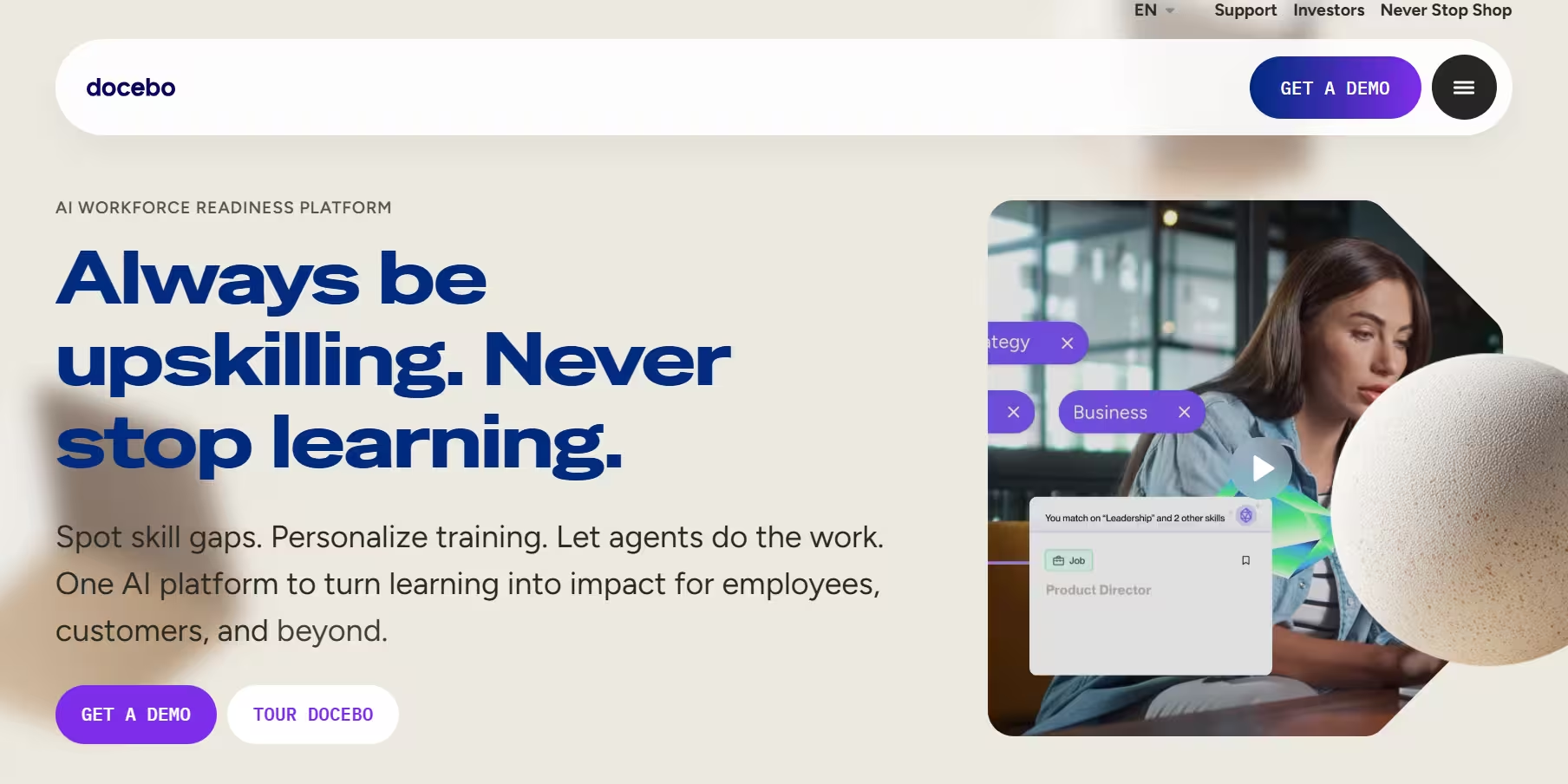
Docebo earns its enterprise reputation honestly.
Starting with the interface, one reviewer says Docebo's clean interface and entry-level price point were what first drew their team to the platform, and another specifically notes it's extremely user friendly to administer without needing deep technical skill for day-to-day tasks. Scalability draws similar praise — reviewers describe it as a robust LMS solution with the ability to customize, scale, and grow alongside their organization. Docebo's own product page also lists analytics and reporting dashboards among its core features — a vendor claim worth confirming in your own trial, not an independently verified strength.
AI is where Docebo leans hardest into its enterprise positioning. The platform includes Docebo Creator for generating course content in seconds, Harmony AI for search and admin support, and AI-driven coaching with real-time feedback. Whether AI-generated courses feel as good as human-built ones is a fair question for your own pilot to answer. But the tooling itself is real and not a roadmap promise.
Docebo also backs up its scale story with numbers. The integration marketplace lists more than 400 secure integrations, and the platform ships with a course library north of 30,000 titles — enough that a mid-size company can plausibly launch training without building a library from scratch. This is what "extended enterprise" LMS use looks like in practice — reaching customers and partners, not just employees, without starting from zero.
Both figures come from Docebo's own site, so treat them as a starting point for your own evaluation, not an independently audited fact.
Add in deep customization — department-specific channels, granular admin controls — and it's clear why larger organizations with complex training needs keep choosing Docebo. That same flexibility is built to scale, at least in principle, from a 500-person org to one with tens of thousands of learners across several business units. The tradeoff, as you'll see next, is that all of this comes at a price the company won't quote you until you ask.
360Learning: strengths
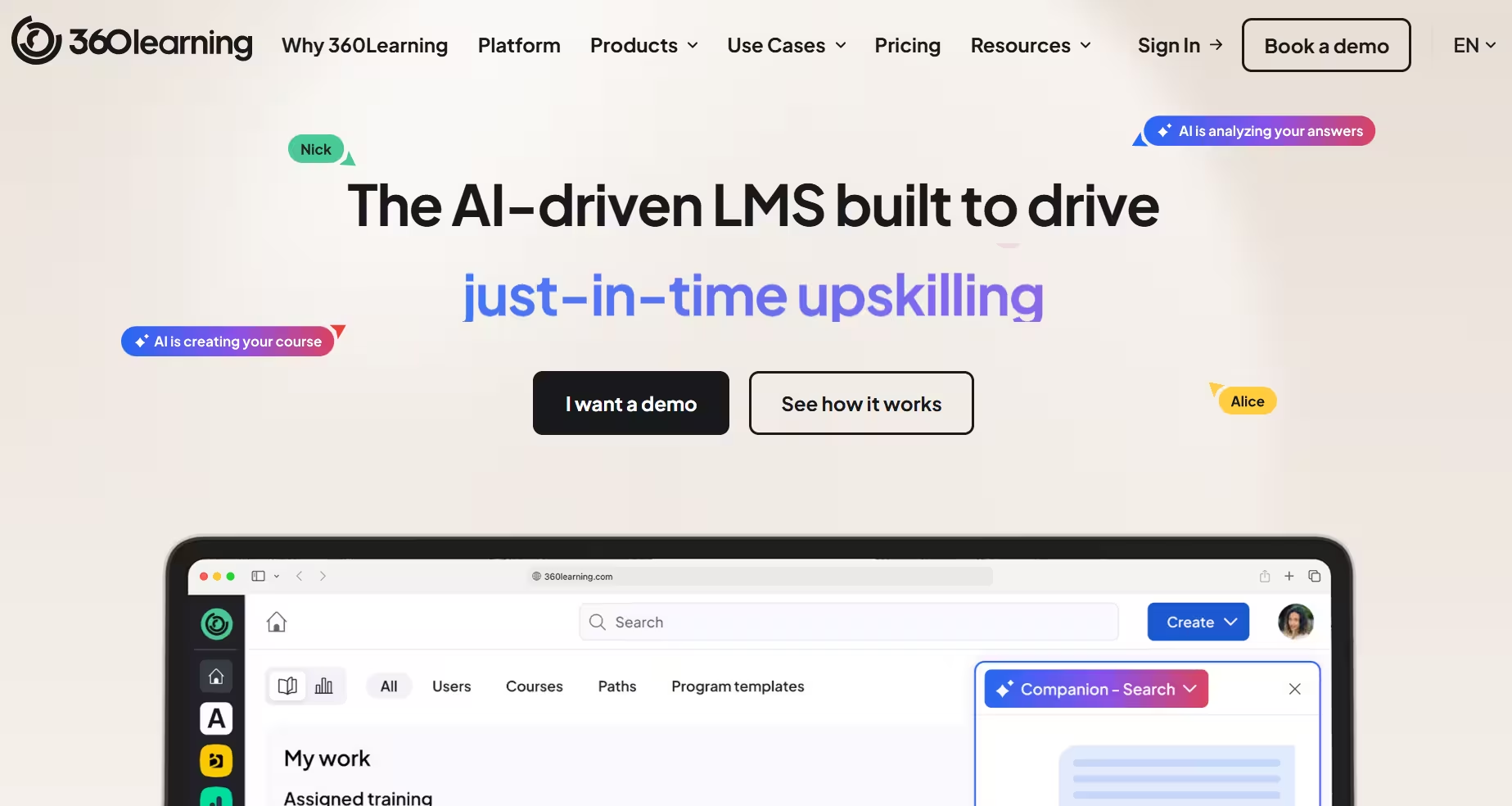
Collaborative learning is 360Learning's defining strength, and it's the first thing every reviewer and competitor mentions about the platform.
Instead of buying a course library, 360Learning hands the whiteboard to your own subject matter experts. One Capterra reviewer says creating, sharing, and tracking training content is simple, even for occasional users, with no instructional-design background required. That's the platform's real differentiator — courses come from people who already know the material, not a marketplace catalog.
The interface backs up the pitch. One verified user calls out the platform's intuitive and user-friendly interface, which makes it easy for both learners and administrators to navigate. For a category that isn't always known for consumer-grade polish, that's a real compliment.
Pricing is where 360Learning pulls ahead on transparency, at least at the entry tier. The Team plan is published at $8 per user per month for up to 100 users, with no minimum commitment — a sharp contrast to Docebo's quote-only model. You can see the number before you talk to a salesperson, which matters if you're building a budget case internally.
Setup is fast too, by most accounts. The collaborative-authoring model plays well with teams that already have engaged internal experts — the kind of people who'd rather build a course than sit through a vendor demo explaining someone else's. That matters most for organizations where the real expertise sits with frontline managers or specialists, not a dedicated training department. The people who understand the material best are the ones building the course, instead of filtering it through an instructional designer who has to learn the subject before they can teach it.
360Learning won't fit every team. But it's honest about what it's good at — turning expertise you already have into training, quickly, without overselling itself.
Docebo: weaknesses
Docebo's biggest weakness is that you can't get a straight answer on what any of this costs.
Both docebo.com and Capterra list Docebo's pricing as a custom quote tailored to your organization, with no published per-user rate anywhere. That's common for enterprise software, but it also means the "Docebo is expensive" reputation runs on rumor and reseller estimates rather than a number you can check. If you've seen a specific dollar figure quoted online, treat it as someone's guess, not Docebo's word.
The complexity that comes with all that customization shows up in admin work, too. Reviewers note that making even simple graphic changes requires HTML and CSS knowledge, and some describe a steep learning curve, with basic features like the notification module and certificate app still awaiting upgrades. A team with dedicated L&D or IT support won't find any of this disqualifying. But it's a real cost if you don't have that capacity.
Support has had rough patches, too. One long-time customer, reviewing back in 2019, described a support backlog so severe that two-week waits for a response weren't uncommon. That's a specific, sourced complaint worth weighing, though it's a dated account of a slow response, not evidence of tickets going unresolved today.
Put together, Docebo asks you to trust a sales process before you see a number, and to bring some technical patience once you're in. For an organization with the staff and budget to absorb both, neither is a dealbreaker. For a leaner team, ask direct questions.
360Learning: weaknesses
360Learning's weakness is the flip side of its strength. Handing course creation to your own experts means handing them fairly basic tools to do it with.
One verified reviewer summed up the ceiling directly, asking for visual content-creation tools to make the editor complete — a sign today's tools don't go much beyond text and images. That's a limitation if your subject matter experts expect anything close to what a dedicated authoring tool offers. Other reviewers describe their own course catalogs as already well-stocked, though, so this reads less like "no content" and more like "basic editing tools" — which matters if your team wants to build anything visually elaborate.
Pricing transparency also has a ceiling. The published $8-per-user Team plan tops out at 100 users; anything past that — Business or Enterprise tiers — moves to the same custom-quote model Docebo uses. The clear, checkable number that makes 360Learning easy to budget for at a small scale disappears exactly when you'd want it most — while planning a larger rollout.
Reporting draws some criticism, too. One reviewer noted that reporting and using metrics can be relatively complicated, particularly when it comes to getting a precise, customized view of training data — a general request for more depth, not a specific complaint about any one use case. If your training program leans heavily on detailed completion analytics, it's worth testing this yourself before assuming it'll cover your reporting needs.
None of this undoes 360Learning's core pitch. The platform's simplicity has edges — thinner editing tools, pricing that gets opaque at scale, and reporting with room to grow.
Docebo vs. 360Learning: features compared
Side by side, the feature gap between Docebo and 360Learning comes down to whether you want a library or your own people building the courses.
Feature | Docebo | 360Learning |
Content authoring | Centralized library (30,000+ courses) plus AI-generated content | Internal subject matter experts author courses collaboratively |
Reporting | Analytics dashboards (vendor-described, not independently verified) | Functional, with tracking depth reviewers want more of |
Licensing & admin | Per-user or usage-based, custom quote; some admin tasks need technical skill | $8/user/month published rate up to 100 users, then custom |
AI capabilities | Course generation, admin search, real-time coaching | AI-assisted authoring support for internal experts |
Docebo's AI leans toward doing the work for you — generating content, powering search, coaching learners in real time. 360Learning's AI tools are built to support the people already doing the authoring rather than replace them, which fits its whole collaborative-learning premise.
Reporting tells a similar story about who each platform is built for, at least by each vendor's own positioning. Docebo's product page markets its dashboards at L&D teams managing complex, multi-audience programs — treat that as a feature checklist, not an independently confirmed depth advantage. 360Learning's reporting works fine for straightforward internal training, but drew specific, sourced feedback that tracking depth has room to grow — worth testing directly if detailed completion reporting is a priority for you.
Licensing follows the same divide. Docebo's usage-based, custom-quoted model matches its enterprise ambitions, while 360Learning's flat per-user rate — at least below 100 users — matches its faster, simpler pitch. That divide also extends to who ends up doing the admin work. Docebo's deeper configuration options mean more setup for whoever manages the platform day to day, while 360Learning's leaner feature set means less to configure, but also less to configure around if your needs get more specific later.
If you're weighing AI hype against AI utility, look at who the AI is actually working for, not how much of it each platform has.
Docebo vs. 360Learning: best for ICP/use case
Docebo fits mid-size to large organizations training more than one audience — employees, customers, and partners — with an L&D team sized to handle real complexity. If you're already running multiple training programs and want one platform with a deep content library behind it, Docebo's target customer looks a lot like you.
360Learning fits organizations built around strong internal expertise — teams with subject matter experts who have real training material in their heads, and enough protected time to turn it into courses. It's a better match for internal-employee training than for customer or partner education, since the collaborative-authoring model depends on experts who share an organization with the people learning from them.
If your training program is mostly onboarding, compliance, or role-specific skill-building for your own staff, and you'd rather hand the work to your existing experts than shop for a course catalog, 360Learning's model deserves serious consideration. If you're running training across multiple audiences and need the breadth of a pre-built library plus deep reporting, Docebo is built closer to that reality.
Company size alone won't settle this. A 300-person company with three excellent internal trainers and no compliance-heavy content might do better on 360Learning than a much larger company that needs broad, ready-made courses fast.
Which should you choose?
Strip away the marketing, and the decision comes down to three questions.
Who's writing your courses? If you want a large, ready-made library plus AI tools that generate new content on demand, Docebo's centralized model does more of that work for you. If you have subject matter experts who already know the material and want to build courses themselves, 360Learning is built around exactly that.
What can you budget? 360Learning gives you a real number to plan against — $8 per user, per month, up to 100 users, before you talk to anyone. Docebo won't tell you a price until you're in a sales conversation. That works if you have time to negotiate, and frustrates you if you need a number for a budget meeting next week. Neither platform stays cheap once you scale past the entry tier — 360Learning moves to custom pricing past 100 users, and Docebo was built to be custom from the start. If you want to see how LMS pricing models compare across the wider category — per-user, tiered, and custom-quote structures — this breaks it down in more depth.
How much admin complexity can your team absorb? Docebo's flexibility comes with real technical overhead. Some tasks need HTML/CSS knowledge, and legacy admin screens draw specific complaints about being clunky. 360Learning's front end is easier to live in day to day, but its course-editing tools are more basic, which shifts the complexity from admin work to content-creation limits. Neither platform makes complexity disappear. It just relocates to a different part of the job, so ask yourself which kind of complexity your team already has people to handle, rather than which platform sounds simpler on a sales call.
Choose Docebo if you're training multiple audiences, have dedicated L&D or IT capacity, and want breadth over speed. Choose 360Learning if your training is mostly internal, your experts have real teaching material to share, and you want a published price before you pick up the phone. There's no universal winner in this matchup, only a better fit for your specific situation — which is why these three questions matter more than any feature list.
Where Absorb LMS fits in
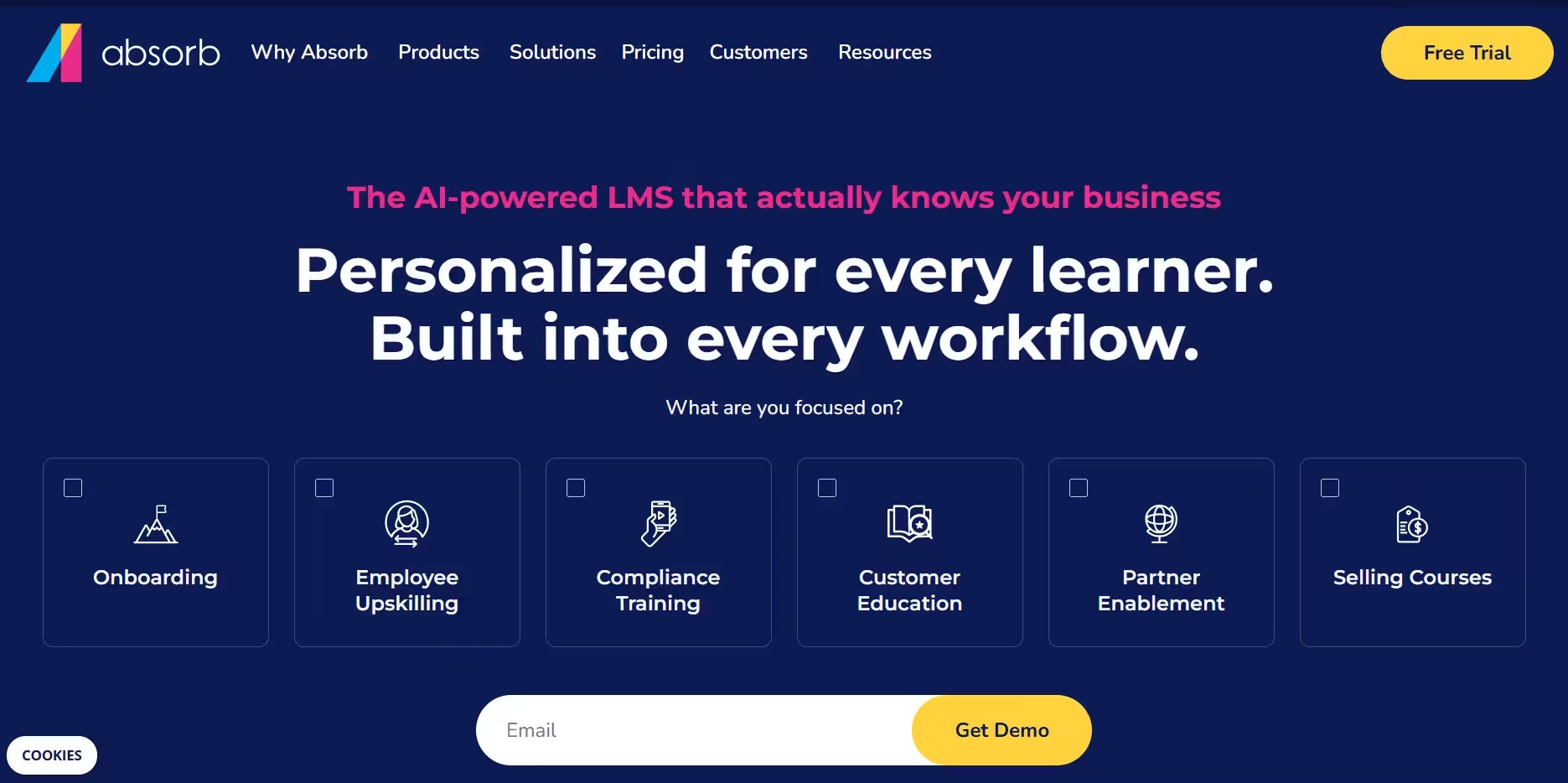
If neither of those descriptions quite fits — you want breadth, user experience, and support — that's usually a sign you're looking for a third option, not a compromise on either one.
Absorb was built around a different bet — it give teams real course-creation speed without forcing a choice between "buy a library" and "build everything yourself." Aura Create uses built-in generative AI to turn a request into a finished course in a few minutes — closer to Docebo's AI-generation speed, but without requiring a large upfront content marketplace to get started. On the admin side, Aura Admin Assist lets administrators act in plain language instead of digging through menus, which is the kind of ease of use both Docebo and 360Learning get partial credit for and neither fully delivers.
Scale is where the evidence gets concrete. And here's a concrete example. When Rakuten expanded its training program, Absorb supported growth from 24 countries to 41, with improved visibility into global training needs through Absorb Analyze — an answer to the reporting-depth questions 360Learning reviewers raise, and to the admin complexity and support gaps Docebo reviewers describe.
If you've read this far because neither platform felt like a clean fit, check out Absorb as a third option to see what it can do for your organization.
FAQs
Is 360Learning good for collaborative learning?
Yes — it's the whole reason the platform exists. 360Learning is built around peer-authored courses, where subject matter experts build the training instead of you shopping for a course catalog. Reviewers confirm creating and sharing training content is simple, even for occasional users — which is the point. You shouldn't need a dedicated instructional designer standing between your best people and a finished course.
Does 360Learning have off-the-shelf course content?
Not really, and it doesn't pretend to. 360Learning's model runs on what your own people build, plus whatever third-party content you integrate, rather than a large native marketplace like Docebo's. Course-editing tools are also fairly basic — one reviewer specifically asked for visual content-creation tools to round it out — so if you're hoping to unbox a library on day one, budget time to build one instead.
Is 360Learning more expensive than Docebo?
Cheaper below 100 users, harder to call above it. 360Learning publishes $8 per user per month for its Team plan, capped at 100 users — a real number you can plan a budget around today. Docebo won't give you that comfort; both its own site and Capterra list it as a custom quote. But 360Learning also moves to custom pricing past 100 users, so the "which is cheaper" question gets murkier exactly where it matters most — right as your rollout gets big enough to need the answer.
Is 360Learning's reporting good for compliance tracking?
Good enough for standard tracking, not built to impress an auditor. One verified user notes that reporting and metrics can be relatively complicated to customize — a general ask for more depth, not a specific compliance failure. If your program leans on detailed audit trails, don't take that on faith. Test it against your own requirements first.
What's the difference between Absorb and 360Learning?
360Learning bets on your people; Absorb bets on speed. 360Learning is built around peer-authored content from your own experts, while Absorb is built around AI-assisted course creation that gets you to a finished course fast, without asking anyone to clear their calendar to build it. Aura Create can turn a request into a course in a few minutes — useful if you want the outcome without turning every expert into a part-time course builder.
Does 360Learning integrate well with other systems?
Yes, and this is one place it doesn't need an asterisk. 360Learning connects cleanly with common HR and content systems, and reviewers describe the integration experience as solid, not a workaround. It's one of the few areas where 360Learning stands toe-to-toe with bigger platforms like Docebo.
Is 360Learning legit?
Yes. 360Learning is an established, funded company with a review history you can go read for yourself, not a name that showed up in your inbox last week. Reviewers describe real, specific experiences — praise and complaints alike, which is itself a sign of a mature, actively-used product. Its strongest reviews cluster around teams doing collaborative, internally-authored training rather than every possible LMS use case. Legit isn't really the question here — fit for your specific setup is.
Looking to make a switch? Absorb is worth a look
Docebo and 360Learning both do what they promise. Docebo brings enterprise depth and AI tools like Docebo Creator and Harmony AI, at a price it won't quote until you ask. 360Learning brings fast, collaborative course-building at a clear starting price that gets murkier once you outgrow it. Neither is the wrong choice for the right team — the whole point of this comparison is that "better" depends on which problem you're solving.
If you're still weighing both, or if neither one quite matches what you need, see what Absorb can do before you commit.


.jpg)
.avif)