.jpg)

Online training for restaurant staff works best when it fits how restaurants run, with high turnover, no desks, and shifts that never stop. If you've ever watched a new hire quit before they found their footing, or scrambled to prove a certification was still current, you already know why "good enough" training just isn't good enough in an industry that's known for high staff turnover.
That's true whether you're running a single-location restaurant or training staff across a multi-location or franchise operation. This guide covers two problems most training advice skips: picking a method that survives turnover and shift work, and proving training and certification happened when someone asks.
What does online training for restaurant staff cover?
Online training for restaurant staff means teaching your team food safety, service standards, and job-specific skills through short digital lessons, not throwaway handouts or forgettable one-time sessions. It applies to servers, hosts, bartenders, and cooks as much as it does to shift leads and general managers.
Frontline staff and managers need different things from online training, not the same content delivered twice. Frontline staff need practical, task-based instruction, like how to greet a table, handle a spill, or run the register. Managers need a different mix, like scheduling, coaching, and keeping the location compliant.
The biggest mistake in training restaurant staff is treating it as a single event. New hires get oriented once, then nothing, and it shows the first time something goes wrong on a busy Friday night. Restaurant employee training works best as an ongoing system. It means onboarding, refreshers, and updates whenever a menu, policy, or regulation changes.
A program beats a one-time event every time, whether you call it restaurant training, restaurant staff training, or something more specific, like food safety or service training. Get that right, and training for restaurant staff sticks instead of getting forgotten by the next shift.
How do you choose a training method for restaurant staff?
Choose a method based on three restaurant realities: high turnover, no desk access during a shift, and, if you run more than one location, the need for consistency across sites. No single method wins on all three, and that's fine. Restaurants generally end up combining a couple of methods instead of picking just one.
Method | Best for | Main limitation |
|---|---|---|
In-person or on-the-job | Hands-on skills and immediate feedback | Hard to repeat the same way across every shift or location |
Paper manuals | Cheap reference material | No way to confirm anyone read or understood it |
Video-only tools | Quick, mobile-friendly content | Passive — nothing tracks what stuck |
A full learning management system (LMS) | Multi-location consistency, tracking, and certification records | More structure than a single small restaurant with a handful of staff usually needs |
Mobile access matters more than most training plans admit. Deskless workers make up 70–80% of the global workforce, and they turn over 1.6 times faster than office-based staff. Restaurant staff fit that description almost exactly: no desk, no company email, and a schedule that changes every week. A training method that requires sitting at a computer doesn't match how your team works.
Video-only and elearning tools built for restaurants can work well here, especially paired with dedicated restaurant training software that tracks who finished what. If you run multiple locations, also check whether your training method connects to the tools you already use, like your point-of-sale system, scheduling software, or HR platform. A method that lives outside those systems adds one more login and one more thing managers have to remember to check.
If you're comparing pre-built online courses instead of building your own content, judge them against the same three questions:
- Does it work without a desk?
- Does it track completion?
- Does it hold up across more than one location?
None of this means every restaurant needs a full LMS. A single-location restaurant with five employees can often get by on hands-on training plus a simple manual. A restaurant with multiple locations, high turnover, or certifications to track usually can't. Match the method to where you are, not where a vendor wants you to be.
What are the most effective ways to train restaurant staff?
The most effective ways to train restaurant staff are short, frequent lessons paired with hands-on practice and fast feedback, not one long orientation session or a manual on its own. Space training out over days or weeks, have new hires shadow an experienced coworker, then have them practice real scenarios before running a shift solo.
The spacing part isn't a guess. Spaced practice produces more durable learning than one-time or crammed training, a pattern that holds across facts, skills, and motor learning. In restaurant terms, five 10-minute lessons across two weeks beat one 50-minute session on day one. This approach is often called microlearning, and it works because nobody remembers a 45-minute onboarding video by their second shift.
The pattern that works, in order:
- A short lesson before the shift.
- Shadowing an experienced employee during it.
- A quick check-in right after, not days later.
Skipping that last step is the most common mistake in training restaurant employees. Managers assume training "stuck" because the employee nodded along, then find out otherwise during a rush.
Front-of-house and back-of-house staff need different scenarios. A server practices handling a table; a cook practices a station. The same three-step pattern works for both, and it holds up for restaurant service training as well as it does for back-of-house training.
How do you build a restaurant staff training program?
A restaurant training program needs three parts. It needs a new-hire onboarding phase, an ongoing refresher phase, and a way to confirm each step got done. Skip any one of the three, and the whole thing falls apart, usually right when you need it most.
A simple [30-60-90 day timeline] covers the new-hire phase:
- Days 1-30: food safety basics, house standards, and the tasks specific to the role.
- Days 30-60: independent shifts, with a manager checking in on specific skills.
- Days 60-90: the shift from "learning the job" to normal refreshers.
This kind of training plan for restaurant staff works whether you're hiring one person or many.
The ongoing phase covers menu changes, seasonal updates, and periodic refreshers on food safety and service standards. A single training push when someone's hired isn't enough. Skills fade, and rules change, even for your best people.
If you run more than one location, build the program once and apply it everywhere. Use the same lessons, the same order, and the same sign-off step at every location, not a version each manager improvises on their own.
Running an identical program across locations pays off most clearly when you open a new one. Picture a composite example: a two-location restaurant group promotes an assistant manager to open and run its second location. That manager follows the same 30-60-90 day timeline as the first location, using the same lessons and the same sign-off step. Because both locations run the identical program, the owner can compare the two on the same timeline instead of guessing whether the new location is catching up.
Every stage of the program should end with a manager confirming the employee completed it, not just assuming they did — that's what makes a training program trackable instead of a suggestion, and it's the same principle that makes certification tracking possible across multiple locations.
Is a restaurant training manual enough on its own?
No, not on its own. A restaurant training manual gives your team something to reference, but it can't confirm anyone read it, understood it, or is still following it six months later.
A good manual still earns its place. It should cover procedures, house standards, and reference material staff can look up mid-shift, like a recipe spec or a cleaning checklist. Keep it short enough that someone will open it when they need it, not just skim it once during onboarding.
Where a manual falls short is tracking. There's no record of who read which section, no way to check understanding, and no built-in reminder when it's outdated. A manual for a single location is one thing. A manual that's supposed to stay identical across five locations, updated by five different managers, rarely does. Whether it's a single restaurant training manual or a stack of PDF training manuals and server training guides, the tracking problem is the same.
The fix isn't dropping the manual. It's pairing it with something that tracks completion and understanding, like a short lesson or quiz tied to each section. The manual holds the content. The tracking layer confirms it landed.
How does technology help train restaurant staff across multiple locations?
Technology helps you train restaurant staff across multiple locations through mobile-first training and centralized tracking, two things a laminated binder in the back office can't do. Restaurant training becomes a technology problem once you're training more than one shift, one role, or one location. With high turnover and new hires starting every week, consistency is hard to keep up by hand.
Mobile-first training matters because most restaurant staff (servers, line cooks, hosts, and bartenders) never sit at a desk during a shift. Training that only works on an office computer misses the closing crew, the weekend brunch team, and anyone who picks up shifts at more than one location.
Microlearning fits restaurant schedules better than long sessions do. A five-minute refresher on a new menu item or allergen procedure before pre-shift lineup is far more likely to get finished than a 90-minute course that has to compete with prep and a full reservation book.
Keeping training the same at every location is the real problem technology solves. Absorb LMS, for example, lets multi-unit restaurant groups and franchises deliver the same food safety, service standards, and onboarding training everywhere. Managers can track completion and competency in one place instead of chasing down paper sign-off sheets at each store.
Role-specific training still matters most. Technology is what makes that training consistent, easy to track, and easy to deliver to a workforce that's always on the floor.
What's AI-powered roleplay in restaurant training?
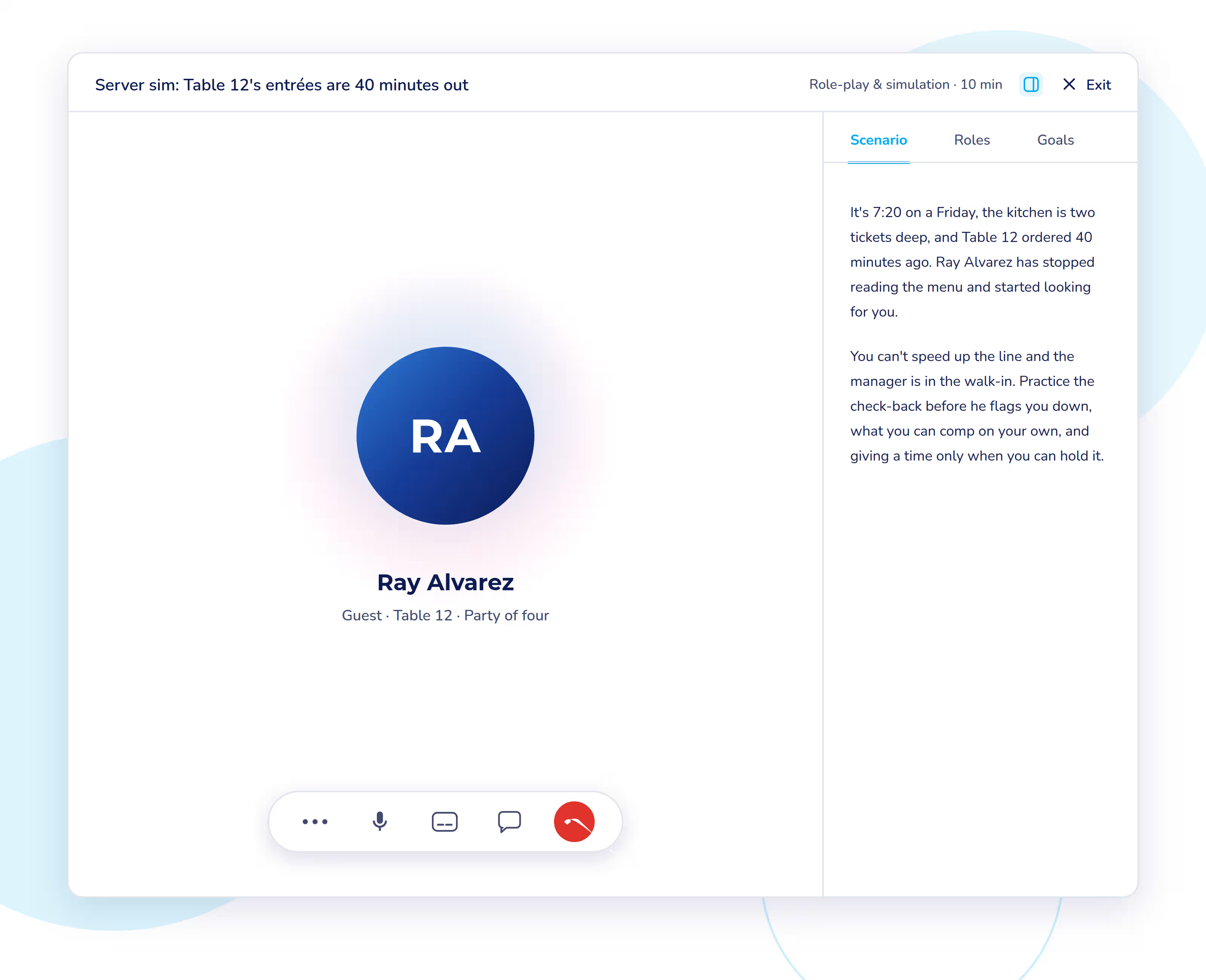
Absorb's Aura Rehearse (coming soon) is agentic AI for restaurant training. It uses AI-powered roleplay to help staff practice hard moments before they happen on the floor. A quiz can confirm your team knows the comp policy. It can't tell you whether a server will stay calm when a guest's order comes out wrong, whether a host can manage a 45-minute wait without losing the table, or whether a shift lead can defuse a complaint about the bill. Aura Rehearse lets them roleplay the moment first, in scenarios built from your own training content, and then gives feedback on what worked and what to try differently.
The same idea applies to any job built on live conversations with customers, whether that's in a sales meeting or a dining room:
"The ability to role play provides a safe environment for your people to experiment, make mistakes, and receive coaching without risking a live opportunity. They build confidence by allowing sellers to rehearse challenging scenarios, refine their messaging, and sharpen their ability to think on their feet. Just as athletes don't wait until game day to practice, top sales professionals don't wait until they're in front of a prospect to test their approach."
—Kerry Heilskov, Director, Sales Enablement & Training, Absorb LMS
What does restaurant management training look like for shift leaders?
Restaurant management training covers a different set of skills than frontline training, like scheduling, coaching, handling conflict, and reading a basic P&L, not just task execution.
Promoting a strong server or cook to shift lead without training them for the new role is one of the most common, and most avoidable, mistakes in the industry. Being good at the job isn't the same as being good at managing the people who do it. A shift lead who's never learned how to give feedback or handle a scheduling conflict will improvise, and improvising under pressure is hard on everyone on that shift, not just the new manager. This is restaurant leadership training, not just a manager onboarding checklist.
Give new managers training in three areas before they run a shift solo:
- How to coach an underperforming employee.
- How to handle a scheduling gap.
- How the location's numbers connect to their daily decisions.
Pair this with shadowing an experienced manager, the same way frontline staff shadow before working solo.
If you have multiple managers across locations, consistency matters here too. A manager trained differently at each site will run that site differently, and staff can usually tell within a week which location they'd rather work at.
What's the cost of not training restaurant staff properly?
Poor training costs restaurants in three ways:
- Higher turnover and replacement costs.
- Slower new-hire productivity.
- Lost business from inconsistent service.
None of these are back-of-napkin guesses. Here's what each one costs, sourced rather than rounded up.
Replacing an hourly employee costs restaurants an average of $2,305 in hard costs, covering separation, replacement, and training combined. Replacing a manager costs over $10,000, and replacing a general manager costs nearly $17,000. Training alone won't stop all turnover, but weak training makes new hires quit faster, which multiplies this cost.
Onboarding speed compounds the problem. Employees generally get about 90 days to prove themselves in a new job. One documented case found employees with a structured onboarding program became fully productive two months faster than employees in a traditional program, and at another company, employees who went through structured orientation were 69% more likely to stay three years. Faster, more reliable onboarding shortens the time a new hire costs more than they contribute.
Inconsistent service shows up in the numbers too. Restaurants with lower staff turnover see measurably higher same-store traffic and sales than restaurants with higher turnover. That's a traffic and sales link, not a review-score claim, but the mechanism is straightforward: a team that's trained and sticks around delivers a more consistent experience than one that's constantly being replaced.
One documented case makes that link concrete. When KFC correlated cashier training-completion rates with its customer satisfaction survey scores, restaurants where every cashier had completed the training scored 8 points higher on overall satisfaction than restaurants where no one had, plus a 7-point gain on the "friendliness" measure specifically, per a 2014 case study recognized by the Academy of Human Resource Development. That's one company's data, not an industry-wide guarantee — but it's the clearest documented link between training completion and how guests actually rate the experience.
How do you track restaurant training and certification compliance across multiple locations?
You track compliance by tying every certification to a name, a location, and an expiration date, then reviewing that list on a set schedule. Waiting until an inspector shows up to find out who's certified is how gaps turn into violations, and it's a stressful way to find out.
Food safety and alcohol service certifications are the two most common ones restaurants track. ServSafe, run by the National Restaurant Association Educational Foundation, covers food manager, food handler, alcohol service, and allergen certifications. These aren't one-time badges. They expire, and an expired certification is the same as no certification at all if it lapses without anyone noticing.
The real problem isn't knowing the certifications exist. It's tracking them across every employee, at every location, without a spreadsheet that's already out of date by the time someone opens it. Who's certified, where, and when does it expire? Most restaurants can answer that for one location. Fewer can answer it instantly for five.
The stakes are real even without a dollar figure attached to them. The CDC has found restaurants with a certified food protection manager are less likely to have critical inspection violations than restaurants without one. Losing track of who's still certified doesn't just create paperwork risk — it chips away at the exact protection certification is there to provide.
Absorb LMS can automatically track certifications, flag upcoming expirations, send renewal reminders, and generate compliance reports that are ready for auditors or health inspectors. Rather than digging through paper files or spreadsheets spread across multiple locations, administrators can access centralized training records and reporting from a single system.
The bottom line
Pick a training method that survives turnover and shift work. Most restaurants end up combining a few methods rather than picking just one. Then build in a way to confirm training and certification happened, especially if you run more than one location.
Start with whichever gap costs you the most right now. If new hires quit before they're productive, fix onboarding first. If you can't say who's certified at each location today, fix tracking first. Either way, you don't need to fix everything this week, just the one thing that's costing you the most.