.jpg)

Restaurant onboarding is the process of getting a new hire ready to work a shift. It covers the paperwork, the training, and the first few weeks that turn a new hire into someone you can count on. Restaurant employee onboarding covers the same ground for every role, from line cook to host stand.
Key takeaways:
- Only 12% of employees strongly agree their organization does a great job onboarding new hires (Gallup) — restaurant onboarding needs to be a process, not a single first-day event.
- Four common frameworks — the 30-60-90 rule, the five stages, the five Cs, and the four steps — describe the same onboarding journey at different levels of detail; pick whichever matches how your team already talks about training.
- Before day one, new hires need a completed Form I-9 and Form W-4, plus, depending on the role, OSHA safety training, FLSA tip credit rules, and food handler certification in many states and jurisdictions.
You might be the manager, HR lead, or owner who has to make onboarding stick. Maybe that's for one restaurant location. Maybe it's for fifty. Either way, you already know how thin a single first-day event gets during a Friday-night rush.
Only 12% of employees strongly agree their organization onboards new hires well. A rough first week shows up fast. You'll see it in line mistakes and empty shifts three weeks later.
What are the stages of the restaurant onboarding process?
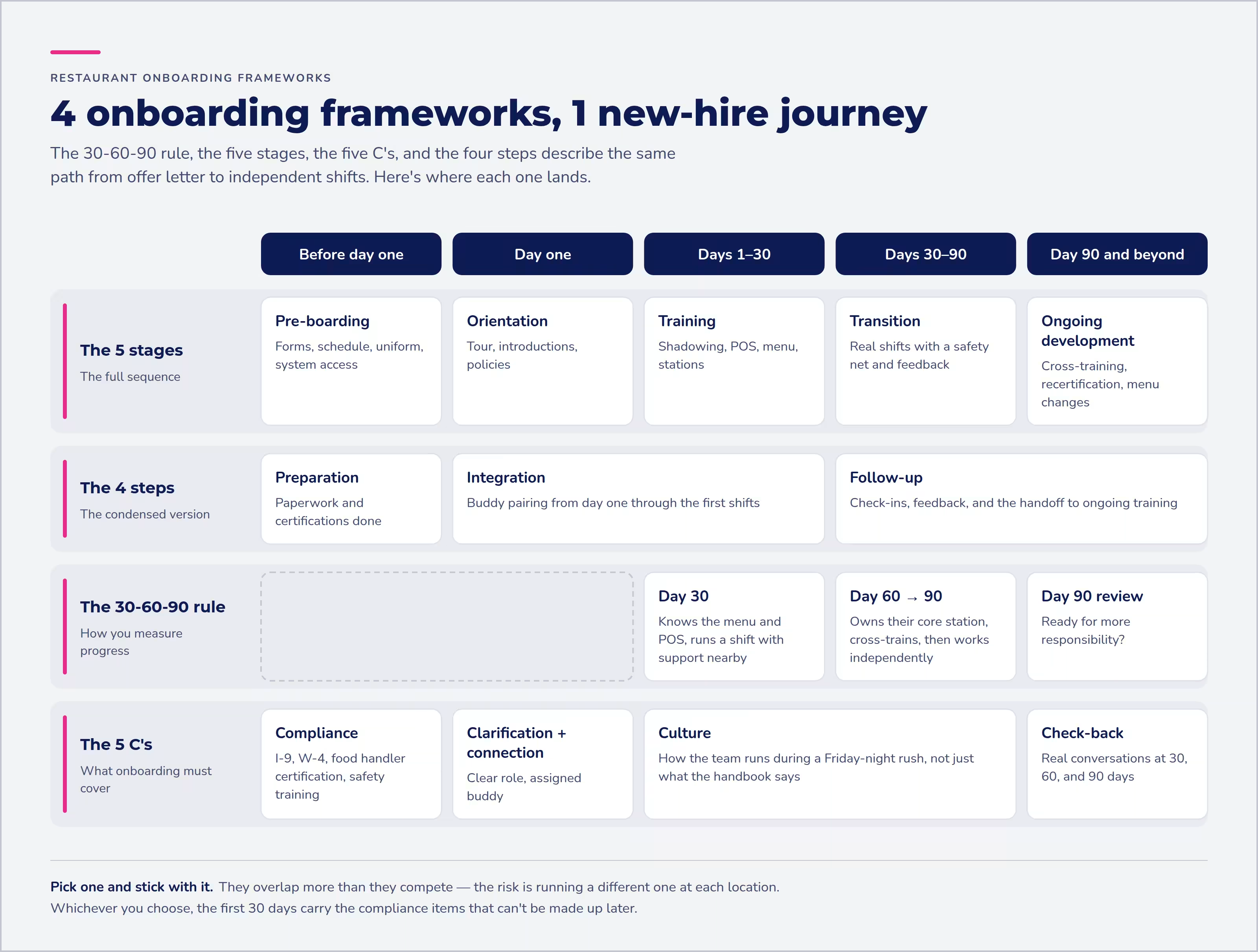
Restaurant onboarding breaks down into a few well-known frameworks. These include the 30-60-90 rule, the five stages, the five Cs, and the four steps. You don't need to use all of them. Pick whichever one matches how your team already talks about training, or mix and match.
What is the 30-60-90 onboarding rule?
The 30-60-90 onboarding rule breaks a new hire's first three months into three checkpoints — 30, 60, and 90 days. Each checkpoint has a clear goal for what the employee should know and do by that point.
By day 30, a restaurant employee should know the menu and feel comfortable on the POS system. They should also be able to run a shift with support nearby. By day 60, they should handle their core station with less supervision. They should also start cross-training on a second station.
By day 90, they should work independently. You should have enough to evaluate whether they're ready for more responsibility.
What are the 5 stages of the onboarding process?
The five stages of onboarding are pre-boarding, orientation, training, transition, and ongoing development. This sequence moves a new hire from paperwork to full performance.
- Pre-boarding happens before day one. It covers forms, scheduling, uniform, and system access.
- Orientation happens on day one itself. It's the tour, the introductions, and the policies.
- Training is the hands-on stage. New hires shadow others and practice on the POS, the menu, and the stations.
- Transition is working real shifts with a safety net and regular feedback.
- Ongoing development is everything that comes after. It includes cross-training, recertification, and staying current as the menu and the rules change.
What are the 5 Cs of new hire onboarding?
The five Cs of onboarding are compliance, clarification, culture, connection, and check-back. This framework makes sure onboarding covers more than paperwork.
- Compliance means the required forms and certifications, like I-9 paperwork, food handler certification, and safety training.
- Clarification means the new hire knows exactly what their job involves, not a vague job description.
- Culture means showing them how the team operates during a Friday-night rush, not just what the handbook says.
- Connection means pairing them with a buddy or mentor from day one.
- Check-back means scheduling real conversations at 30, 60, and 90 days instead of assuming silence means everything is fine.
What are the four steps of the onboarding process?
The four steps of onboarding are preparation, orientation, integration, and follow-up. This is a simpler version of the five stages. It condenses the journey into the essentials.
These frameworks overlap more than they compete. The four steps and the five stages describe the same journey at different levels of detail. The 30-60-90 rule and the five Cs are ways to structure and measure that same journey.
Use whichever one matches your team's language. The checklist below works with any of them.
What is pre-boarding for a new restaurant employee?
Pre-boarding covers everything that happens between a job offer and a new hire's first shift. That means checking that they can legally work, collecting tax forms, and confirming any required certifications are in place or scheduled.
Every new hire needs a completed Form I-9 verifying their eligibility to work in the United States. They also need a Form W-4 for tax withholding. Depending on the role, they may also need OSHA-required safety training. If tipped employees are on your payroll, FLSA tip credit rules apply to how you pay them.
Many states and local jurisdictions also require a food handler certification before someone can work with food. Confirm it's on file, or get training scheduled before their first shift.
Exact requirements vary by state. Check your local labor department before you finalize your own checklist. Get the paperwork done before day one. Then day one can focus on the job instead of the forms.
What does day one look like for a new restaurant employee?
A new restaurant employee's first day should cover facility orientation, safety basics, and a hands-on introduction to their station. A manager or buddy should be present for the whole shift, not just the first hour.
Front-of-house and back-of-house employees need different day-one walkthroughs. FOH staff need time on the POS system, a tour of table sections, and practice with guest-service basics. BOH staff need a walkthrough of their station, prep procedures, and safety equipment. Both need the same thing underneath — someone assigned to answer questions and step in when things get busy.
Pair every new hire with a buddy or mentor on day one. Keep that pairing through their first few shifts. This is the "integration" step from the four-step framework above. It's where the plan turns into practice, one shift at a time.
Is there a free restaurant employee onboarding checklist template?
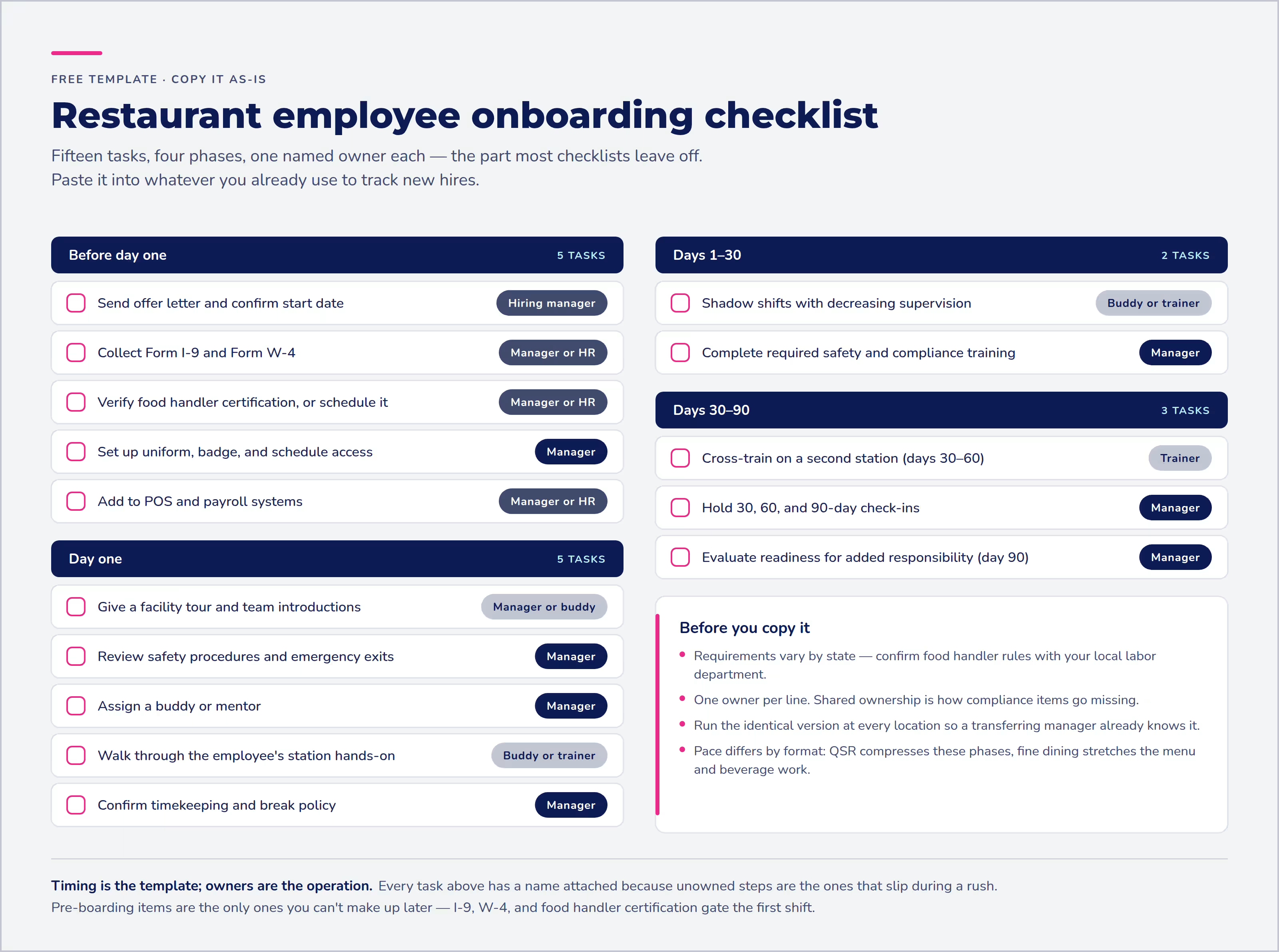
Yes. Here's a free restaurant employee onboarding checklist template you can use as-is or adapt to your own operation. No signup required. Copy it into whatever tool you already use to track new hires.
The checklist below follows the stages already covered, including pre-boarding, day one, and the first 30-60-90 days.
Task | Timing | Owner |
|---|---|---|
Send offer letter and confirm start date | Before day one | Hiring manager |
Collect Form I-9 and Form W-4 | Before day one | Manager or HR |
Verify food handler certification, or schedule it | Before day one | Manager or HR |
Set up uniform, badge, and schedule access | Before day one | Manager |
Add to POS and payroll systems | Before day one | Manager or HR |
Give a facility tour and team introductions | Day one | Manager or buddy |
Review safety procedures and emergency exits | Day one | Manager |
Assign a buddy or mentor | Day one | Manager |
Walk through the employee's station hands-on | Day one | Buddy or trainer |
Confirm timekeeping and break policy | Day one | Manager |
Shadow shifts with decreasing supervision | Days 1-30 | Buddy or trainer |
Complete required safety and compliance training | Days 1-30 | Manager |
Cross-train on a second station | Days 30-60 | Trainer |
Hold 30, 60, and 90-day check-ins | Days 30, 60, 90 | Manager |
Evaluate readiness for added responsibility | Day 90 | Manager |
If you run more than one location, the real risk is five different versions of a good checklist, not one bad one. Standardize this list across every location. That way, a new hire in one restaurant gets the same experience as a new hire in another. A manager transferring between sites will already know how onboarding works there too.
How is onboarding different for an independent restaurant vs. a multi-location chain?
The core onboarding process is the same whether you run one restaurant or fifty. The difference is who owns it and how consistently it runs.
At an independent restaurant, one manager usually owns the whole process. That makes it easy to customize, but also easy to skip steps when things get busy.
At a multi-location or franchise operation, the challenge flips. You need to document and standardize the process. It should run the same way whether a manager built it or inherited it, and whether a new hire started last week or two years ago.
Quick-service and fine-dining restaurants also onboard differently, regardless of which onboarding framework they use. QSR onboarding tends to move fast. It focuses more on speed and consistency across a smaller set of tasks.
Fine-dining onboarding usually runs longer. It spends more time on menu knowledge, wine and beverage training, and service style.
What restaurant onboarding mistakes should you avoid?
The most common restaurant onboarding mistakes share one root cause. They treat onboarding as a single event instead of a process.
- Treating day one as the whole plan. A great first day doesn't survive week two without follow-up.
- Skipping the buddy or mentor pairing. Without someone to ask, new hires take longer to feel comfortable on the floor. A slow start makes it that much easier to quit before the job clicks.
- Losing track of compliance paperwork. Missing I-9s, expired certifications, and incomplete safety training are easy to miss without a checklist and an owner for each item.
- Never checking back after day one. Without a 30, 60, or 90-day check-in, you won't know someone is struggling until they've already decided to leave.
- Stopping at "onboarded." This treats onboarding as finished the moment someone can work a shift alone. Onboarding should instead connect to the training that keeps people current.
Every one of these mistakes costs more than it looks like on paper. Replacing a hire takes real time and money. Every week spent re-onboarding a replacement is a week that hire isn't fully productive.
How does restaurant onboarding connect to ongoing training?
Onboarding shouldn't end once a new hire can work a shift alone. It should hand off directly into ongoing training that keeps your staff current on compliance requirements, and your standards change.
Training doesn't stop after day 90. Menu updates and limited-time offers need the same clear instructions a new hire got in their first week. Food safety and allergen certifications have to be tracked and renewed. If you run more than one location, every location should also train the same way instead of improvising its own version.
Doing all of that by hand gets hard fast. Five Guys JV Ltd. runs close to 300 restaurants across the UK, France, Germany, and Spain. It used to certify crew on stations like the grill and fry station with paper checklists and Excel sheets. Each country had its own learning portal, so there was no way to keep training in sync across markets. "There was an unfortunate lack of consistency," says Neil Whitaker, Senior L&D Manager at Five Guys JV Ltd.
After moving all four markets onto Absorb LMS, the team built learning journeys that mix online compliance and skills training with on-the-job training. Crew members certified in one program can move into management programs, so onboarding leads straight into the next role. Automated notifications remind employees when courses are due, and managers can see who hasn't finished required modules. Micro-learnings under 20 minutes fit into quiet moments on shift.
Compliance course completion rose from 70% to 96%. Engagement jumped from 50–60% to between 90% and 99% across all four markets. See how Five Guys unified training across Europe.
The bottom line
Restaurant onboarding works best as a process, not a first-day event. It starts before the offer letter and doesn't stop once a new hire can run a shift alone. Start with the checklist above, adapt it to your operation, and standardize it across every location you run.
Connecting that process to ongoing training keeps your team certified, consistent, and sticking around. That matters especially once certifications need renewing and every location is training its own way. If you're ready to see what that looks like at scale, take a look at Absorb's frontline worker solution.