.jpg)

If you manage a hotel property or lead its training, hotel staff training is really four or five programs at once. Front desk, housekeeping, food and beverage, and management all need different skills, but most hotels train everyone the same way.
Key takeaways
- Hotel staff training works best as four separate, role-specific programs — front desk, housekeeping, food and beverage, and management — not one generic curriculum.
- Each role needs its own tactics: scripted service recovery for front desk, chemical-safety training and pairing for housekeeping, FDA-aligned food safety for food and beverage, and coaching-based feedback for managers.
- Onboarding should split into universal basics and role-specific training, with every new hire paired with an experienced staff member for at least their first week.
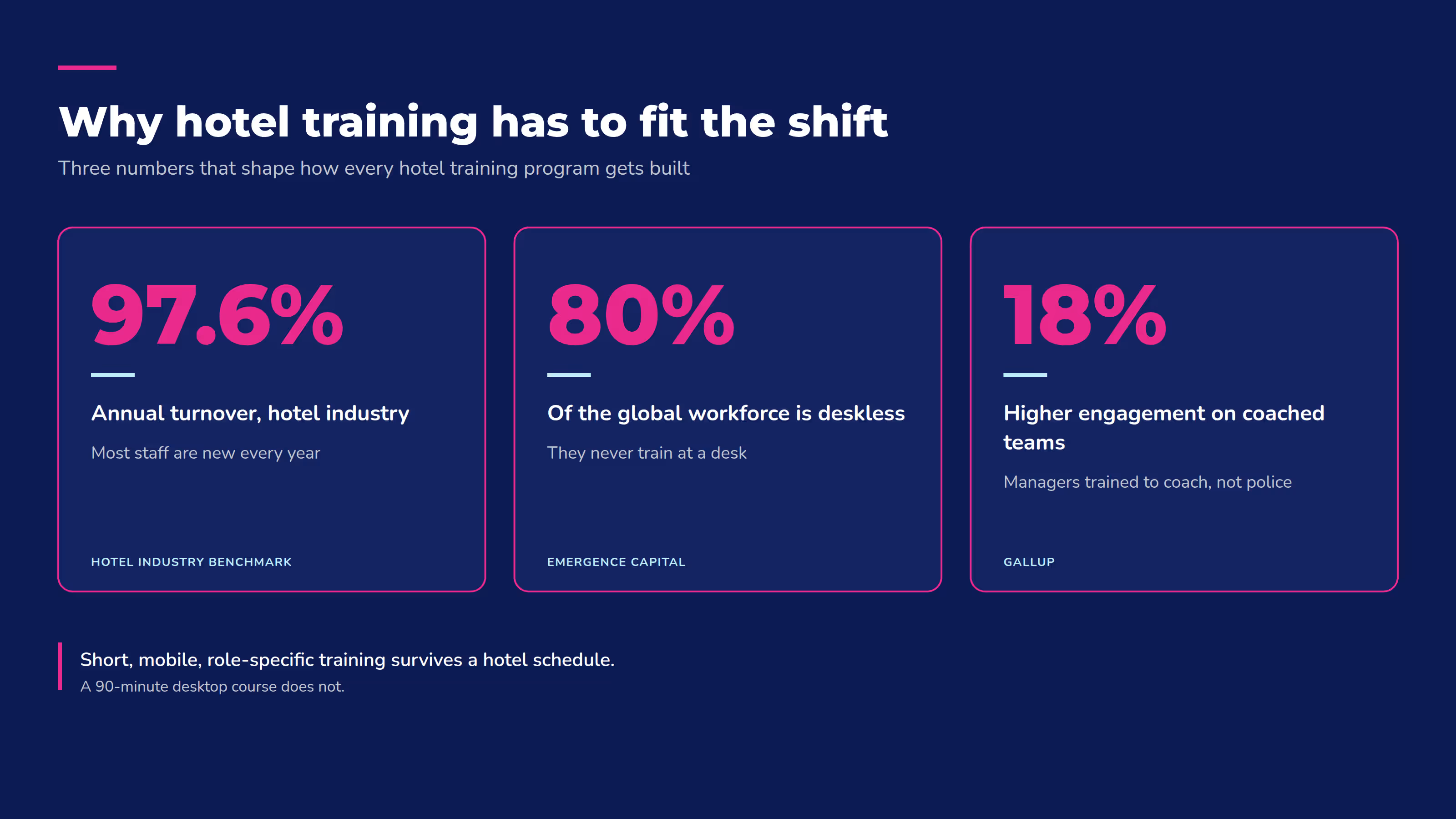
The hotel industry has a 97.6 percent turnover rate, and most hotel staff are part of what Emergence Capital calls the 80 percent of the global workforce that's deskless — they never sit at a desk to do the job. That gap between training and reality shows up fast. A single onboarding session and one manual won't hold up against it.
This guide covers each role, plus onboarding, compliance, and measuring results.
What makes hotel staff training harder than it looks?
Hotel staff training is harder than most corporate training because you're really running four or five different training programs at once, serving a workforce that's not sitting at a desk to do the job.
Front desk needs guest-facing communication skills, and housekeeping needs speed and safety.
Food and beverage needs compliance knowledge, and management needs coaching skills.
A single tip list can't cover four different skill sets well.
Whether you call it hotel staff training or hospitality staff training, these roles get the most attention in this guide. They carry the most day-to-day training weight, and the biggest risk when training is missing.
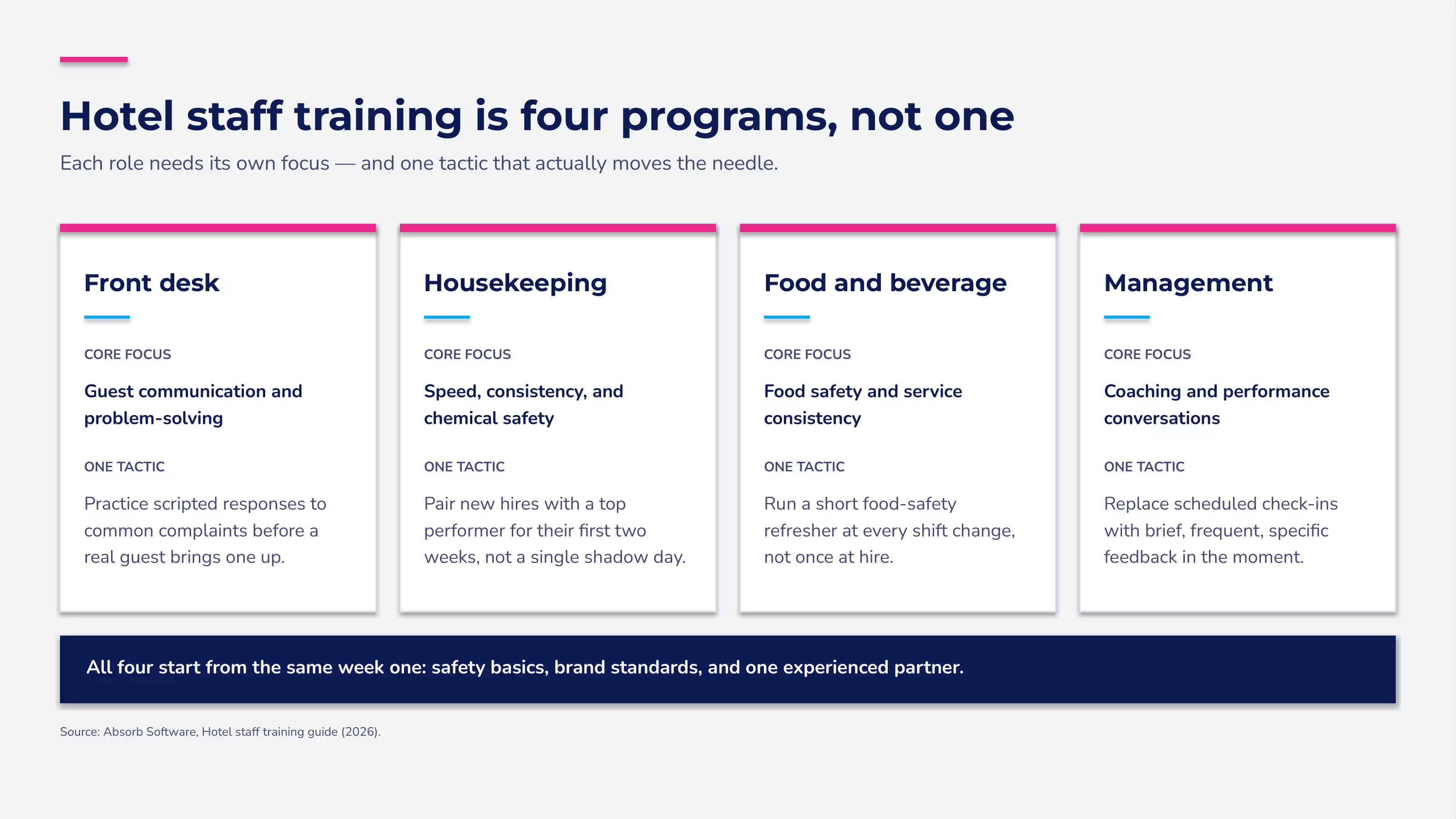
Hotel role | Core training focus | One tactic that moves the needle |
|---|---|---|
Front desk | Guest communication and problem-solving | Practice scripted responses to common complaints before they happen live |
Housekeeping | Speed, consistency, and chemical safety | Pair new hires with a top performer for their first two weeks |
Food and beverage | Food safety and service consistency | Run a short refresher before every shift change |
Management | Coaching and performance conversations | Replace scheduled check-ins with brief, frequent, specific feedback |
Each role gets its own section below, with the kind of detail a single "10 tips" list can't give you.
How do you train hotel front desk staff?
The best hotel front desk training centers on real guest interactions. Your front desk team is the first and last person a guest talks to. That's also where the hardest conversations happen — complaints, overbooked rooms, late checkouts.
Start with your property management system. Front desk staff should be comfortable checking guests in and out, handling room changes, and pulling up a reservation before their first solo shift. Build in supervised practice time so they're not learning it live while a line forms.
Train for the conversations that go wrong next. Give new hires a short list of common complaints, like a room that isn't ready or noise from a neighboring room. Then have them practice responses out loud, in pairs, before a real guest brings one up.
Teach new hires a simple framework — acknowledge the problem, apologize once, and offer a specific fix.
Service recovery deserves its own training moment, separate from day-to-day scripts. When something does go wrong, staff need the authority and the practice to fix it on the spot.
A front desk agent who has to find a manager for every small issue creates a second problem, one that's often worse than the first. Decide in advance what your team can offer without approval, and train to that limit specifically.
Revisit front desk training thirty days after hire. The guests are real by then, and the questions your new hire gets asked are rarely the ones covered in orientation. For a deeper breakdown of building, delivering, and measuring front desk training specifically, see our hotel front desk training guide.
How do you train hotel housekeeping staff?
Good hotel housekeeping training treats speed and quality as one skill. A housekeeper who cleans a room perfectly in forty-five minutes and one who cleans it well in twenty are both valuable, depending on what your day needs.
Build your training around your brand's specific room standards. Walk a finished room with new hires and point out exactly what an inspector checks.
A task list alone won't teach them that level of detail. Specific, visible standards train faster than written instructions alone.
Chemical safety belongs in this training from day one. OSHA requires employers to label hazardous chemicals, keep safety data sheets on hand, and train workers to handle them appropriately. Cleaning chemicals are a real safety risk in housekeeping work, and clear training reduces both the injuries and the liability.
Cross-train housekeeping with front desk on guest requests. A housekeeper who knows how to log a maintenance issue or flag a guest request to the front desk closes the loop faster than a report that waits until the end of a shift.
Pairing works better than a manual here. Put new housekeepers with an experienced staff member for their first one to two weeks instead of a single shadow day. That timeline gives speed and standards room to develop together. For a deeper, room-by-room breakdown, see our full hotel housekeeping training guide.
How do you train hotel food and beverage staff?
You train hotel food and beverage staff by keeping food safety and service quality consistent across every shift, including the ones no manager happens to be watching. That consistency gap is often what food and beverage training checklists miss, and getting it wrong shows up in health inspections and reviews at the same time.
Ground food safety training in the same standard regulators use. The FDA Food Code gives food-service operators a scientifically sound technical and legal basis for regulating the retail and food service segment of the industry, which explicitly includes restaurants and similar establishments, so your hotel's food and beverage outlets fall under it too.
Build your training around the same categories: proper food temperatures, cross-contamination prevention, and hand-washing protocols. Repeat these at every shift change.
Where alcohol service applies, staff need clear training on checking identification, recognizing intoxication, and knowing when to stop serving. This is one area where a written policy isn't enough. New hires should practice the conversation of declining service before they have to do it under pressure.
Service style should stay consistent too. A guest ordering room service should get the same tone and pace as one sitting in your restaurant. Teach new hires the specific phrases and offers your brand uses for upselling, so quality doesn't depend on who's working that day.
Staff need allergen awareness as well. They should know your menu's common allergens well enough to answer a guest's question without checking with the kitchen every time.
How do you train hotel managers and supervisors?
You train hotel managers and supervisors by giving supervisor training the same real investment as front desk or housekeeping training. Many hospitality leaders say it's the first program to get cut, even though managers set the tone for every other department. If your front desk, housekeeping, and food and beverage teams are well trained but your supervisors aren't, the training doesn't stick.
The biggest shift to train for is moving from policing to coaching. Think of it as the difference between catching mistakes after they happen and building the skills that prevent them in the first place. A manager who only shows up to correct problems trains their team to hide problems instead of fixing them.
Teach managers to give feedback in the moment, right when they see it. A specific, timely comment, "that room turn was fast and the bathroom still looked great," does more than a quarterly conversation ever will. Train managers to name what's working, and what needs to change.
Scheduling and staffing judgment belong in manager training too. Knowing how to build a schedule that survives a call-out, and how to redistribute work fairly when it happens, is a skill, not instinct. Many new supervisors are promoted for other strengths, and few ever get formal training in this specific skill.
Managers set the service standard by showing employees how it's done. Greeting guests and checking on tasks in progress teaches new supervisors more than any handbook.
What should hotel staff onboarding include?
Hotel staff onboarding should get a new hire ready to work their role safely and confidently within the first week. A checklist that only covers paperwork and a facility tour is an orientation — onboarding goes further.
"Completion is the easiest thing to measure and the least useful," says Troy Powell, Absorb's Director of Human Resources. "What you actually want to know is: did this process make someone productive faster, and did it make them feel like they made the right choice joining?" A new hire who clicks through every onboarding course but still can't work a shift without help hasn't actually been onboarded.
Split onboarding into two parts. The first covers what every new hire needs regardless of role — safety basics, brand standards, where to find help.
The second covers what's specific to their job. Front desk orientation and housekeeping orientation shouldn't look the same past day one.
Pair every new hire with an experienced staff member for at least their first week. This is the fastest way to transfer the details a manual can't capture, like how a specific guest request usually gets handled, or which shortcuts are fine to take.
Seasonal and hourly onboarding should move faster, but it shouldn't get shorter. Cut the material that doesn't affect their day-to-day work, but don't cut the safety and guest-interaction basics just because someone's contract is temporary.
If you run more than one property, keep the onboarding structure the same everywhere, even if local details differ. New hires at your downtown location and your airport property should learn the same core skills the same way, so a transfer or a multi-property manager doesn't start from scratch. For a full checklist built for shift-based, multilingual teams, see this hospitality onboarding guide.
What should hotel compliance and safety training cover?
Hotel compliance and safety training should cover real, specific risks that come up in daily operations. This isn't legal advice, and hotels vary by location and size, but a few areas belong in every property's training.
Workplace safety training should cover incident reporting, basic first aid awareness, and what to do in an emergency. Practice these regularly instead of reading through them once at hire.
Harassment prevention training deserves real time, not a checkbox. The EEOC recommends regular, interactive training tailored to the audience and the organization as one of the most effective ways to prevent and address workplace harassment. That means training championed by leadership and revisited on a regular schedule.
Labor law basics belong in manager training specifically, since supervisors are the ones making scheduling decisions day to day. That includes meal and rest breaks, overtime rules, and minor labor laws if you employ workers under eighteen.
Build a simple refresh schedule for this category. Compliance training that only happens at hire gets forgotten by the time it matters.
How do you measure hotel staff training effectiveness?
You measure hotel staff training effectiveness with a few key KPIs and a simple training ROI calculation. Most hotels stop at "we ran the training," without ever checking whether it changed anything.
Start with completion rates, but don't stop there. A completed course doesn't guarantee a changed behavior. Track how long it takes a new hire to work a shift without close supervision, and watch whether that number moves after a training change.
Guest satisfaction scores tied to specific departments give you a more direct read. If housekeeping training changes, track the housekeeping-related feedback on its own, separate from your overall score.
Gallup's own research on manager training offers a useful model for measuring whether training worked. Managers trained in coaching and people development saw up to 18 percent higher engagement among their own teams, plus real gains in performance and lower turnover on those same teams. This research is about workplace training generally, not hotels specifically, but it's a clear example of tying training to real outcomes like engagement and performance.
A simple training ROI calculation doesn't need to be complicated. Compare the cost of training against the cost of what it prevents — a bad review, a slower front desk line, a compliance incident. Then track whether that cost drops after training runs.
How does technology help train hotel staff across multiple properties?
Technology helps you train hotel staff across multiple properties through mobile-first training and centralized tracking, tools a binder in a back office can't provide. Hotel staff training becomes a technology problem the moment you're training more than one shift, one role, or one property, because consistency is hard to maintain by hand.
Mobile-first training matters because most hotel staff — housekeeping, front desk, food and beverage — rarely sit at a desk during a shift. Training that only works on a computer in an office misses the overnight shift and anyone without regular computer access during their workday.
Microlearning fits hotel schedules better than long sessions do. A five-minute refresher before a shift starts is far more likely to get finished than a ninety-minute course that competes with a packed schedule.
Keeping training the same across every property is the real challenge technology solves. Absorb LMS, for example, lets multi-property hotel groups deliver the same training across every location. Managers can track completion and competency centrally — no chasing down paper records at each property.
Role-specific training still matters most. Technology is what makes that training consistent, easy to track, and easy to deliver to a workforce that's rarely at a desk.
"Every LMS on the market can tell you a learner finished the course. Almost none can tell you whether that person can actually hold the conversation. That gap is where training quietly fails, and it is the gap Aura Rehearse closes (coming soon!). We are giving every learner a coach with unlimited patience, available at any time, grounded in that company's own policies rather than generic scripts, and scored against a rubric the business defined. The impact is not just better practice. It is evidence. Managers get a transcript and a per-criterion score instead of a completion checkbox, compliance teams can demonstrate practiced competency rather than consumed content, and Absorb moves from proving that training happened to proving it worked."
—Chris Ball, Tech Product Manager for Absorb LMS
What's AI-powered roleplay in hospitality training?
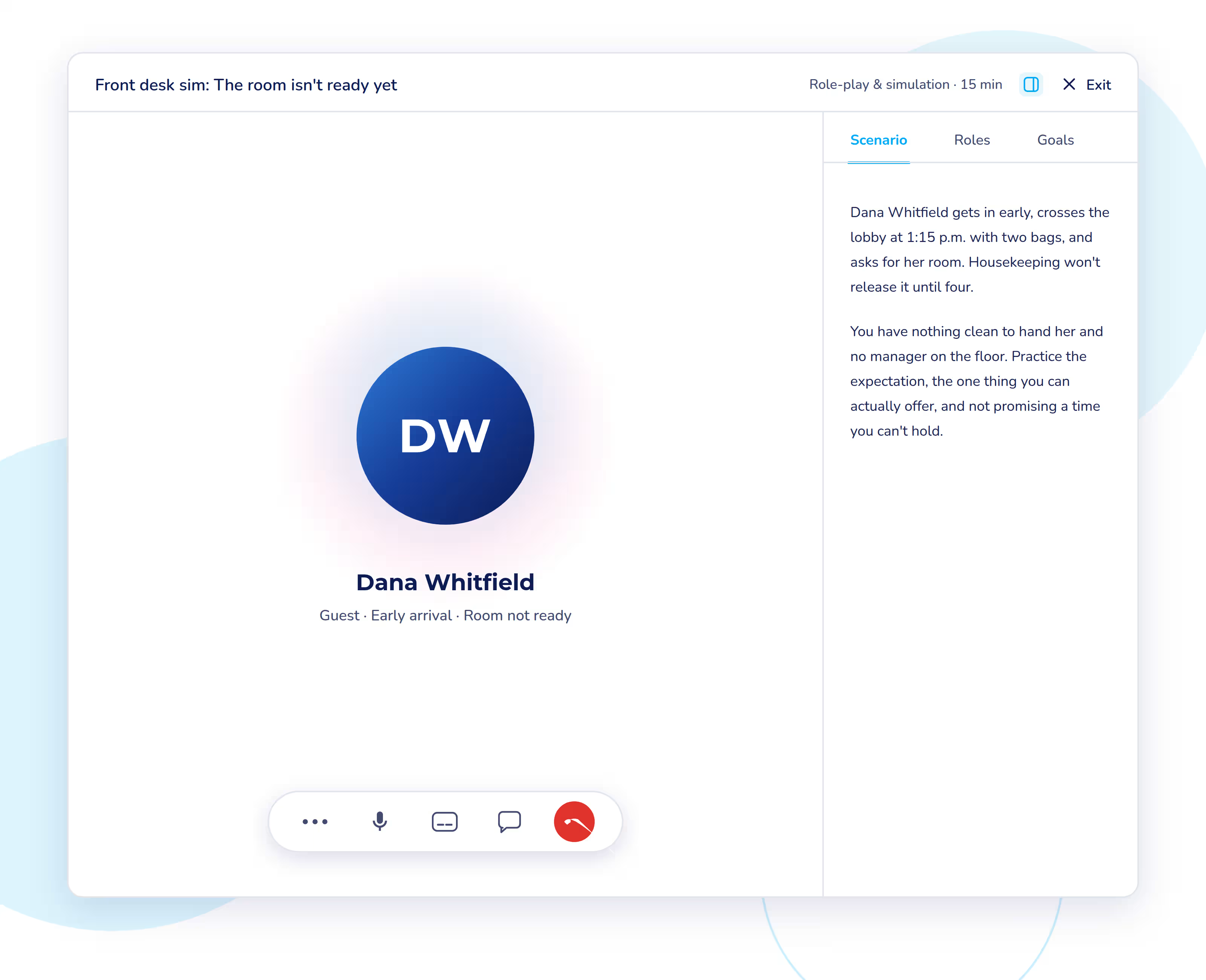
Absorb's Aura Rehearse (coming soon) is agentic ai for hospitality training. It allows for AI-powered roleplay to help staff practice challenging situations before they happen. A quiz can confirm your team knows the return policy, but it can't tell you if they have the muscle memory to use it when a customer's upset, a front desk hotel employee gets push-back on price, or if someone calls the front desk with a complaint. Aura Rehearse lets them roleplay the moment first, in scenarios built from your own training content, then get feedback on what worked and what to try differently.
Does better training reduce hotel staff turnover?
Better training supports staff retention. The strongest evidence so far, though, is about guest experience — turnover itself is harder to prove directly. A Cornell hospitality study found that more intensive front-desk training measurably improved guests' perception of staff helpfulness, a real, verified outcome. It didn't measure whether that same training reduced how often staff quit.
Hospitality's turnover problem is well documented on its own — the industry's overall rate sits near 98 percent. The reasons are familiar — physically demanding work, inconsistent scheduling, and training that leaves new hires unsure how to succeed in their role.
A few training tactics do support retention directly in the first ninety days, when most turnover happens. Give new hires a clear path to their first small win, a shift they complete without help, a guest interaction they handle well. Check in specifically at the two-week and thirty-day marks — a ninety-day review alone comes too late to fix a struggling new hire.
Make sure training doesn't stop after week one. Staff who keep learning something new tend to stay longer than staff whose training ends the day it starts.
What's the bottom line on hotel staff training?
Hotel staff training works when it stops trying to be one program. Front desk, housekeeping, food and beverage, and management each need their own training, built around what that role does every day.
Start with whichever role is causing you the most pain right now, then work outward. Get the fundamentals right in each section above, then build the onboarding, compliance, and measurement habits that keep training from fading after week one. And don't forget new AI-powered frontline training can help with specific scenario rehearsal.
If you're running this across more than one property, or across shifts that rarely overlap, Absorb LMS delivers the same training everywhere, tracks who's trained, and makes it easy to update everyone at once when something changes.