.jpg)


A healthcare certification tracking system needs five capabilities: role- and location-aware expiration tracking, automated renewal reminders, centralized CE and audit documentation, multi-site visibility, and a connection to broader compliance reporting. This is a different job than tracking course completions, since a lapsed license or certification is a distinct, regulator-checked compliance failure.
Why generic training tracking isn't enough for healthcare certifications
Generic training tracking isn't enough for healthcare certifications because a lapsed license or certification is a distinct, regulator-checked compliance failure, not a missing training record. Federal rules require hospitals to have “a procedure to ensure that hospital nursing personnel for whom licensure is required have valid and current licensure,” according to Medicare Conditions of Participation for hospitals.
Course-completion tracking and license or certification tracking aren't the same job. A missed onboarding module is an inconvenience, but a lapsed nursing license or an expired CPR certification is a legal-practice problem.
Note that the search results for this topic often get blurry. Some of what pops up when you search for “healthcare credential management” is about provider credentialing, like verifying a physician's qualifications for hospital privileges or payer enrollment, a specialized process usually run by a hospital's medical staff office.
That's a different job for a different team than tracking certifications, licenses, and continuing education (CE) credits across a broad clinical workforce of nurses, technicians, and clinical staff. If you're managing the latter, that's what this guide covers.
Certification tracking is a step beyond storing training records in a folder. A training record shows someone completed a course once. Certification tracking has to know when that credential expires and whether it's still valid today. If that's missed, at minimum you have a gap in your compliance documentation, but depending on the credential, a staff member could end up practicing without current authorization.
What a healthcare certification tracking system should do
These five capabilities work together as one evaluation framework. If your system only does one or two of them, you have gaps.
Track expiration dates by role, license type, and location
An RN license, a CPR/BLS card, and a specialty certification don't expire on the same schedule, and they don't carry the same renewal requirements. A system that treats all of them as one generic “training due” bucket hides the fact that a specialty credential expiring next month is a very different risk than a course that's just overdue.
Tracking by role and license type also means knowing what's expected at each site: a satellite clinic may require different certifications than the main hospital campus. Getting this right is the foundation of any healthcare credential workflow. A healthcare credential system that can't slice tracking by role, license type, and location isn't solving the problem, no matter how many other features it has.
If the system also verifies that a license or certification is genuine, not just tracking a date, that's a lighter-weight version of primary source verification. It's worth having, but distinct from the full verification process a hospital's medical staff office runs for provider privileging and payer enrollment.
Automate renewal reminders before lapse
License renewal shouldn't depend on memory. Once an organization is tracking dozens of roles, license types, and renewal cycles across multiple sites, a manual reminder system relies on someone remembering to send it, and someone else remembering to read it.
Automated, role-aware expiration alerts solve the “remembering” problem. Alerts go to both the staff member and their manager, timed well before the deadline, not the week of.
The strongest systems pair the alert with the fix. The same platform that flags an expiring credential can hand the person the CE or renewal course itself, so nobody has to go find a separate course somewhere else. That's what separates healthcare certification tracking that just watches the calendar from a system built to close the loop.
When you manage compliance content outside of your LMS, you're taking on an enormous administrative burden that's largely invisible — until something goes wrong. For harassment prevention training alone, there general requirements for both supervisor and employee specific trainings and many state-specific requirements triggered by employee population. This can lead to over 20 course permutations to track, update, and maintain. The integrated approach handles that automatically, preserving audit history throughout. Mike Avery, VP, Product Enablement, Absorb
Centralize continuing education, certificates, and documentation for audits
A healthcare certification tracking system should centralize completion certificates and license documents in one record that's ready to show an auditor on demand. Accreditation bodies already expect this level of documentation. In its laboratory accreditation program, for example, Joint Commission requires organizations to verify credentials with the primary source and document that verification both at hire and at renewal. NCQA takes a similar approach for the organizations it accredits recredentialing every three years, with accredited organizations expected to review a sample of credentialing files as part of ongoing oversight.
When that documentation lives in one place instead of scattered across email and shared drives, audit prep stops being a scramble. The best healthcare certification progress tracking tools treat this kind of record-keeping as core functionality, not an add-on. For a broader look at what compliance reporting should cover beyond certifications, see Absorb's compliance training reporting guide.
Provide multi-site visibility for compliance and HR leaders
Multi-site tracking only earns its name if it shows who's certified, where, and what's expiring when, broken out by role, in one view. Without it, compliance and HR leaders overseeing multiple sites often can't see certification status across locations without checking each site separately. That gap usually surfaces during an audit or an incident, not before one.
Per-site spreadsheets create exactly this kind of blind spot. A credentialing manager can trust that the main campus is covered and still have no idea that a satellite clinic's compliance officer left three months ago, with nobody picking up the renewal tracking since.
Connect certification data to broader compliance reporting
Certification status works best connected to the rest of an organization's compliance reporting, not siloed in a separate system. When it's connected, a credential renewal shows up alongside the rest of the compliance picture, instead of requiring a separate export and a manual cross-check.
This capability supports the broader compliance picture. It's not the core job of a certification tracking system on its own. For the deeper mechanics of healthcare regulatory compliance, HIPAA, and accreditation tracking, see our guide to healthcare compliance training. For the general mechanics of certification tracking outside a healthcare context, see our certification tracking best practices guide. If you're also evaluating broader training tracking software beyond certifications specifically, our training tracking software guide covers general evaluation criteria.
Is your certification tracking audit-ready?
Use this checklist to evaluate your current healthcare credential management program, or a shortlist of healthcare certification progress tracking tools you're considering, against the five capabilities above.
- Does tracking account for different roles, license types, and renewal cycles, rather than one generic bucket?
- Do renewal reminders go out automatically, to both staff and managers, well before the deadline?
- Can the same system also deliver the CE or renewal training itself, not just flag that it's due?
- Are CE credits, certificates, and license documents centralized in one searchable record?
- Can you see certification status across every site and shift, not just the location you're standing in?
If you answered no to two or more of these, your current approach likely has blind spots, and that's common, not a sign you've been doing this wrong. Most organizations have gaps. Start with whichever answer worried you most.
From spreadsheets to systems
A spreadsheet can list every certification your staff holds. But it can't automatically tell you the moment one is about to lapse at a site you're not currently looking at, and it can't hand that staff member the course they need to renew it. A connected system does both, tracking status and delivering the training that keeps it current, in the same place.
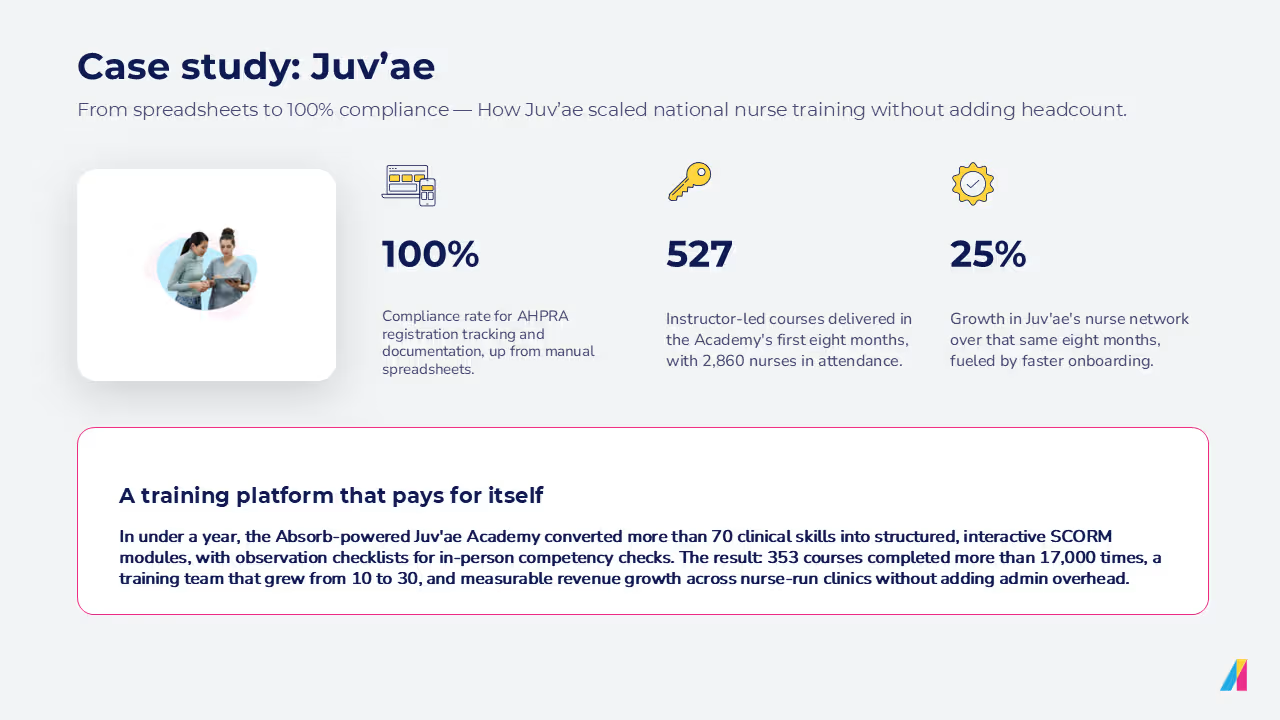
Case study: Juv’ae Academy
Juv'ae Academy needed a way to train hundreds of nurses without diluting quality or compliance standards. With Absorb:
- 460+ nurses trained under one consistent standard: Juv'ae Academy scaled clinical training and compliance across a fast-growing network on Absorb LMS, without cutting corners on quality.
- Training that doubles as a business plan: Juv'ae paired regulatory education with business-building content on Absorb, arming nurses to grow their practices ethically and with confidence.
- 2025 Absorbies winner: Customer Education Program of the Year, recognized for measurable results, inclusive design, and a customer education strategy other L&D teams will want to steal.
Absorb LMS for halthcare tracks certification and license status by role and location, and delivers the renewal training itself in the same platform. See how Absorb LMS tracks every credential by role and location, and delivers the renewal training in the same platform.