.jpg)

Healthcare compliance training teaches your staff the rules that keep patient care, billing, and data handling on the right side of the law. Any organization billing federal healthcare programs or handling protected health information needs it, and the bar barely moves whether you're running a single clinic or coordinating training across a dozen hospital campuses. The seven elements of an effective compliance program, covered below, show where training fits and what it needs to cover.
Key takeaways
- Healthcare compliance training goes beyond HIPAA to cover OSHA, CMS, and the other rules that apply to your operations.
- An effective program rests on seven elements, per OIG's General Compliance Program Guidance, and nearly all of them depend on training to work.
- HIPAA, OSHA, and CMS each set their own training obligation, with different scope and cadence — know which applies to your organization.
What counts as healthcare compliance training?
Healthcare compliance training teaches staff the laws and regulations that apply to their jobs. HIPAA training covers patient privacy and data security. Healthcare compliance training adds OSHA's workplace safety rules, CMS's program requirements, and anything else that touches your operations and payer relationships.
Skip it, and you're exposed. HHS's Office for Civil Rights has fielded more than 374,000 HIPAA complaints since 2003, according to its latest enforcement update. It has settled or fined 152 cases for a combined $144.9 million. An organization with no training record can't prove to a regulator, or its own board, that staff ever knew the rules they're accused of breaking. That shortfall surfaces fastest during an audit or an incident investigation, when "we have a policy" isn't enough without proof someone was trained on it.
A compliance officer usually owns responsibility for healthcare compliance on paper. Delivering the training, though, falls to whoever's closest to staff day to day, whether that's HR, a department manager, or whoever runs the learning platform.
Health industry compliance case study
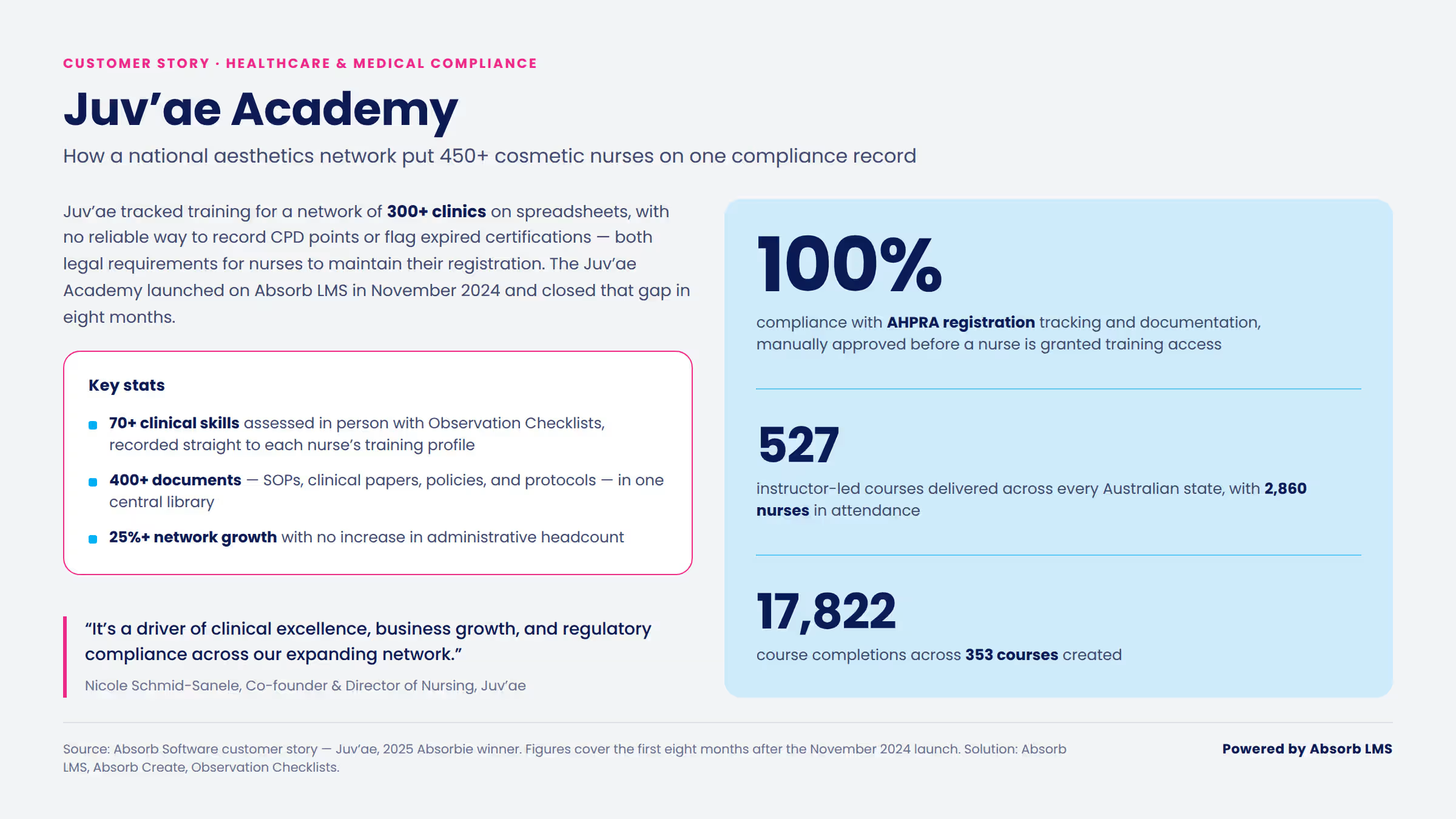
When Juv'ae had a compliance challenge, they used Absorb. Check out the full case study.
What are the 7 elements of healthcare compliance?
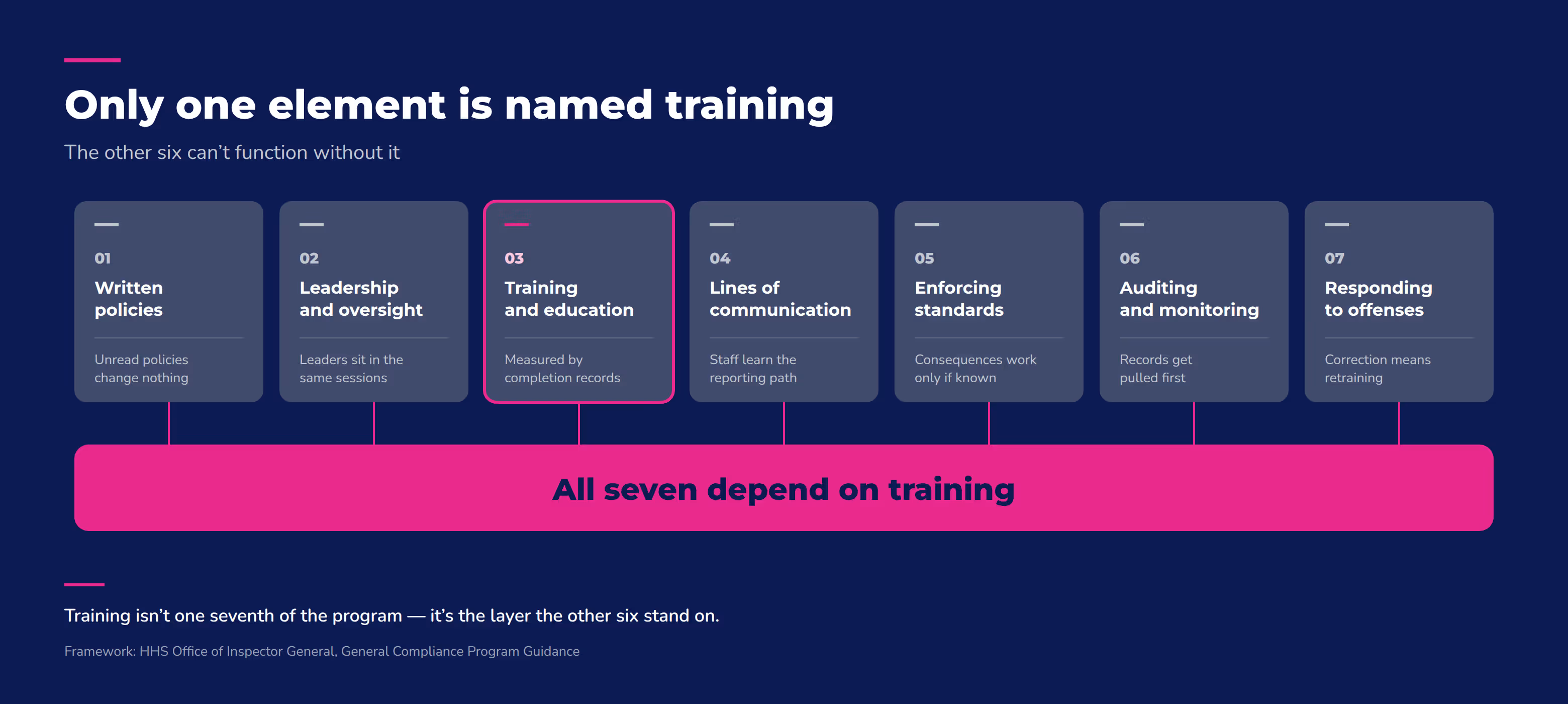
OIG's General Compliance Program Guidance lists seven elements of an effective compliance program: written policies and procedures; compliance leadership and oversight; training and education; open lines of communication; enforcing standards; risk assessment, auditing, and monitoring; and responding to detected offenses. The guidance is voluntary, so treat it as the benchmark for a strong program. Training and education is one of the seven by name, and nearly all of the others depend on it to work.
Element | What it means | Training implication |
|---|---|---|
Written policies and procedures | The rules your organization commits to following | Staff need hands-on training on the policy, the kind that goes beyond a copy sitting in a shared drive |
Compliance leadership and oversight | Someone owns the program and reports on it | This training reaches leaders and managers as much as it reaches frontline staff |
Training and education | Staff understand the rules that apply to their job | Completion and renewal rates measure this element most directly |
Open lines of communication | Staff can report concerns to the compliance officer, anonymously if needed, without fear of retaliation | Training needs to teach staff exactly how and when to use that channel |
Enforcing standards | The organization applies consequences and incentives consistently | Staff need to know what happens if they skip required training |
Risk assessment, auditing, and monitoring | The organization checks whether the program is working | Training-completion records are usually the first thing an audit pulls |
Responding to detected offenses | Problems get corrected out in the open | Corrective action often means retraining, which only works if the organization documented the training the first time |
None of these seven elements treat training as a once-and-done task. Most organizations renew it annually and retrain the moment a policy shifts or an incident exposes a weak spot.
What regulations require healthcare compliance training?
HIPAA, OSHA, and CMS each carry their own compliance training obligation for healthcare organizations, and no two look exactly alike.
The HIPAA Privacy Rule requires covered entities to train their workforce on policies for protected health information. New staff need that training within a reasonable time after they join. When a policy changes in a material way, the staff whose jobs it affects need retraining.
The Security Rule adds a separate requirement: a security awareness and training program for the whole workforce, management included. Covered entities also have to document that training happened. That record is what an auditor will ask to see.
OSHA's Bloodborne Pathogens Standard takes a different angle. Training happens the moment someone's assigned a task with occupational exposure risk, then at least once a year after that.
CMS sets its own compliance training rule for Medicare Advantage organizations. If you operate an MA plan, your compliance officer, employees, senior leaders, managers, and governing body members need training at orientation and at least once a year after that. If you don't operate one, this rule doesn't apply to you.
These are the baseline federal rules, not a full compliance calendar. State laws, accreditation standards, and your specific payer contracts can all add requirements on top of them, so use this as a starting point and confirm specifics with your own compliance or legal team.
.avif)
How do you choose the right way to deliver healthcare compliance training?
Healthcare organizations usually deliver compliance training through a learning management system or through courses bought one at a time. The right fit depends on how many roles and locations you manage.
A learning management system suits most mid-size and large healthcare organizations. You assign courses by role, track who's finished what, and pull a report when an auditor asks. Buyers often search for it as healthcare compliance training software, and it handles the training side of compliance, while policy management, incident reporting, and exclusion screening usually need separate tools. Cost is usually the first thing buyers compare, but the bigger number is what a gap in training costs later.
When it comes to compliance training the risk of falling behind isn't linear, it's exponential. The per-learner cost of keeping your compliance training current might feel like a significant line item, but it only takes one workplace safety incident or a single HR lawsuit to dwarf that investment many times over. The cost of noncompliance is dramatically higher than the cost of maintaining it.
— Mike Avery, Absorb's VP of Product Enablement
A course-shop model, where you buy individual training modules one at a time, suits a small organization with simple, steady requirements just fine. Add more roles, locations, or regulation changes, though, and it gets unwieldy fast. There's no central place to see what you've assigned or who's finished it.
Individual certifications, like the credentials in the FAQ below, are a separate path. They build one person's expertise and don't replace organization-wide training.
Price matters, of course. But what matters more is whether the tool can track and report training the way your audits require.
How do you keep healthcare compliance training audit-ready?
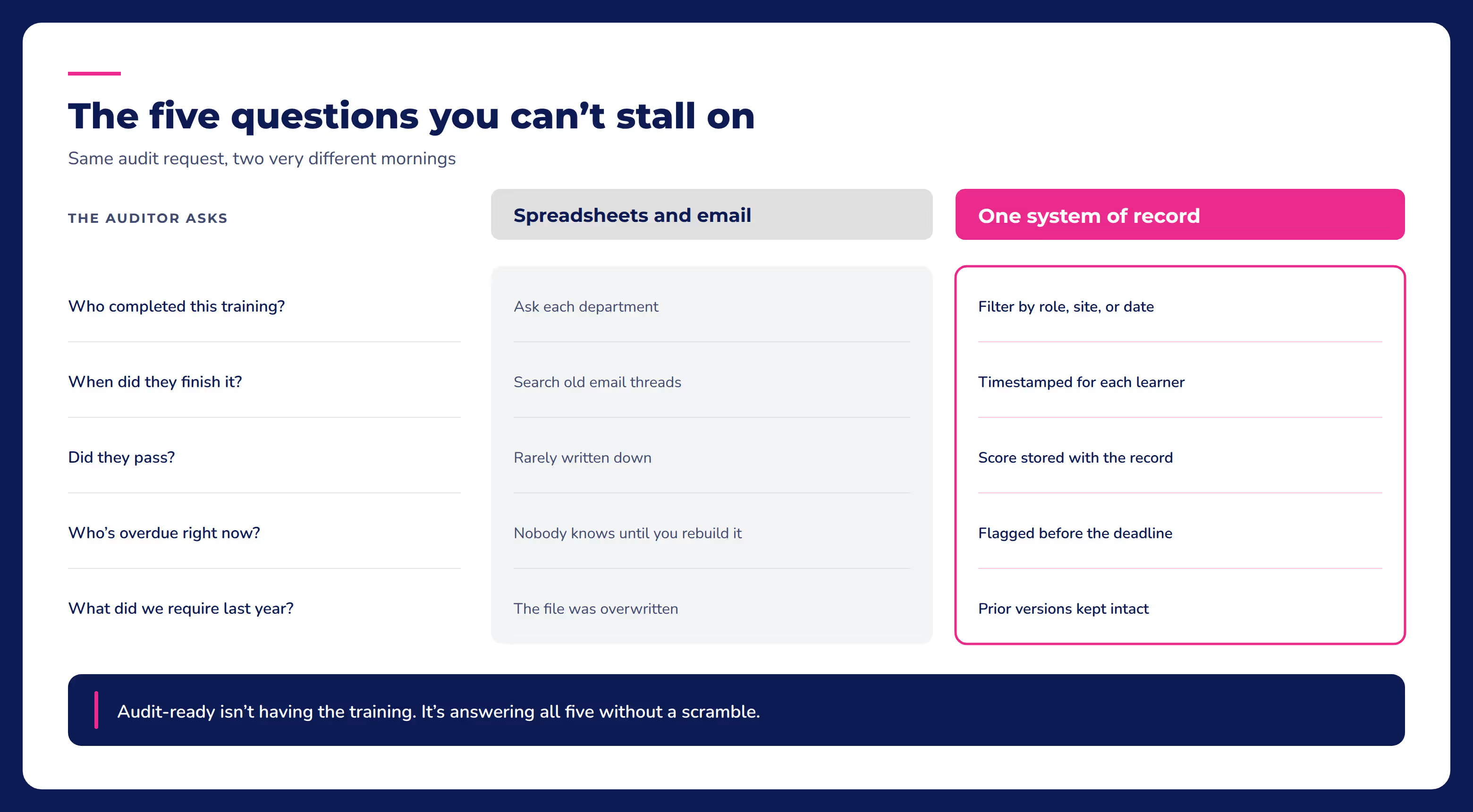
Staying audit-ready means naming, on demand, exactly who completed which training, when, and whether they passed, instead of assuming most people probably did.
More locations and role types make that harder. A hospital system with a dozen sites, and a mix of clinical, administrative, and contract staff, can't run on one department's hand-updated spreadsheet — it needs a single place that shows training status across everything. If separate spreadsheets are how you're piecing that together right now, that's your cue to automate it.
"When auditors come in and different departments are all speaking the same language, using the same risk definitions, the same metrics, the same reporting formats, that unified picture is a significant advantage. It signals that compliance training is embedded across the organization, not siloed in one team. Standardized, centralized, and traceable: that's what audit-ready looks like."— Ify Anazia, Absorb's Senior GRC Analyst
An LMS is built to do that. Absorb LMS assigns compliance training by role and location, tracks completion automatically, and pulls together the reports compliance officers need during an audit, without anyone chasing status updates over email. The same audit-readiness principle extends to credentials and certifications that expire on their own schedule, not just completed courses.
What's the takeaway on healthcare compliance training?
Healthcare compliance training works when it's built around the seven elements regulators look for, backed by the rules that apply to your organization, and documented well enough to prove it happened. That documentation is what turns "we trained everyone" from a talking point into something you can show an auditor.
Start by checking your current training records against the seven elements above. Whatever's missing there is exactly what an audit will find too. Absorb LMS assigns that training by role and location and keeps the records ready before anyone asks for them, so adding more roles and locations doesn't mean a bigger scramble to prove it.