


Gamifying your LMS makes training something people want to come back to. Badges, points, and leaderboards turn a list of required courses into progress people can see. Those elements can boost everything from onboarding to day-to-day engagement.
More organizations are adding game elements across the workplace, and the LMS is a natural place to start. Here's why gamification works, the five benefits it brings, and the game elements worth adding first.
What's gamification in the workplace?
Gamification means adding game-like elements to settings that aren't games, such as websites, online communities, and learning management systems. The goal is engagement, to give people a visible reason to take the next step.
It works, though not by magic. A meta-analysis of gamification research found small but significant positive effects on learning, motivation, and learner behavior. The effect on learning held up even in the most rigorous studies.
As gamification keeps engaging and motivating employees, it will keep spreading across organizations. That means better employee learning and training and, in turn, better business results.
Why does gamification matter for eLearning?
Gamification matters because eLearning is now how much of workplace training happens, and game elements make it stickier. New technology and the shift to hybrid and remote work made eLearning essential, and budgets reflect it. U.S. organizations spent $102.8 billion on training in 2025, and spending on outside products and services jumped 29%.
More organizations now use eLearning and an LMS to make training work for employees, whether they're remote, hybrid, or on-site. As eLearning grows, so does the opportunity to benefit from gamification.
Self-paced courses don't come with a trainer at the front of the room keeping the energy up. Game elements fill part of that gap with a visible goal and a reason to finish. That's why gamification is fast becoming a standard part of eLearning, helping employees get the most out of the courses you've already built.
What are the benefits of LMS gamification?
Gamifying your LMS brings five main benefits: smoother onboarding, friendly competition, better tracking, higher engagement, and a better learning experience overall. Here's what each looks like in practice and what to measure.
Benefit | What it looks like in your LMS | What to track |
|---|---|---|
Smoother onboarding | Points and badges for each onboarding milestone | How long new hires take to finish onboarding |
Friendly competition | Leaderboards by team, branch, or region | Active learners and course starts |
Better tracking | Points tied to specific criteria | Progress by learner and by team |
Higher engagement | Rewards that give people a reason to log back in | Completion rates and voluntary enrollments |
Better learning experience | Visible progress toward a goal | Learner feedback and survey scores |
- Improving your onboarding process. Hybrid and remote work mean a traditional first-week orientation may no longer be enough. More organizations now use digital onboarding tools, like an LMS, with gamification built in. Gamified onboarding works well in flexible work environments and can help with knowledge transfer, retention, and productivity. For ideas, see how gamification makes employee onboarding more effective.
- Sparking friendly competition. Leaderboards, badges, achievements, and points keep team members engaged and productive while motivating them to keep pace with high-performing coworkers. Few things get a sales team through a product course faster than seeing a rival two spots ahead.
- Improving your tracking. An effective LMS tracks each learner's activity and progress, so you get useful data without chasing anyone for updates. LMS reporting and analytics give you clearer oversight of each employee's progress and development.
- Increasing employee engagement. This may be the biggest benefit of all. Workplace training can get repetitive, and people retain less from a course that bores them. With gamified systems in place, employees can learn and retain information more effectively.
- Improving the learning experience. Employees value chances to learn at work and grow their careers, but many organizations don't give them a clear path. In a 2020 CIPD survey of UK organizations, only 29% said their employees had clear learning and development plans in place. Pairing your LMS with gamification is an effective way to upgrade your training and the overall learning experience for your team.
Which gamification methods work best in an LMS?
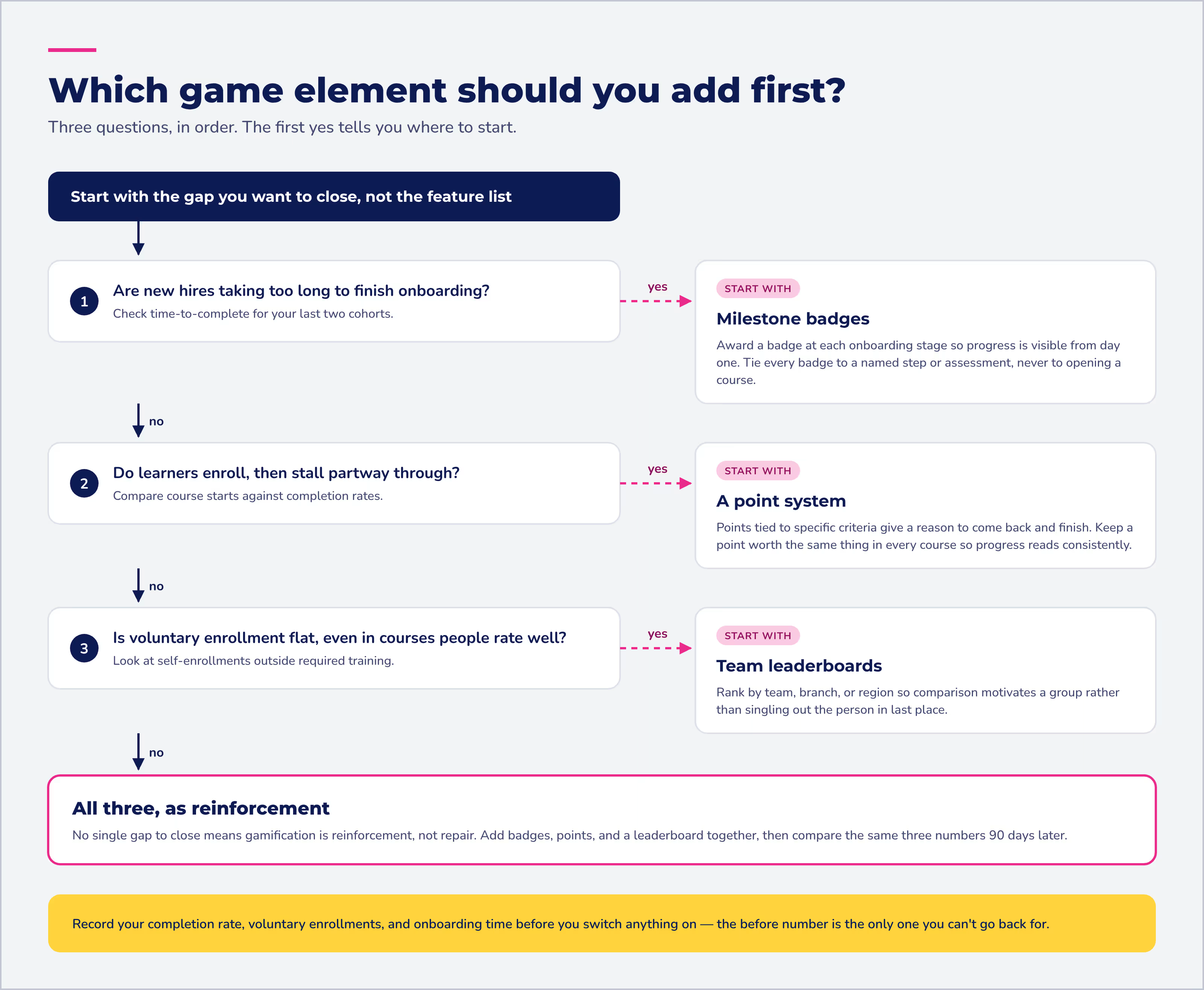
Badges, points, and leaderboards are the most common game elements, and the easiest to start with. Here's how each one works. For more ideas, see these LMS gamification examples and best practices.
Badges
Badges are rewards that represent a learner's achievement. You can brand them with your company's look or keep them as simple, eye-catching symbols of a mastered skill. Nobody needs a trophy for opening a course, but a badge for passing the forklift safety assessment is worth showing off.
Badges reward your workforce, and people can share them on your company's social platforms, too.
Points
A point system in your LMS helps you track learning progress over time. Use consistent points tied to specific criteria, so a point always means the same thing. Awarding points motivates team members and gives your organization useful feedback along the way.
Leaderboards
Leaderboards drive motivation, engagement, and productivity. Learners can see how their progress compares with other people in their workplace or region, which motivates team members who want to stay at peak performance and keep pace with high-achieving coworkers.
In Absorb LMS, the Absorb Engage option adds LMS gamification and social tools like leaderboards, polls, and discussion forums to your training portal.
Is gamification the future of workplace learning?
Yes. As more businesses see what a gamified LMS can do, the industry keeps growing. Here are some of the major gamification trends to expect in the coming years:
- More businesses using gamified methods for recruiting and training
- Better data and reporting for the organizations that use them
- Continued growth in market size
Mordor Intelligence estimates the global gamification market will grow from $36.46 billion in 2026 to $112.32 billion by 2031.
Together, an LMS and gamification can help your business improve employee learning and training. They can take your organization's engagement and productivity to the next level, and better business outcomes tend to follow.
Frequently asked questions about LMS gamification benefits
What are the benefits of gamification in an LMS?
The main benefits of LMS gamification are smoother onboarding, friendly competition, better tracking of learner progress, higher engagement, and a better overall learning experience.
What does LMS mean in video games?
In gaming, LMS usually stands for "last man standing," a mode where players compete until only one is left. In training, LMS means learning management system, the software that delivers and tracks courses. Gamifying your LMS borrows the competitive spark and skips the elimination round.
What are some examples of an LMS?
Absorb LMS is one example of a learning management system that supports gamification, including leaderboards through Absorb Engage. For more, see these learning manaement system examples and what each is used for.
How do you know if LMS gamification is working?
Compare your numbers before and after you add game elements. Watch completion rates, voluntary enrollments, and how long new hires take to finish onboarding. If those improve and learner feedback stays positive, it's working.
If your organization is ready to make training more engaging, see Absorb LMS in action.