


The best succession plans pick future leaders based on proof they're ready, not on who's been around longest. Your learning management system already collects that proof, and its reporting tools let you evaluate skills, track next-level training, and assess management expertise. Then the right person is ready when a key role opens.
Bench players in sports are often stars waiting for their chance. Your organization has a bench too, and you'll need it when key talent leaves. LMS data shows you who's warming up and who's ready to play.
What are the best practices for succession planning?
Succession planning comes down to three practices: evaluate skills, provide next-level training, and assess management expertise. Each one runs on data your LMS already tracks.
Best practice | What you do | LMS data to check | What it tells you |
|---|---|---|---|
Evaluate and expand skills | Define what a successful leader looks like, then map those skills, behaviors, and traits to training | Completions against the courses mapped to leadership skills | Your bench strength: who's already eligible and who has gaps |
Provide next-level training | Run a leadership development program, and require key courses before promotion when a gap persists | Each candidate's progress in assigned courses | How close each person is to ready |
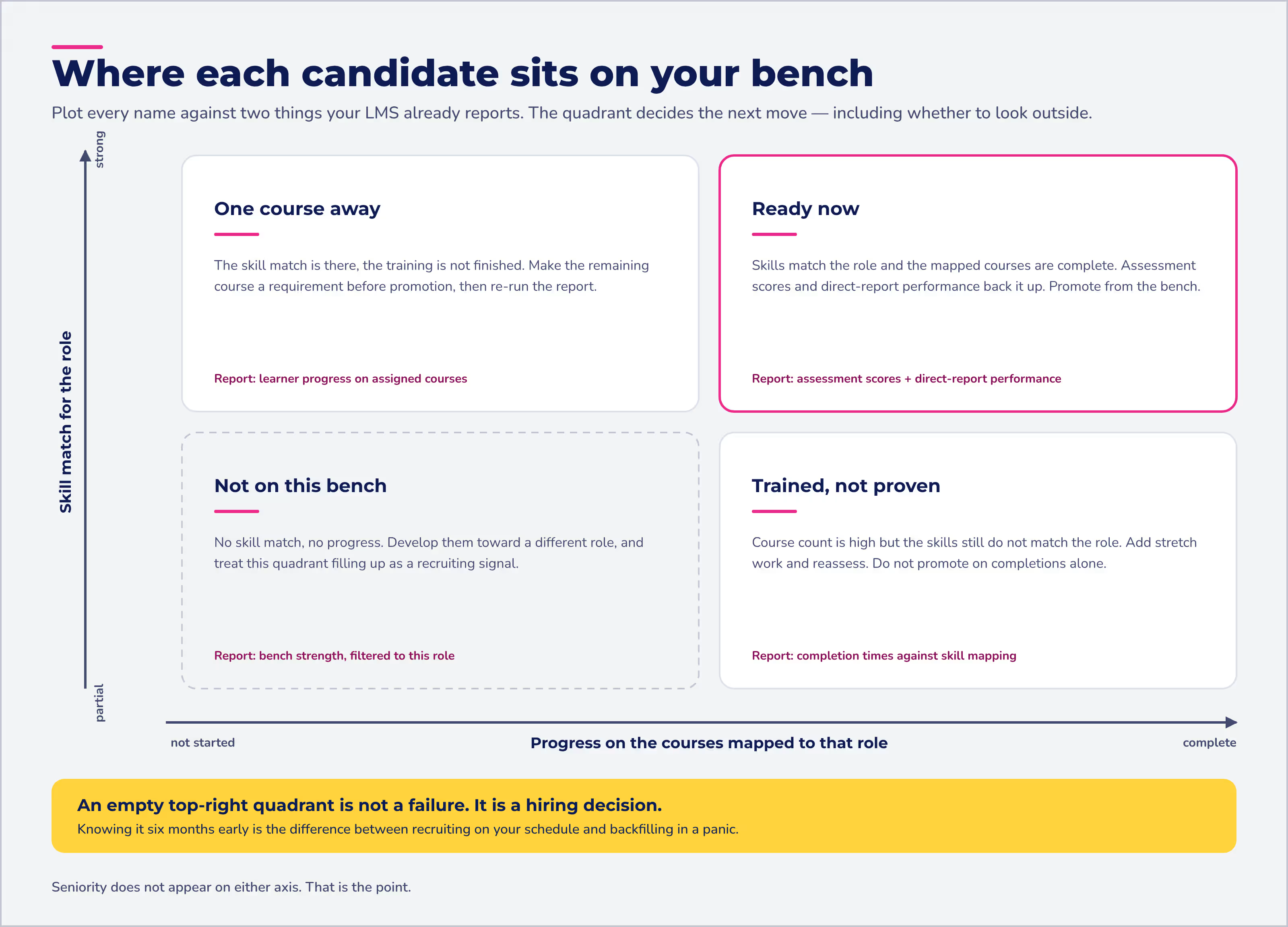
Assess management expertise | Add objective measures to word-of-mouth opinions | Completion times, learner progress, assessment scores, and how a manager's direct reports perform | Who's ready to lead, and who's building a bench of their own |
How do you evaluate leadership skills for succession planning?
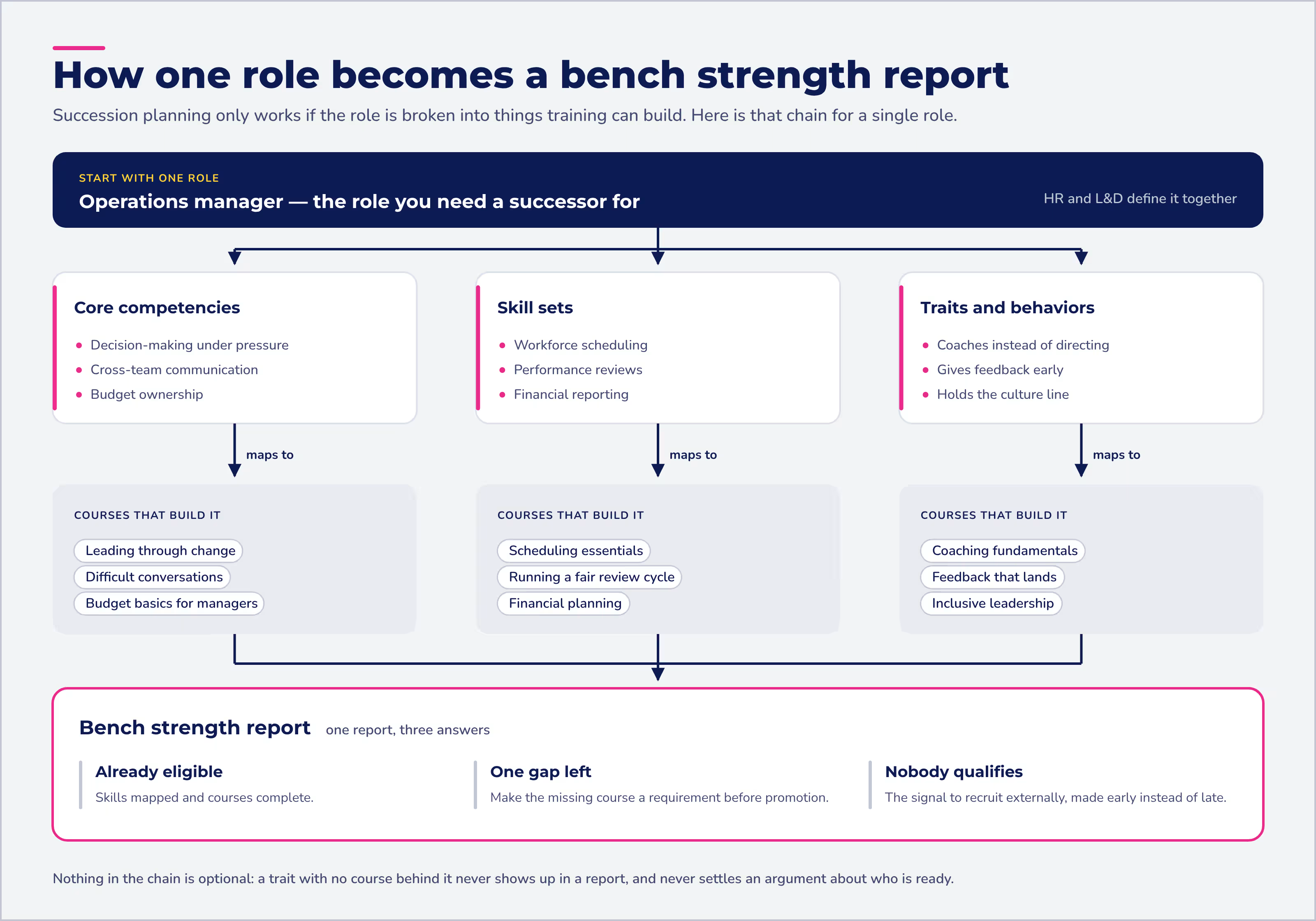
Start by agreeing on what a successful leader looks like in your organization. HR and L&D should define it together, then use LMS reports to see who already measures up.
Cover these areas:
- The job description and core competencies for the role
- The skill sets the role requires
- The personality traits and behaviors that support your organizational culture
Once you've defined them, map each one to the training that builds it. Then run reports on your bench strength to see who may already be eligible for a leadership role.
From there, your L&D team can fill a vacancy from existing talent. Or it can build a plan so future leaders get the knowledge they need before the role opens.
How do you prepare employees for their next role?
Give high-potential employees training built for the job they're moving into. Many organizations do this with a dedicated leadership development program.
A program for up-and-coming leaders might cover:
- Management
- Employee engagement
- Financial planning
When a skills gap persists, make specific courses a requirement before promotion. An employee development LMS lets you assign that training and track each person's progress and readiness for the next role.
How do you know if someone is ready for a leadership role?
Look at their training data alongside what managers say about them. Plenty of organizations pick leaders by word of mouth. One manager calls an employee a "natural leader," and everyone agrees someone else is the "strongest manager" in operations.
LMS analytics with Absorb Analyze give you an objective measure to put next to those opinions. LMS reports can show:
- Completion times
- Learner progress
- Assessment scores
- How well a manager's direct reports perform in assigned courses
That last one also tells you whether a manager is building a strong bench of their own: people on their team who are ready for promotion.
What if no one's ready for the role?
Then you recruit from outside, and the data makes that an easy call. When leaders across the company can see who's coming up through the ranks, they know whether to promote from the bench or hire.
Frequently asked questions
Why does succession planning matter for a business?
It keeps the business running when a key leader leaves. Having a successor lined up for critical roles helps an organization maintain continuity during leadership transitions.
Should seniority decide who gets promoted?
No, seniority alone isn't enough. Filling a leadership gap well means choosing the person whose skills, training, and track record show they're ready, and that's not always the person who's been there longest.
Can you give me an example of a succession plan?
For a manager role, HR and L&D define the skills, behaviors, and traits the role needs, map them to courses, and run a bench strength report. Two high-potential employees join a leadership development program, with a financial planning course required before promotion. When the role opens, leaders compare both candidates' assessment scores and how their own teams perform.