




The business case for diversity training holds up when the training builds specific workplace skills, treats every employee the same way, and gets measured on behavior instead of completions.
The usual pitch for the benefits of diversity training in the workplace is a list of good outcomes plus a McKinsey stat. It works until a CFO asks, "Does the training cause any of that?" or legal asks, "Who reviewed this?" If you're the HR, L&D, or compliance leader making the case to leadership, you need a version that survives both questions.
No matter the subject, training that doesn't produce lasting results is often one-off, mandatory, or a check-the-box session. There's always a strong case for training people to work well with everyone.
What are the benefits of diversity training in the workplace?
The benefits of diversity training in the workplace are real but conditional. In research settings, well-designed training has changed how people think about and treat others for months. It also supports goals every employer shares: respectful conduct, harassment prevention, collaboration, and retention.
Most of those business outcomes are plausible rather than proven for training itself. The biggest claims, like higher revenue and more innovation, come from studies of diverse teams, not studies of training.
The best direct evidence comes from two experiments with college students, where perspective-taking and goal-setting exercises had effects months later. Harassment prevention rests on expected practice: the EEOC treats prevention as the best tool against harassment and recommends training. Retention matters because turnover is expensive, with replacing an employee costing one-half to two times their salary, though that's the cost of the problem, not proof training fixes it.
Here's how the common benefits stack up:
Benefit | What the evidence shows | Strength |
|---|---|---|
Better attitudes and behavior toward colleagues | Perspective-taking and goal-setting exercises had effects months later in two experiments with college students | Research-backed, with limits |
Harassment prevention and respectful conduct | The EEOC recommends prevention training, and California and New York require it | Expected practice, not proven to cut incidents |
Stronger managers and better collaboration | No direct study of training's effect in our sources | Plausible, not proven |
Retention | Turnover is costly, but no source shows training reduces it | Plausible, not proven |
Innovation and financial performance | Companies with the most diverse executive teams are more likely to outperform | Correlational, about teams |
The McKinsey finding behind that last row gets stretched the most. Companies with the most diverse executive teams had a 39 percent greater likelihood of outperforming the least diverse. That's about who sits on the leadership team, not about whether anyone took a training course. Use it to explain why inclusion matters, not as proof of training ROI. Different points of view lead to different questions and different questions can uncover issues that a team didn't notice before.
A strong business case leads with benefits you can measure in your own organization. Behavior, complaint trends, and retention on specific teams will hold up in a budget meeting.
Does diversity training work?
Diversity training works under specific conditions. One-off, mandatory awareness sessions tend to produce short-lived effects. Skill-building exercises have shown effects lasting months in small experiments. When training is built as an event, not a habit, the results aren't strong.
Spending on diversity training has run ahead of the proof. A major review in the Annual Review of Psychology found that investment has "outpaced the available evidence" that the programs work. The authors, Patricia Devine and Tory Ash, reviewed hundreds of studies and flagged "an overreliance on surrogate and individual-level measures." In plain terms, many studies measured how people felt right after a session, not how they behaved later.
Short sessions also fade fast. Sociologists Frank Dobbin and Alexandra Kalev found the positive effects of diversity training “rarely last beyond a day or two.” They also found that voluntary programs tended to do better than required ones.
What does research say improves results?
Perspective-taking and goal-setting are exercises that have good results. In perspective-taking, participants write a few sentences imagining the challenges someone from a different group might face. In goal-setting, they set specific goals for inclusive behavior.
Both exercises had effects that lasted months in experiments with college students. Perspective-taking improved attitudes measured eight months later. Goal-setting led to more supportive behavior after three months and better attitudes after nine.
The evidence base is small, and neither experiment tested a workplace program so treat these findings as design guidance to test in your own organization, not a guaranteed result. Practice specific skills, keep at it, and measure what changes.
Why do employees push back on diversity training?
Employees push back on diversity training most when it's mandatory, one-off, and framed around blame instead of skills. Research shows those designs can produce resistance and short-lived effects. Voluntary or well-framed, skill-based programs tend to fare better.
Most backlash against diversity training traces back to how it's delivered. A once-a-year video with a quiz at the end tells employees it's a superficial exercise.
Diversity training can backfire under those conditions. Sociologists Frank Dobbin and Alexandra Kalev found that compulsory programs often provoke resistance, while voluntary ones did better.
The best training teaches a usable skill, includes everyone in the same room, and continues after the first session.
How do you build a business case for diversity training?
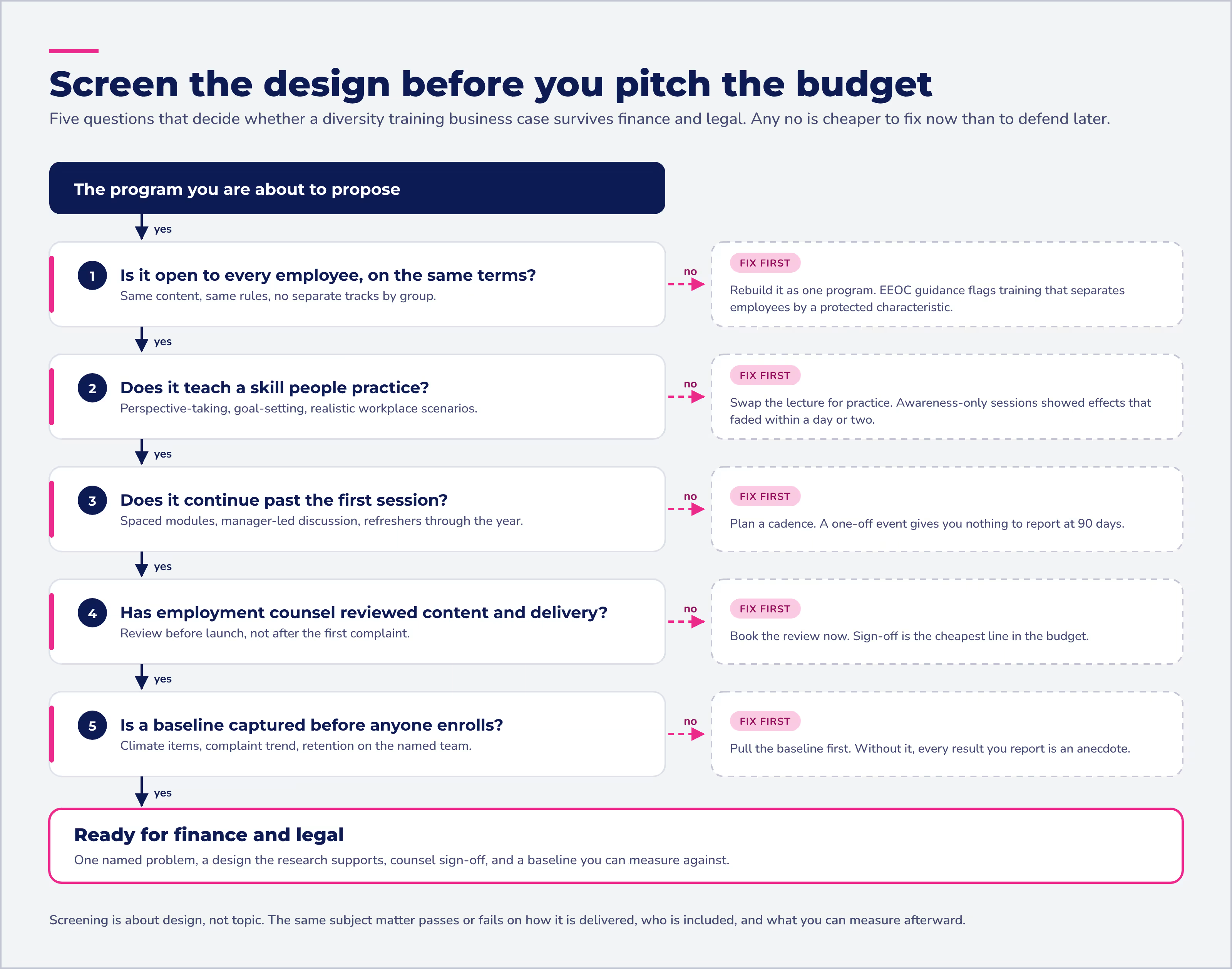
Build a business case for diversity training in six steps. Name a specific business problem, put a cost on doing nothing, define a program the research supports, have counsel review it, set behavior-based metrics with a baseline, and commit to a budget and reporting schedule.
- Name the business problem. Pick something concrete, like manager turnover in one region, rising complaints, or friction between two teams. "Be more inclusive" isn't a problem statement.
- Put a cost on doing nothing. Use your own turnover, investigation, and productivity numbers. As a benchmark, replacing an employee can cost one-half to two times their annual salary, according to Gallup's 2019 research.
- Define the program. Target the audience by role, not demographic, and keep it open to everyone. Plan ongoing learning with skill practice and manager follow-up, not a single session.
- Add a review checkpoint. Have employment counsel review content and delivery before launch.
- Set metrics and a baseline. Choose three or four measures, like assessment scores, climate survey items, complaint trends, and retention by team. Capture them before launch.
- Set the budget and reporting schedule. Count content, employee time, and platform costs. Report results at 90 days, six months, and one year.
If your training already runs in an LMS, much of the baseline in step 5 is a report you can pull today.
Use this template to turn those steps into a document leadership can approve:
Business case section | What to include | Example |
|---|---|---|
Problem | One specific, measurable issue | Manager turnover in the Midwest region is above the company average |
Cost of inaction | Your numbers plus one benchmark | Replacement costs, open-role time, investigation hours |
Program design | Audience, format, length, follow-up | All people managers, quarterly modules plus team discussions |
Counsel review | Who reviews, and when | Employment counsel signs off before launch |
Metrics | Three or four measures with a baseline | Assessment scores, climate survey items, regional turnover |
Budget and reporting | Total cost and review dates | Cost per manager; reports at 90 days, six months, one year |
If finance asks for ROI, show your baseline and how you'll compare results at 90 days, six months, and one year. A one-off session rarely provides that evidence.
What makes a diversity training program effective?
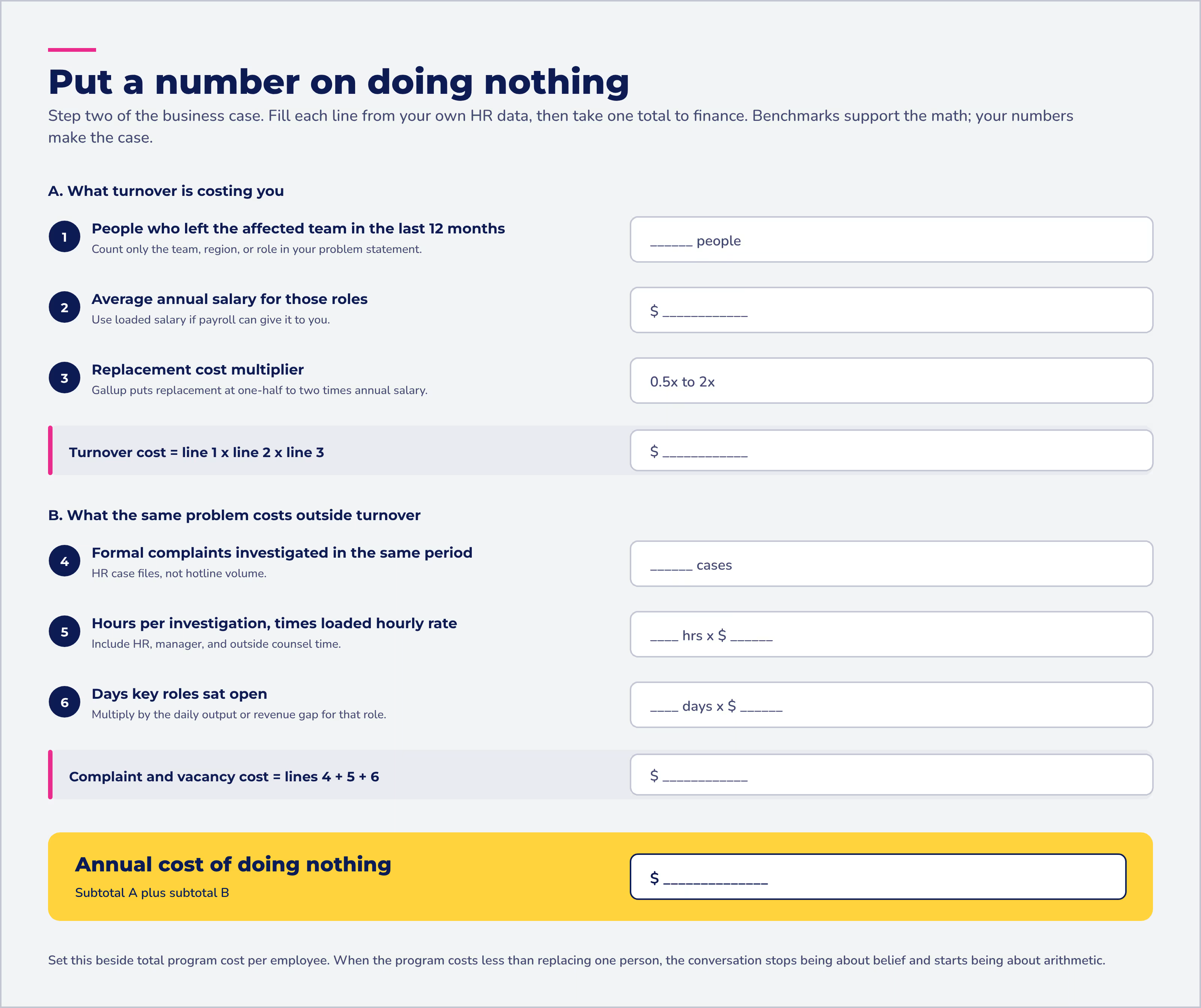
Effective diversity training programs run as ongoing learning, not a single session. They teach specific skills, involve managers, include everyone together, and connect to everyday practices like mentoring and fair processes.
Build these elements into the program design:
- Sustained over time. Plan short, spaced sessions instead of a single annual event, since research shows one-time effects can fade within days.
- Skill practice. Use perspective-taking, goal-setting, and realistic workplace scenarios instead of awareness lectures.
- Manager reinforcement. Managers discuss the material with their teams and model it.
- Open to and required of everyone equally. No separate tracks by demographic group.
- Mentoring open to all employees. Pair learning with ongoing support.
- Tied to real policies. Connect each module to your actual conduct and complaint policies.
Labels like "inclusion training," "diversity and inclusion training," and "DEI training" overlap. The design matters more than the name.
How should you review an existing program?
Review an existing diversity training program against a short list of checks before the next cycle:
- Keep every session open to all employees, and train people together
- Focus content on workplace behavior, not group blame, stereotypes, or required statements about personal bias
- Apply participation rules and consequences the same way to everyone
- Check any contract or state requirements that apply to your organization
- Have employment counsel review materials before launch
- Keep records of what was taught and who attended
Should diversity training be one session or an ongoing program?
Diversity training should be an ongoing program. Research finds the effects of single sessions rarely last beyond a day or two, while skill-based exercises have shown effects months later in small experiments. An ongoing program also gives you more points to measure whether it's working.
How do you roll it out across locations and roles?
Roll it out with an LMS that can target, schedule, and track training for every group. In Absorb LMS, you can:
- Build learning paths and set recurring assignments so training continues through the year
- Use enrollment rules to assign courses by role, location, or manager level
- Track instructor-led sessions alongside online modules, so in-person workshops count too and you can see what each learner has completed and where skill gaps remain
- Pull from content libraries, including Ryley Learning content on diversity and inclusion, then add assessments and surveys to check understanding
- Invite stakeholders from across your business to help curate content and share their perspective in the LMS
Give managers their own track on how to run team discussions and respond to concerns, and use social learning features to facilitate interaction between sessions, so learners can connect and share their stories.
How do you measure diversity training ROI?
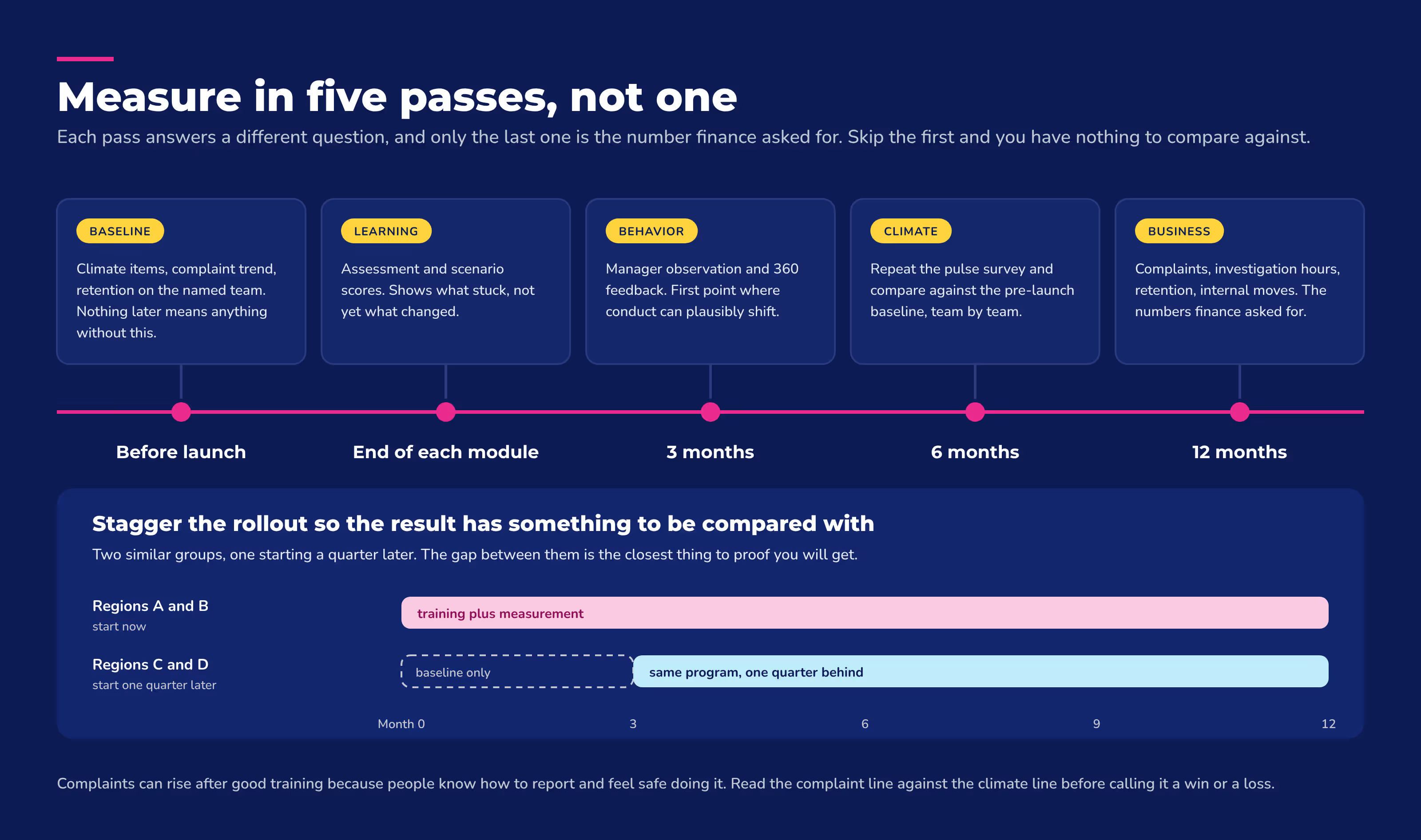
Measure diversity training ROI on behavior and business outcomes, not completion rates. Track knowledge checks, observed behavior, team climate survey scores, complaint and investigation trends, and retention against a baseline you set before launch.
Behavior metrics matter because many diversity training studies relied on what researchers Patricia Devine and Tory Ash called surrogate measures, like how people felt right after a session. Your business case needs more than that.
This framework is adapted from the Kirkpatrick model's four levels:
Level | Metric | How to collect | When |
|---|---|---|---|
Participation | Enrollment and completion | LMS reports | Ongoing (baseline only) |
Learning | Assessment scores | Quizzes and scenario checks | End of each module |
Behavior | Observed conduct | Manager observation, 360 feedback | 3 and 6 months |
Climate | Respect and belonging scores | Pulse survey items | Before launch, then quarterly |
Business | Complaints, investigation time, retention, internal moves | HR and LMS data | 6 and 12 months |
Analyze results by team, role, and location. Run any demographic analysis through counsel and your HR data policy, and don't set demographic targets.
Separate training's effect from everything else by comparing against a baseline and, where you can, a group that hasn't started yet. Say your program begins with managers in two regions while two similar regions start next quarter. If climate scores rise in the first pair and stay flat in the second, you have a stronger case that training made the difference.
Read complaint numbers carefully. Complaints can rise after training because employees know how to report and feel safer doing it. Pair complaint counts with climate survey scores and investigation outcomes before calling a rise good or bad.
Absorb LMS reports, assessments, and surveys give you the first three levels in one place. Completion records also show what was trained, who took it, and when, which helps if a program is ever questioned.
What else do people ask about diversity training?
What is DEI training?
DEI training is workplace training on diversity, equity, and inclusion. It usually covers respectful conduct, communication across differences, and preventing harassment and discrimination. Its value depends on design. Training that's open to everyone and focused on behavior is on firmer ground than training that separates or singles out groups.
Is DEI training legal?
Yes, US employers can offer DEI training. Programs that are open to everyone and focused on workplace conduct are on the firmest ground. EEOC guidance flags training that's "discriminatory in content, application, or context" or that separates employees into groups by race, sex, or another protected characteristic. Federal guidance recognizes harassment-prevention training that doesn't single out particular groups. Have employment counsel review your program.
What are the goals of diversity training?
The goals of diversity training are respectful conduct, preventing harassment and discrimination, better collaboration across differences, and stronger managers. Good programs make each goal measurable, like fewer complaints on a team or higher climate survey scores, so you can tell whether training moved it. That's the importance of diversity training in practice: it teaches and reinforces the conduct you already expect.
What are the advantages of a diverse workplace?
A diverse workplace is linked to stronger financial performance. Companies with the most diverse executive teams were more likely to outperform their peers. That's a correlation, not proof of cause, and training is only one input.
How is diversity training different from anti-harassment training?
Diversity training and anti-harassment training overlap, but anti-harassment training focuses specifically on preventing harassment. Title VII prohibits workplace harassment, though it doesn't itself require training. The EEOC recommends anti-harassment training as a prevention step, and some states require it.
Is diversity training required by law?
Diversity training generally isn't required by law. Some states require harassment-prevention training, though. California requires it every two years for employers with five or more employees, and New York requires annual training for all employees.
Where should you start with a diversity training business case?
Start with one business problem and build the six-step case around it. A specific problem gives you a baseline, a budget, and a result you can report.
Your next step: fill in the business case template above with one problem from your own organization, then take it to finance. When you're ready to plan delivery and measurement, see how Absorb LMS handles learning paths, enrollment rules, and reporting.


.avif)