

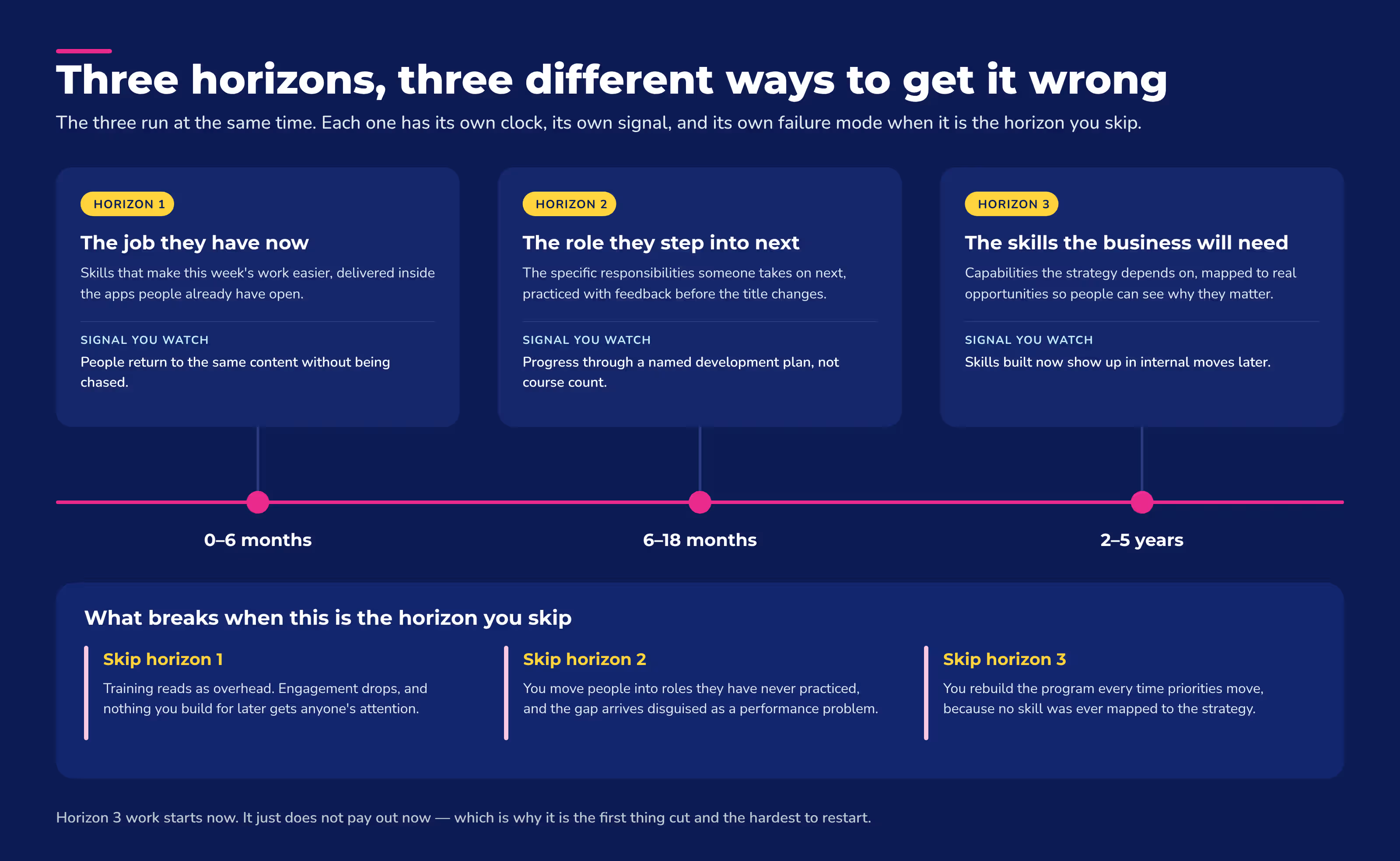
The best learning and development programs plan for three things at once: the skills people need today, the roles they'll step into soon, and the skills your business will need years from now. Plan for all three, and your program can flex when priorities shift instead of starting over every time they do.
And priorities will shift. The past few years showed how hard it is to predict the future of business. A plan with flexibility built in keeps your business moving toward its long-term goals and gives each learner a clear path forward, even as the landscape changes.
Horizon | Best practices | What helps in your LMS |
|---|---|---|
Present-day learning: skills people need for the job they have now | Tailor content to the individual and deliver it inside the tools people already use | Integrations with line-of-business apps, like Salesforce |
Near-future learning: responsibilities people will take on soon | Give regular feedback, track progress, and make content easy to find | Progress tracking, one central home for content, and simple navigation |
Long-term learning: skills the business will need years from now | Share the strategic vision, map skills to real opportunities, and pair future skills with chances to use them now | Skills mapping, blended learning, and personalized learning paths |
A few practices hold steady across all three:
- Start with strategic planning, so every program serves a business goal
- Connect your LMS to your HR system, so learning ties to roles and career moves
- Use analytics to see who's progressing and who's ready for more
- Revisit the plan when the business changes, not just once a year
How do you build learning and development that can take on change?
Build it around internal mobility, which means spotting people with the right skills and moving them where the business needs them. That's harder than it sounds. In a Deloitte survey, 49% of respondents named the lack of processes to identify and move employees as a top-three barrier to internal talent mobility.
Forward-looking learning and development fixes that with data. You need an LMS with detailed analytics reporting to track learner participation and progress, so you know who's building which skills.
Strategic planning comes first. It's how you build a plan that serves the present, near-future, and long-term needs of your learners. Get a clear picture of where the business is headed, then integrate your LMS with your HR information system so learners can see their next step and move toward it.
How do you support present-day learning?
Tailor it to the individual learner. Content that meets people's needs right now is the gateway to deeper engagement, because people come back to training that helps them today.
The most effective way to make learning relevant is to make it part of the work itself. Connect your LMS to the line-of-business apps your team already uses for learning in the flow of work.
For example, when you integrate Salesforce with your LMS, you can highlight upselling and cross-selling strategies with in-portal course suggestions. Your team builds their knowledge without leaving the app, which delivers more value to the business and keeps learners on track.
Present-day best practices to start with:
- Personalize content by role and skill level
- Put training inside the apps people use every day
- Suggest the next course based on what someone's working on
How do you prepare learners for near-future roles?
Target the specific skills people will need to take on new responsibilities soon. Learners build confidence in those skills when activities come with useful feedback from instructors or other learners.
Your LMS can make that feedback loop more interactive:
- Show progress continuously. Features that update learners on their progress or performance keep the experience interactive.
- Keep content in one place. Store videos, courses, and webinars in the LMS, so people can find them without hunting.
- Make it easy to come back. Simple navigation and a welcoming interface give learners a reason to return for more learning and resources.
Pair this with an employee development plan, so each person knows which role they're working toward and which skills will get them there.
How do you plan for long-term learning?
Share your vision for the business. When learners know why certain skills matter, they understand the context for building them. That transparency speeds up skill building because people can see how strategic skills map to real opportunities and goals.
Combine future-focused skill building with present-day chances to apply new skills. Whirlpool replaced broad, generalized training for its frontline service technicians with personalized learning paths in Absorb LMS, delivered through a blended learning model of eLearning and virtual instructor-led training.
Whirlpool reported a 14% improvement in First Call Completion and an 8.2% increase in customer satisfaction. It also reduced training costs by 21% year over year.
In Absorb LMS, Absorb Skills supports this kind of planning. It identifies skill gaps, recommends courses tailored to each person's goals, and tracks progress in one place.
How do you know your learning and development program is working?
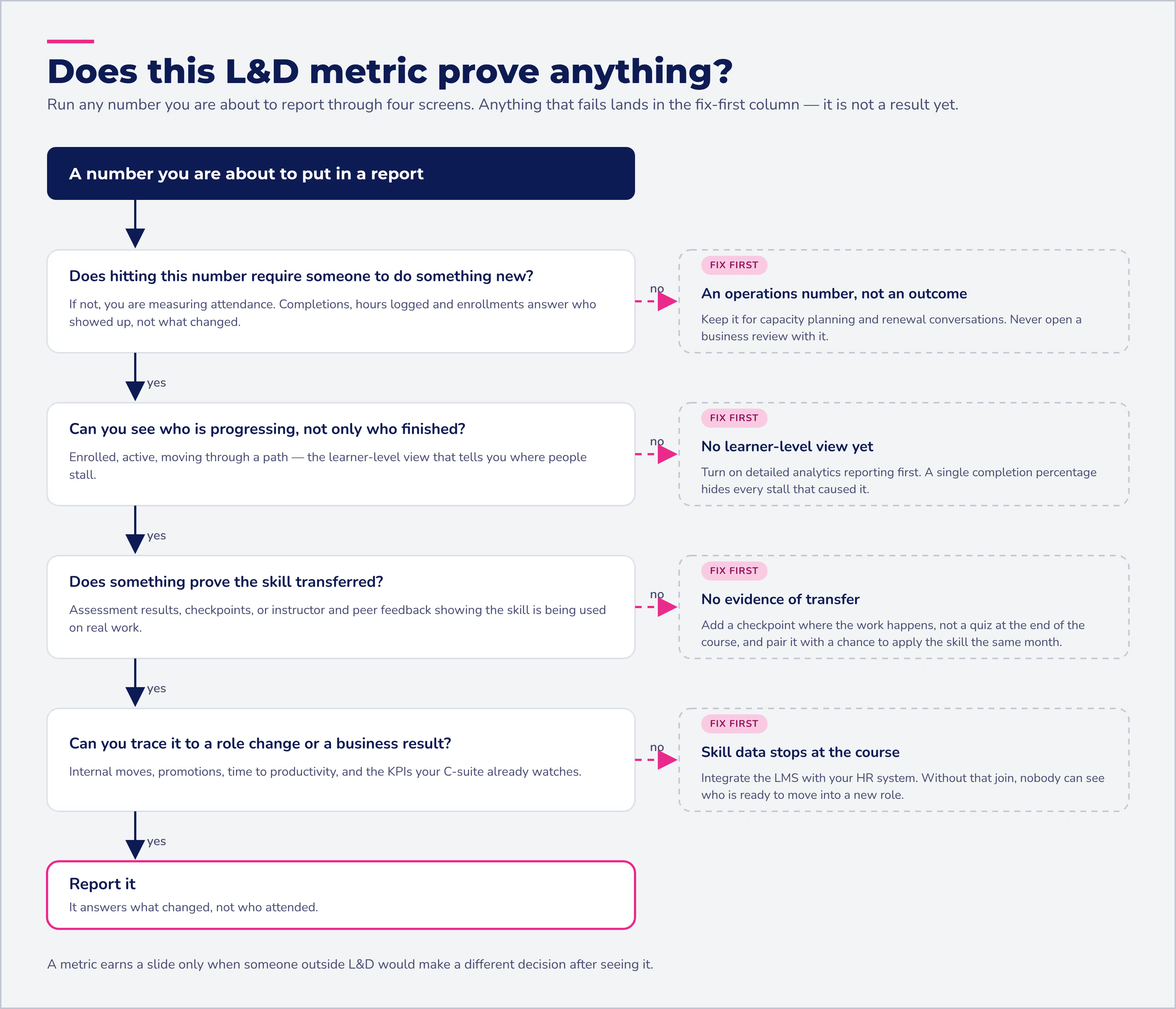
Measure it against the business goals in your strategic plan, not just completions. Completion rates tell you people clicked through to the end. They don't tell you whether anyone can do something new.
Track three kinds of signals:
- Participation and progress: who's enrolled, who's active, and who's moving through their learning path
- Skill growth: assessment results and checkpoints that show people can apply what they learned
- Business results: internal moves, promotions, and the learning and development KPIs your C-suite watches
Frequently asked questions about learning and development best practices
What does L&D mean?
L&D stands for learning and development. It's the function, often part of HR, that builds employees' knowledge and skills through training, coaching, and development programs.
What is the difference between learning and development?
Learning is gaining specific knowledge or skills, often for the job someone has now. Development is broader, longer-term growth that prepares someone for future roles.
What should a learning and development plan include?
A learning and development plan should include the skills each person or team needs, the gap between those skills and current ones, the training that will close the gap, a timeline, and how you'll measure progress.
How do you create a learning and development strategy?
Start with your business goals, then work out which skills your people need to reach them. From there, decide how you'll deliver training and measure results. For a step-by-step approach, see how to create a learning and development strategy.
What role does HR play in learning and development?
HR usually owns learning and development or works closely with the team that does. It connects training to hiring, performance, and career moves, which is why integrating your LMS with your HR system matters.
Skill is what moves organizations forward. Future skill requirements are coming fast, so your LMS needs to help you look ahead while supporting learning in the present, near future, and long term.