


.jpg)


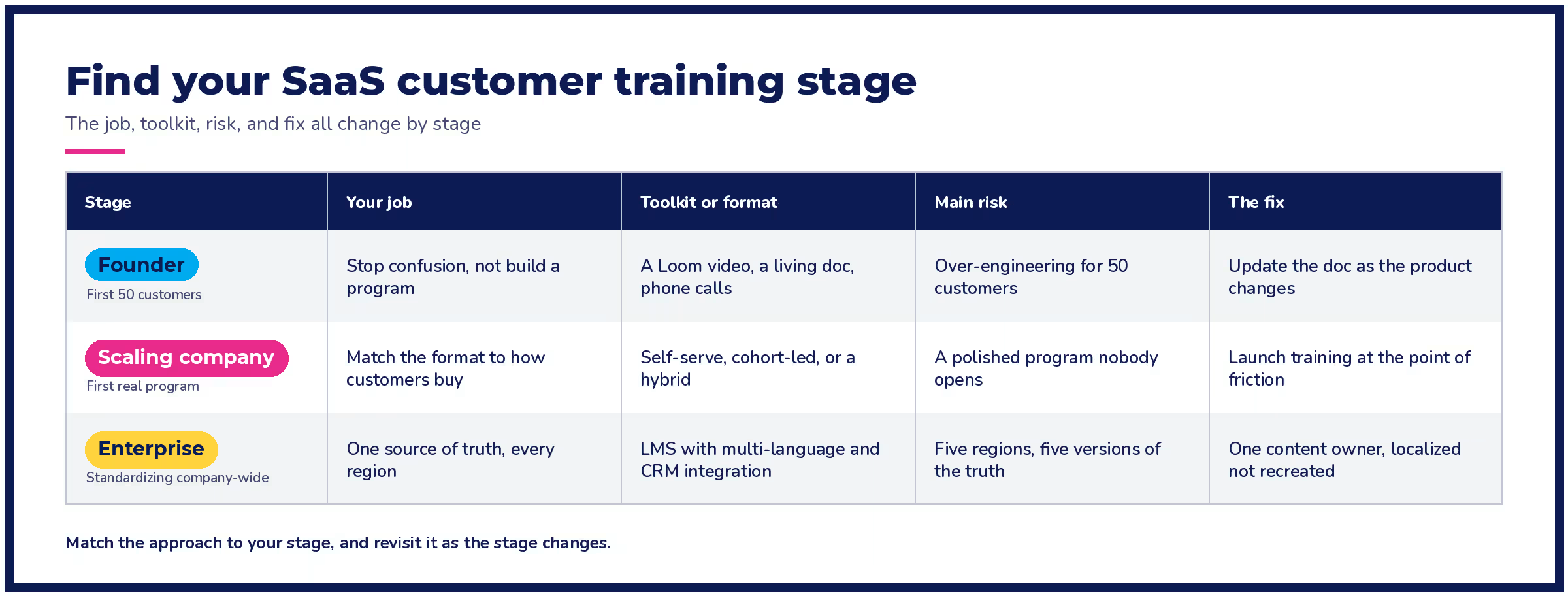
SaaS customer training is a different job depending on your company's size — the founder, the scaling customer success lead, and the enterprise team running training across 12 time zones are all technically doing the same thing, with almost nothing else in common.
A quick note... This is about training your customers, not training to become a customer success professional — a real, but really different topic. (One word apart, no hard feelings!)
The guide is organized by stage so you can find yours fast, and read that section first.
What's SaaS customer training?
SaaS customer training is how a software company teaches its customers to use the product well enough to get value from it — through onboarding, documentation, videos, live sessions, or a combination of all four. It falls under the broader banner of SaaS customer education, the umbrella term for helping customers succeed with what they bought.
Don't confuse it with training for customer success professionals, which is about building your own CS career, not your customers' skills. Different job, different audience, different guide.
All of this is important because customers who understand your product stick around longer, need less hand-holding from support, and get more value out of what they're paying for. We'll get specific about that connection, including where the data does and doesn't hold up, later in this article.
The founder training their first 50 customers
At this stage, answering the phone yourself beats any curriculum you could write. A training program is a later problem. Right now you're the training program, and that's fine.
At this stage, "training" usually means a mix of things that don't look like training at all, like a Loom video you recorded once and reuse constantly, a doc you update every time someone asks the same question twice, and a live call where you watch someone click around and wince internally. This scrappy mix is the correct process for a company this size.
At this stage, at a glance:
- Your job: stop people from quitting out of confusion, not build a program
- Your toolkit: one Loom video, one living doc, one phone
- Your risk: over-engineering, not under-training
- Move on when: the same question eats an hour a week, or you hire your first CS person
The minimum viable approach has three parts:
- Record short videos for the two or three things every new customer struggles with. Reuse them relentlessly.
- Write down the answer to any question you've now answered three times. That's your first knowledge base, whether you call it that or not.
- Get on a call for anything high-stakes or high-friction. Automation can wait.
The most common mistake at this stage is over-engineering the training itself, not under-training customers. Building a fancy course library for 50 customers is a worse use of your time than personally onboarding those 50 customers, because at this size, the relationship is the training.
You'll know it's time to move past this stage when the same questions start eating hours you don't have, or when you're hiring someone whose whole job is customer success. That's the signal to formalize — covered next.
The scaling company building its first real training program
The hustle that got you to 50 customers won't get you to 500. You'll feel this shift before you can name it. Support tickets repeat themselves, onboarding takes longer than it should, and the docs you wrote for 50 customers don't hold up for 500.
One real data point on what formalizing this actually pays for: a Forrester study found that scalable, role-specific onboarding cut onboarding costs by $2.4 million — a blended figure across employees, customers, and partners together, not customers alone, but a concrete sign that this isn't busywork.
That's usually the moment someone reaches for a comparison chart of training platforms and realizes the company trying to sell you their platform wrote every one of them. Fair warning. This section isn't that. Here's what to weigh instead.
At this stage, at a glance:
- Signal it's time: repeat tickets, slower onboarding, docs that don't scale past 500 customers
- Format choice: self-serve, cohort-led, or a hybrid of both
- Evaluate on: can you measure it, does it fit how customers reach you, can your team update it without IT
- Start tracking now: completion rate, time-to-first-value, ticket volume
Pick a format that matches how your customers buy and use the product, not the format that's trendiest:
- Self-serve works well when your product is simple enough to learn without help, or your customer base is too large to train one-on-one.
- Cohort-led (live sessions, scheduled onboarding) works when the product is complex or the stakes of getting it wrong are high.
- Hybrid, self-serve for the basics and live for the hard parts, is where most scaling companies land, because most products have both easy and hard parts.
When you evaluate a platform, look past the feature list. Check whether you can track if training is working, whether it fits into how customers already interact with you, and whether your team can update content without filing a ticket with IT. Everything else is secondary.
In practice, that might mean picking one course, say the walkthrough for your most support-heavy feature, and checking whether customers who finish it file fewer tickets about that feature than the ones who skip it. If they don't, the course isn't teaching anything, no matter how good the completion rate looks on a dashboard.
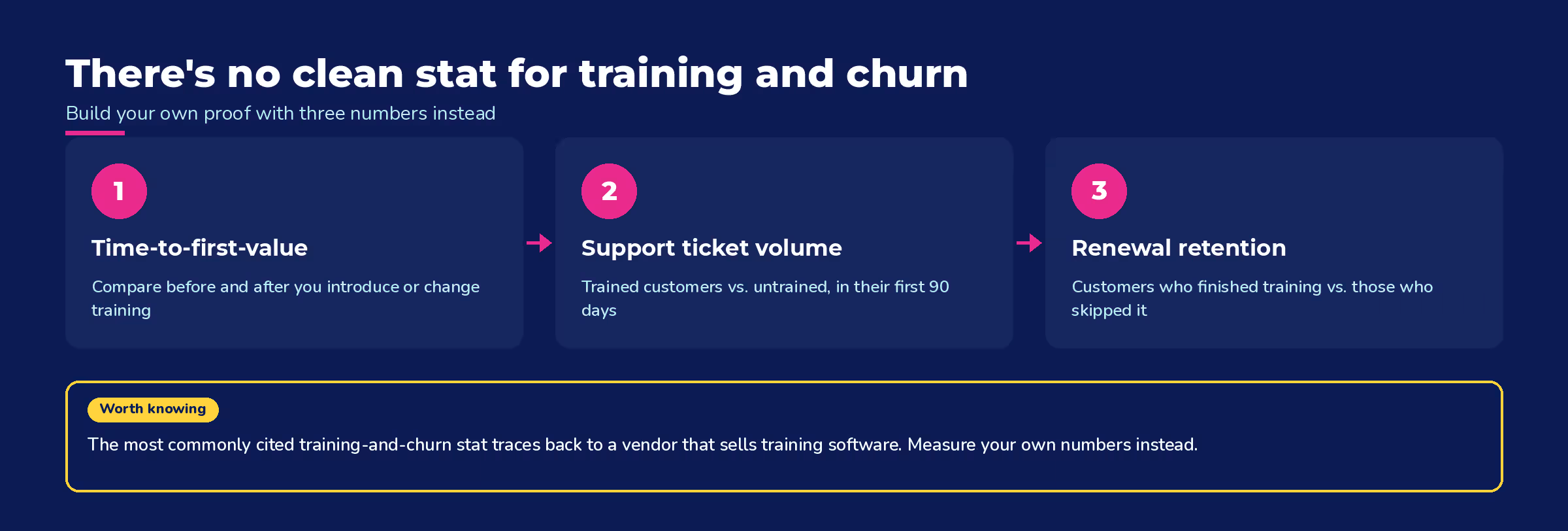
Start measuring now, even informally — completion rates, time-to-first-value, and support ticket volume before and after training. You'll want this baseline later, because the next question everyone asks is whether any of this actually reduces churn.
The enterprise standardizing training across the company
Five regions training customers the exact same way — that's the actual bar at enterprise scale. What worked for a 20-person customer base doesn't survive contact with a global one.
Multi-language support stops being a nice-to-have and becomes table stakes. A training program available only in English is missing most of your global customer base, no matter how good it is. Consistency matters just as much within a single language — a customer in one region shouldn't get materially different guidance than a customer in another, or your "single source of truth" is really several competing ones.
Integration is the other piece that changes at this scale. Training data needs to connect to CRM and support systems so your team can see who's trained and where the gaps are, rather than guessing based on ticket volume. Governance and reporting requirements also show up here for the first time — someone, somewhere, is going to ask for proof that training happened and worked, and "we're pretty sure people watched the videos" won't hold up.
At this stage, at a glance:
- Non-negotiable: multi-language, not just English-plus-translation-later
- Non-negotiable: one source of truth across every region
- New requirement: proof that training happened, not just a good-faith assumption
- What breaks first: spreadsheets and individual heroics
Absorb LMS supports the multi-language delivery and CRM integration that enterprise customer training programs need to run consistently across regions — worth a look if spreadsheets and good intentions have stopped being enough. See how Absorb approaches customer education.
Stage | What "good" looks like | Tools to reach for |
Founder (first 50 customers) | Fast, personal, a little scrappy | Loom videos, a shared doc, live calls |
Scaling company (first real program) | Structured, measured, format matched to the product | Self-serve content, cohort sessions, or a hybrid mix |
Enterprise (standardizing company-wide) | Consistent, localized, integrated | An LMS with multi-language support and CRM integration |
Does customer training reduce churn?
There's a customer retention training question everyone eventually asks, whether training people on your product keeps them around or just makes onboarding feel more official. Research on customer education and loyalty found a positive, significant relationship between educating customers and how loyal they stayed. That study looked at the financial services industry in 2007, not SaaS renewals in 2026, so treat it as supporting logic rather than a headline number. (The underlying idea holds up.)
Trained customers reach value faster, hit fewer avoidable walls, and disengage less quietly. A 2017 follow-up study added a useful nuance. Training customers on your specific product builds loyalty, but training them broadly on your market can backfire by making it easier to compare you to competitors.
A simple way to start tracking your own results:
- Track time-to-first-value before and after you introduce or change training.
- Compare support ticket volume for trained versus untrained customers over their first 90 days.
- Watch retention at renewal for customers who completed training versus those who didn't.
What goes wrong, and how to fix it before it does
Every stage of customer training has its own predictable way of failing you can catch early
At the founder stage, the failure mode is training that's just "figure it out" with extra steps — a doc nobody updates, a video from eighteen product versions ago, still confidently pointing at a button that no longer exists. Revisit your two or three most-used resources every time the product changes, not on some hypothetical someday.
At the scaling stage, the failure mode is a formal program nobody uses, built to look complete rather than tied to an actual moment when customers need it. A course library nobody opens is just an expensive filing cabinet. Launch training at the point of friction, such as first login, a specific feature, or a common support ticket, not as a standalone destination customers have to go looking for.
At the enterprise stage, the failure mode is regional drift, like five offices, five slightly different versions of "the truth," and a suspicious amount of confidence in each one, until an auditor or an unhappy customer finally notices. One source of content, localized rather than recreated, with a clear owner for keeping it current, is what keeps that from happening.
Frequently asked questions
Is "customer training" the same as "customer success training"?
No. Customer training teaches your customers to use your product. Customer success training prepares someone for a career in customer success. They sound alike; they're not the same thing.
How long should a SaaS customer training program take to show results?
Give it one full customer lifecycle before judging results — usually 60 to 90 days for onboarding-stage metrics like time-to-first-value, and a full renewal cycle for retention impact. Judging sooner mostly measures how fast you built it, not whether it works.
Do you need a dedicated customer education team, or can customer success own it?
Customer success can own it at the founder and early-scaling stages. A dedicated team usually makes sense once training volume or complexity starts pulling CS away from actual customer relationships — that's a scaling-stage or enterprise-stage problem, not an early one.
What's the difference between customer training and customer onboarding?
Onboarding is the first chapter; training is the whole book. Onboarding gets a customer to their first success. Training keeps working after that, covering new features, edge cases, and everything a customer needs beyond day one.
What tools do customer success teams need for training, and is that the same thing as an LMS?
Not exactly. Customer success tools generally cover communication, health scoring, and account management. An LMS is specifically built to deliver, track, and report on training content. Most scaling and enterprise teams end up needing both, working together rather than one replacing the other.
Wherever you're starting, start there
Train customers for where you actually are, not for a checklist sized for a different company. A founder doesn't need a learning platform yet. An enterprise can't run on Loom videos and good intentions anymore. Match the approach to the stage, and revisit it as the stage changes. That's the whole method here.
When training has to work the same way across regions, languages, and systems, that's exactly the problem Absorb LMS is built to solve, with multi-language delivery and CRM integration built in. See how Absorb LMS handles customer education.


_cardimg.avif)
