





Whether you're building the case for a customer education program, or defending one you already have, you know that "trust me, it works" isn't enough for your pitch.
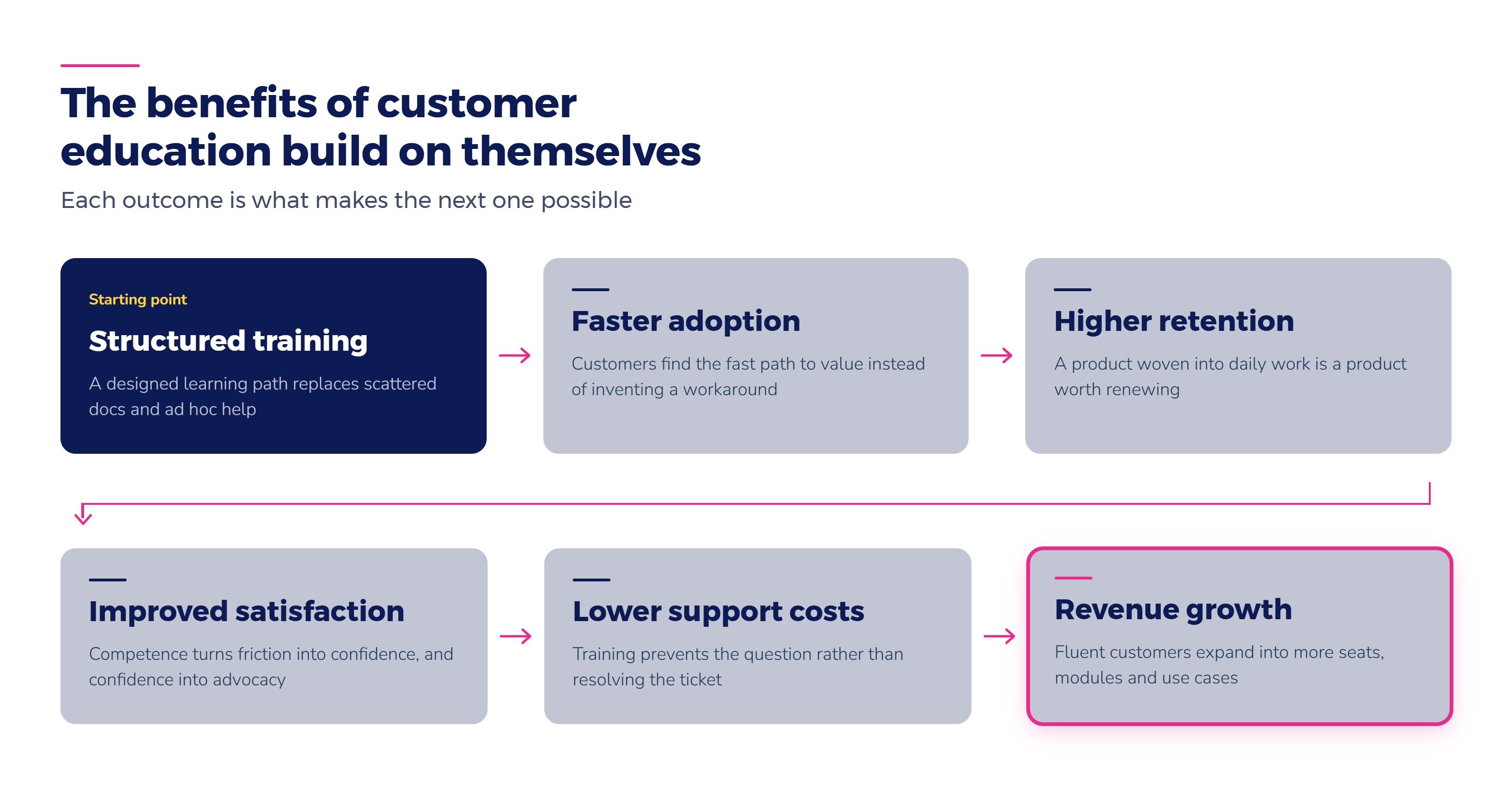
Customer education is structured training that helps customers, prospects, and partners get more value from your product. When companies invest in it, they see five consistent benefits: faster product adoption, higher customer retention, improved customer satisfaction, lower support costs, and revenue growth through expansion and advocacy.
The good news is these outcomes are measurable. You can see them in product adoption numbers, support tickets, and ARR or deal size. Below, you'll find the data, definitions, and arguments you need to build the budget case.
What is customer education?
Customer education is the structured training you build for the people who use your product. It includes onboarding courses for new customers, certification programs for partners, and self-service content that answers common questions before they become support tickets. It's proactive: you teach people what they need before they ask.
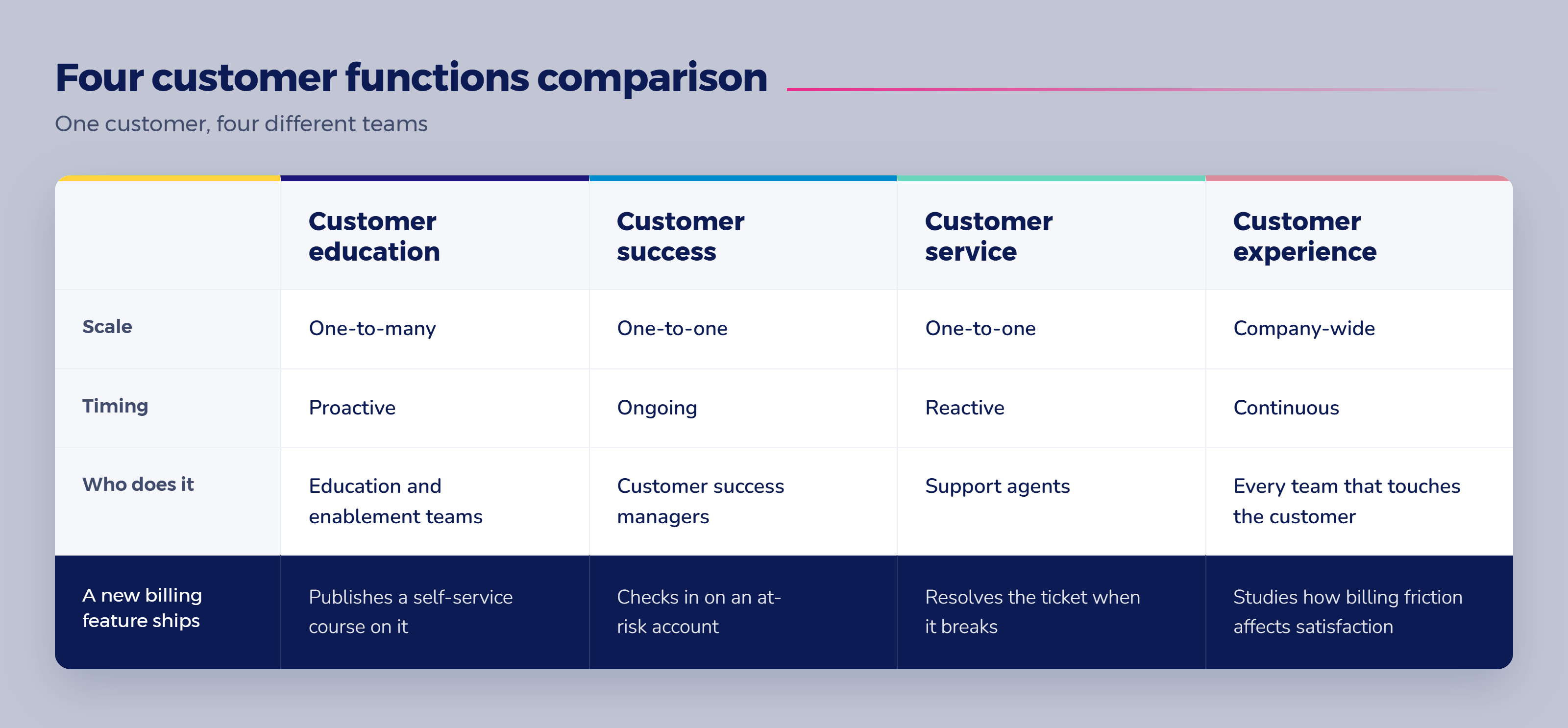
This definition may sound close to a few other terms in your organization: customer success, customer service, and customer experience. Here's how they differ.
Customer education vs. customer success
Customer success works with individual accounts. A dedicated manager usually monitors account health and steps in when something looks off. Customer education works at scale. It builds content once and delivers it to hundreds or thousands of customers. According to Talented Learning, customer education sits side-by-side with customer success teams rather than replacing them. One scales knowledge. The other manages relationships.
Customer education vs. customer service
Customer service reacts. A customer hits a wall, opens a ticket, and a support agent solves the problem. Customer education tries to stop that wall from showing up in the first place. If you searched for customer education vs. customer service, here's the core difference: one discipline solves problems after they happen. The other prevents them.
Customer education vs. customer experience
Customer experience is the broadest of the four terms. It covers every interaction a customer has with your company, from the sales conversation to the invoice. Customer education is one lever inside that larger experience. It's not a synonym for it.
Take a software company launching a new billing feature. A customer education team publishes a self-service course that shows how to use it. That's different from other roles. A customer success manager checks in on an at-risk account. A support agent solves a billing ticket after the fact. A customer experience team studies how billing friction affects overall satisfaction. All four matter, but only one of them is customer education.
Customer success as a discipline has its own frameworks and pillars. These are separate from what a training program delivers. This article shows how education supports that work. But it won't replace a customer success strategy on its own.
Keep these four terms separate. You'll ask better questions about where to invest first.
The 5 benefits of customer education, backed by real data
Customer education isn't just a nice-to-have. When it's done well, it shows up in numbers your team already tracks: how fast people adopt your product, whether they stick around, and how much they spend.
1. Faster product adoption
Untrained customers guess. They poke around your product and find a workaround that mostly works. They never discover the feature that would have saved them an hour a week. Structured onboarding fixes that. It shows people the fastest path to value from day one.
The data backs this up. TSIA surveyed more than 2,800 respondents. It found that 68% of trained customers used the product more. 56% used more of its features. And 87% said they could work more independently after training.
Absorb customer Insperity saw this firsthand. It partnered with Absorb LMS to train its 290,000-plus clients. Client usage increased by more than 35%.
Certification programs make this easier to track. When a customer completes a certification course in Absorb LMS, you know they've seen the features that drive adoption. It's not just that they logged in once. That gives your customer success team a real signal, instead of a guess.
2. Higher customer retention and lower churn
A customer who understands your product sees the value they're paying for. A customer who doesn't is a renewal risk, even if they haven't said anything yet.
We saw this in our own customer education program. We launched Absorb Academy, our self-serve learning portal. After that, we measured a 25% increase in customer retention rate.
Rho is a clinical research organization that uses Absorb LMS to train both employees and external partners. It scaled its own program from 300 to more than 2,800 users across 25-plus countries. It held a 97% training compliance rate the whole time. That's a sign that education can scale without customers falling through the cracks.
Engagement analytics track course activity alongside account health. They give your team an early warning when a customer stops learning, often before that customer stops renewing. If a customer's course activity drops off, that's worth a check-in call before the contract does.
3. Improved customer satisfaction
Confused customers get frustrated. Confident customers stick around and tell other people about you. Education is the fastest way to move someone from the first group to the second.
That same Absorb Academy program boosted retention and also increased our NPS score by 14%. Insperity trains its clients through Absorb LMS. It reported improved client satisfaction alongside its usage gains.
Self-service resources make this easier to sustain. A searchable knowledge center tied to your course content lets customers find their own answer at 9 p.m. on a Sunday. They don't have to wait for a support agent on Monday morning. That means fewer stuck moments, less frustration, and a friendlier relationship with your product.
4. Lower support costs
Every support ticket costs money to resolve. Self-service tickets cost the least of all. HDI is the professional association for technical support teams. It found that self-help tickets are the cheapest channel by far. Costs can vary by more than 100 times between the lowest-cost self-help ticket and the highest-cost walk-up ticket.
Customer education shifts more of your ticket volume into that cheap, self-help category. After we launched Absorb Academy, we reduced our own support ticket volume by 15%.
This works because it attacks the root cause, not just the symptom. Support fixes a problem the customer already has. Education keeps that problem from happening in the first place. That's the proactive-versus-reactive difference we covered earlier.
When your knowledge base content is tied to your course library, a customer searching for help lands on the same explanation your training already gave them. That reinforces what they learned, instead of making them start from scratch. Reduced support costs are also one of the easiest benefits to quantify for a budget conversation. Most support teams already track cost per ticket.
5. Revenue growth through expansion and advocacy
A customer who has mastered your core product is a much easier sell on the next tier, the next seat, or the next module. They already trust that your product works. They've seen it work.
Certification programs create a natural moment to introduce the next thing a customer needs: an advanced course, a new module, or access for a wider team. Absorb LMS can tie certifications to specific product tiers or extended-enterprise licensing. That gives your customer success and sales teams a built-in signal for when a customer is ready to expand. They don't have to guess from usage data alone.
Educated customers also become better advocates. They can explain your product to a colleague, a prospect, or their own network with more confidence. That's because they actually understand it.
Who benefits from customer education (hint: it's bigger than just "the customer")
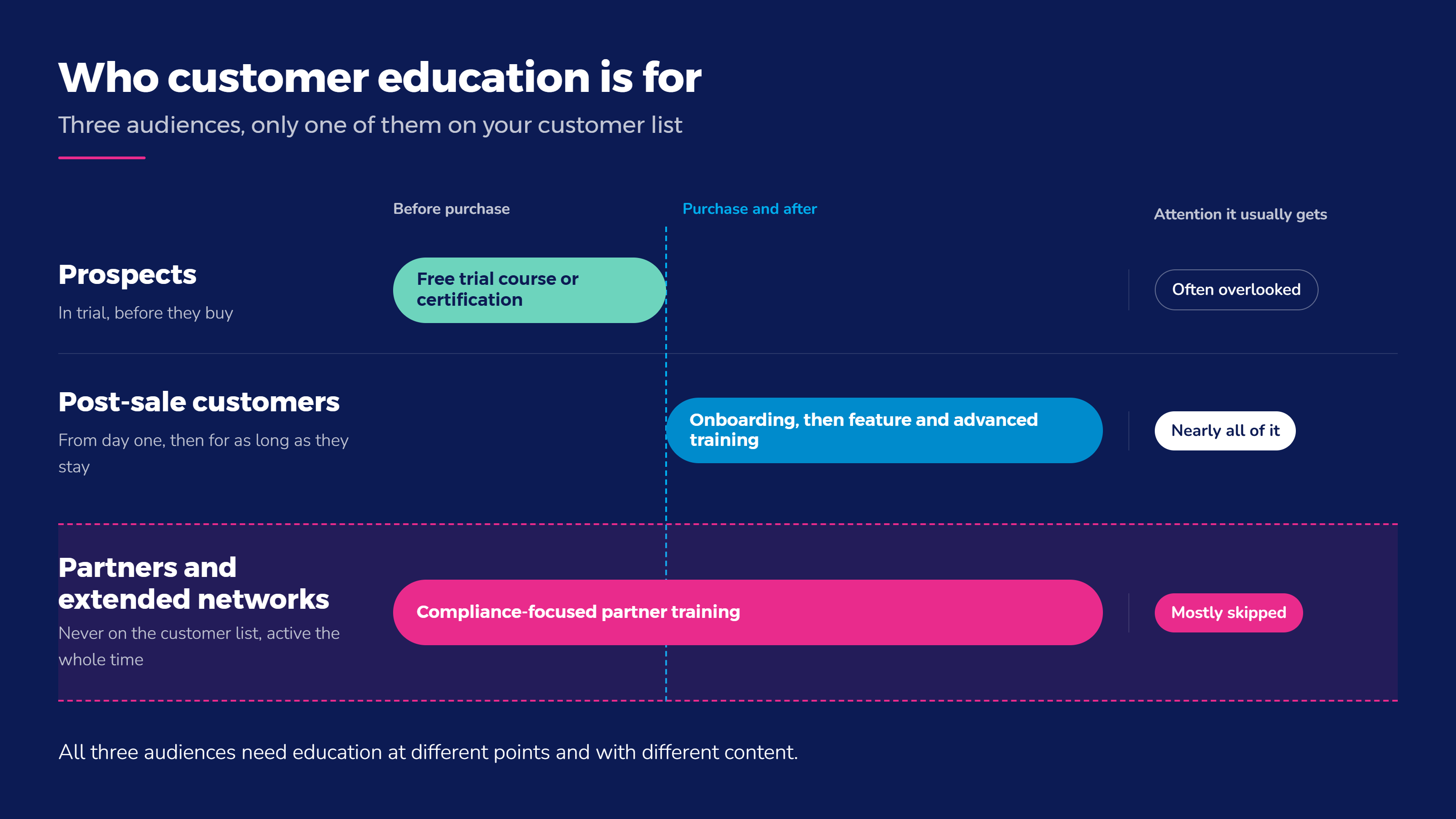
Most articles on this topic assume "customer" means one thing: someone who already bought your product. But that's not the full story.
Prospects
Some of the most effective customer education happens before someone becomes a customer at all. A free course or product certification during a trial period helps a prospect see real value fast. That shortens the sales cycle and lowers the risk of a stalled deal.
Post-sale customers
This is the most commonly covered group: customer onboarding, then ongoing education as people use more of your product. It's the foundation. But it's not the whole picture.
Partners and extended networks
This kind of partner customer education is where most companies stop investing. It's also where the opportunity is biggest.
For example, Juv'ae Academy is a national aesthetics network. It used Absorb LMS to train more than 460 external cosmetic nurses. These weren't employees, but professional partners who needed consistent, compliance-focused education to do their jobs safely. The program won Absorb's 2025 "Customer Education Program of the Year" award.
Pierre Fabre took a similar approach. Its René Furterer and Avène brands needed to train salon owners, stylists, estheticians, doctors, and dermatologists. These professionals sell and recommend Pierre Fabre's products, but they don't work for the company. Pierre Fabre launched an external training site for one of those brands in just three weeks.
Rho is a clinical research organization. It built a single program that trains both internal staff and external partners. The program scaled to more than 2,800 users across 25-plus countries, while holding a 97% compliance rate.
This model is worth copying if your business relies on external partners to represent your product correctly. It matters most in regulated industries, where compliance training isn't optional.
Industries with complex products or heavy compliance requirements tend to see the biggest payoff in this area. Think healthcare, financial services, and manufacturing. The cost of an undertrained customer or partner is higher when safety or regulation is on the line.
Customer education covers both onboarding and the ongoing relationship after it. It doesn't stop at your customer list. Prospects, customers, and partners all need it, just at different points and with different content.
How to build the internal case for customer education
You've seen the benefits. Now you need to convince whoever controls the budget.
Start with the cost of doing nothing. Untrained customers file more support tickets, churn at a higher rate, and adopt fewer features. All of that costs money, whether or not there's a line item for it.
SHRM recommends a simple two-part calculation for any training program: the dollar value of the benefits, minus the dollar cost of running it.
.avif)
For the benefits side, use what you already have. Support tickets cost your team real money per ticket. If customer education can shift a meaningful share of those into self-service, that's a dollar figure your CFO understands right away.
Most subscription businesses can put a dollar value on their churn rate. If yours can too, even a small improvement in retention can pay for a training program many times over.
Scale efficiency is another angle. Rho grew its trained population from 300 to more than 2,800 users across 25-plus countries. It did this without adding staff at the same pace, while still holding a 97% compliance rate. That's an argument for a lean team supported by the right system, rather than a headcount request for every new market.
As Darren O'Connor, Absorb's Director of Customer Success, puts it:
"When you're making the business case for customer education, don't sell it as education. Sell it as an efficiency driver and a revenue protection layer. If customers don't adopt, nothing else matters — and product alone doesn't solve for scale, complexity, or change management. Customer education fills that gap."— Darren O'Connor, Director of Customer Success, Absorb
What to bring your budget holder
When pitching customer education, bring your budget holder three specific things:
- The support-ticket-cost math — what a ticket costs today, and how much self-service could realistically handle.
- The retention math — what even a small improvement in renewal rate is worth in dollars.
- One comparable example, like Rho's, that shows this scales without linear cost growth.
A vague pitch about "customer education" competes poorly against a specific number. Tie that number to a business outcome your leadership already tracks.
Who owns customer education, and what tools do you need?
There's no single right answer for who runs a customer education program. In some companies, it sits with customer success. In others, it's a dedicated customer education or customer enablement role.
This is especially true once the program grows past one person building courses on the side. Someone needs to own it full-time, no matter the title. Programs that live as a side project for a busy CSM tend to stall.
Core tools you need
Whoever owns it needs a few core tools:
- A learning management system to host and track courses
- Course-authoring or screen-recording software, so you can build content quickly, without a full production team. Some LMS tools, like Absorb, include course-authoring.
- A community forum or discussion board, where learners can ask questions and connect with each other. This could be a Slack channel, or a dedicated space in your LMS.
Customer education LMS vs. employee training LMS
A customer education LMS isn't quite the same as the system you use to train employees. Your team already knows your company. Your customers and partners don't. So your customer education tool needs to look and feel like your brand, not an internal HR tool.
It should also integrate with your CRM and product analytics. That way, you can connect course completion to account health and usage data, not just track who finished a video. When you're evaluating a customer education solution, put that kind of integration first, ahead of any single flashy feature.
Can one platform handle both employee training and customer education?
Often, yes. Absorb LMS supports both from a single account. That means you avoid running two separate systems and two separate budgets. The only choice you need to make is whether your customer-facing content gets its own branded portal.
What it costs
Pricing for customer education platforms varies. It depends on the number of learners, the amount of content you need to build, and how deeply you want it integrated with your other systems.
Treat it as a budget conversation with your vendor. Don't expect a single published number. Most vendors price this based on your specific setup.
Tips for launching and measuring a customer education program
Building a customer education strategy doesn't require a year-long rollout plan. Here's a quick summary of how to launch one, measure it, and improve customer education over time:
1. Align to a business goal first
Pick the outcome you're solving for before you build a single course. It might be fewer support tickets, faster onboarding, or better retention. That goal decides what you measure later.
2. Segment your audience
Prospects, new customers, power users, and partners all need different content. Don't build one course and hope it fits everyone.
3. Build content in short pieces
Microlearning means five- to ten-minute lessons focused on one task. These get finished more often than a 45-minute course nobody has time for.
4. Measure and adjust
Track completion. But also track what completion is supposed to change: fewer tickets, higher usage, better retention.
None of this has to take long. Pierre Fabre launched a branded-training site for one of its brands in just three weeks. It was built specifically for the salon owners and professionals who sell its products, not a comprehensive program covering every audience at once.
How this differs from employee training
Customer education differs from employee training in a few practical ways. Your audience doesn't work for you. That means you can't require them to finish a course the way you can with staff.
Content also needs a shorter shelf life, since your product changes faster than your job descriptions do. And anything you get wrong shows up in front of a paying customer, not an internal team.
Frequently asked questions about customer education
What does customer education mean?
Customer education means structured training built for customers, prospects, and partners. It includes onboarding courses, certification programs, and self-service content. These help people get value from your product without needing to file a support ticket.
What are the 5 benefits of customer service?
That's a related but different question. Customer service benefits come from resolving problems after they happen. This article covers customer education, which focuses on preventing those problems in the first place. See the section above on how the two disciplines differ.
What are the 5 pillars of customer success?
Customer success has its own frameworks. These are usually built around individual account management, not scaled training content. Customer education supports customer success work, but it isn't the same discipline. See the distinction above.
What are the benefits of customer experience?
Customer experience covers every interaction a customer has with your company. Customer education is one piece of that larger picture, not the whole thing. This article focuses specifically on the training piece.
What is the difference between customer education and customer success?
Customer success typically works one-to-one, through an account manager who monitors individual customer health. Customer education works one-to-many. It builds content once and delivers it at scale. The two work together rather than replacing each other.
What is a customer education program?
A customer education program is the ongoing set of courses, certifications, and self-service resources a company builds. It trains customers, prospects, and partners. It's usually owned by a customer success or dedicated customer education team. It often includes compliance training for regulated industries.
How do you improve customer education?
Start by aligning content to a specific business goal. Segment your audience instead of building one-size-fits-all courses. Use microlearning formats that people actually finish. See the launch tips above for the full breakdown.
What is the main goal of customer education?
The main goal is to help customers, prospects, and partners get more value from your product with less friction. That shows up as faster adoption, higher retention, lower support costs, and better NPS scores.
What is the best way to educate customers?
Short, focused microlearning content tends to outperform long courses. Match the format to when your customer actually needs the information, not just what's easiest to produce.
How do you build a customer education program?
Pick a business goal. Segment your audience. Build content in short pieces. Measure whether completion actually changes the outcome you're solving for. The launch tips section above walks through this in more detail.
Ready to build your case for a winning customer education program?
Customer education touches product adoption, retention, satisfaction, support costs, and revenue.
Businesses that get the most from it don't stop at training their existing customer list. They train prospects before the sale, partners who represent their product in the field, and customers long after onboarding ends.
Absorb LMS supports that broader reach from one system. That means employee training, customer education, and partner programs together, with a branded portal for the audiences outside your company.
You won't have to jump between three systems to educate three audiences. And you won't have to rebuild your program from scratch as it grows.
Explore Absorb LMS or talk to our team about what a program built for your business could look like.


_cardimg.avif)
.avif)