.jpg)

Onboarding churn is preventable once you treat it as a system instead of an event. Diagnose which signal you're seeing, apply the fix that matches it, automate detection, and measure what worked.
Roughly 60–70% of all SaaS churn happens in the first 90 days, and most CS teams only notice once the cancellation is already in motion.
Onboarding completion is a frequently tracked metric, but completion doesn't tell you which of your customers are at risk for churn. This article is the diagnostic manual to identify the root cause of customer churn, three early signals, and a four-step system any CS team can run — no matter if you’re dealing with a five-person startup's customer base or a five-thousand-account enterprise book. The diagnosis works with any stack, but running it consistently is easier with a connected customer education platform behind it.
Why onboarding churn happens: One root cause, three symptoms
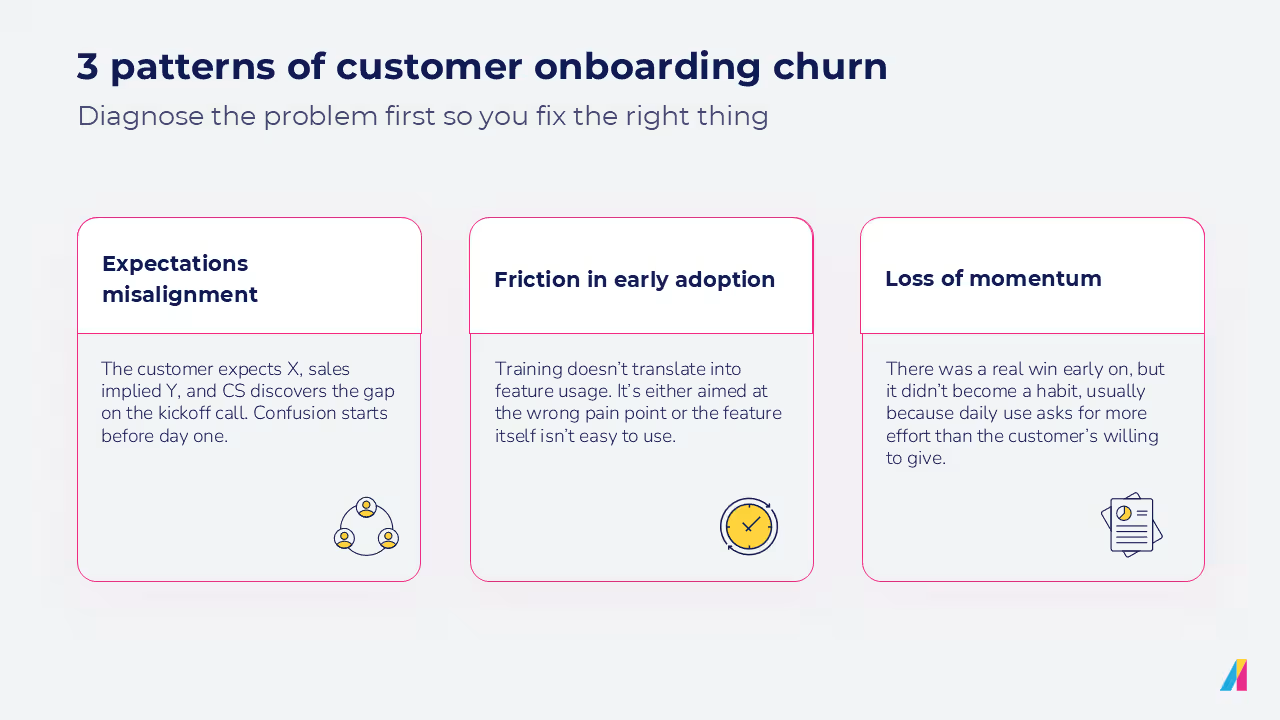
Onboarding churn shows up three different ways — but dig into any of them and you usually land on the same thing underneath. Three patterns explain almost every onboarding churn case:
- Expectations misalignment. The customer expects X, sales implied Y, and CS discovers the gap on the kickoff call. Confusion starts before day one is even over.
- Friction in early adoption. Training doesn't translate into feature usage — either it's aimed at the wrong pain point, or the feature itself is hard to use.
- Loss of momentum. There was a real early win, but it never became a habit, usually because daily use asks for more effort than the customer's willing to give.
Notice that ‘bad training’ is missing from that list. It's the symptom everyone points to first, because it's the most visible part of the process — but it's rarely the actual cause.
Dig one layer under all three, and you'll usually find there’s an expectations misalignment baked in before onboarding even started. A customer expects one thing, what was sold implied another, and CS discovers the gap on the kickoff call. This lives in the seam between sales and customer success, which means you probably can't fix the handoff at an org level on your own. But what you can do is detect it early.
Retention sits at the top of nearly every CS team's priority list — 57% of customer education programs name it as their top objective, according to The State of Customer Education 2026 from Lighthouse Research & Advisory and Absorb. But naming a priority isn't the same as building a system to protect it.
The detection window — days 0–3 — is where intervention is still possible. A structured handoff process, built around catching expectations misalignment before it becomes an issue, gives you a baseline to check new accounts against. It shows up in the data almost immediately as the customer who enrolls but never starts, who logs in once and stalls, or who asks a telling question that reveals they thought they bought something else.
When we do retrospectives on churned customers, it almost always points to a breakdown in expectations and process — not just service or delivery. Content delivery tends to get blamed because it's visible and easy to evaluate. But step back and it's usually misaligned expectations, unclear success criteria, or a weak connection between what the customer bought and what they're actually trying to achieve. It gets labelled as a content problem when it's really a relevance problem. — Darren O'Connor, Director, Customer Success, Absorb
The takeaway is misalignment is detectable in onboarding signals way before a customer says anything’s wrong. Validate what was promised, watch the first 72 hours closely, and treat early silence as data ... not as a good sign. There are three signals worth watching.
Customer onboarding churn signal #1: The setup gap (Days 0–3)
The setup gap is the space between signup and first action — the customer enrolls in onboarding but never opens the first module, or logs in, sees a blank dashboard, and leaves.
Abandonment concentrates in the first few interactions, according to Nielsen Norman Group's usability research on onboarding and empty states — in onboarding terms, that's days 0–3. Call it the buyer's remorse window. The customer just committed, and they're likely a little uncertain. If they don't see clear direction fast, plenty of them decide to leave before day four arrives.
In healthy cohorts, the large majority start the first module within 24 hours. If fewer than half have started by day one, you have a setup gap. Watch for zero enrollments by day one, logins with no module entry, and high enrollment paired with zero progression.
Customers who don't experience clear value within the first week are far more likely to churn, per UserGuiding's onboarding research. A customer who hasn't opened a module by day three is already behind schedule to get there — which is why the fix here is speed, not analysis. (For how time-to-value connects to retention more broadly, see onboarding metrics that predict churn.)
How to prevent the setup gap
- Confirm expectations on the kickoff call against what the customer needs
- Send the first module link within hours of signup, not days
- Auto-escalate to CS outreach when there's no enrollment by day 1
- Audit whether your onboarding dashboard gives new users clear direction or drops them into an empty screen
- Track whether 75%+ of each cohort starts within 24 hours
Customer onboarding churn signal #2: The value gap (Days 4–14)
The value gap is the space between finishing training and adopting the product — the customer completed your modules but hasn't used the core feature the training was about.
That gap usually signals one of three things. Either:
- The training taught the wrong thing
- The feature is genuinely too hard to use
- The customer's real pain point isn't where you assumed it was.
The tell in your data is simple — modules completed, features untouched.
Nearly all users who haven't experienced value within two weeks will churn, according to Amplitude's 2025 Product Benchmark Report. Two weeks without adoption isn't a slow start — treat it as a decision already being made, and act on the prevention list below rather than waiting for more data to confirm it.
How to prevent the value gap
- Audit whether module content addresses the customer's stated pain point — if it doesn't, redesign it around their real goal
- Shorten modules; anything past 10 minutes invites drop-off, so aim for 5–7
- Add a hands-on practice step before the customer's first real use of the feature
- Auto-trigger a day-7 nudge when there's no feature usage after training — well-timed nudges re-engage an estimated 15–25% of at-risk users, per Whatfix's onboarding-metrics research
- Track whether 60%+ of trained users adopt the core feature within 7 days; if not, the training is misaligned to real needs
Customer onboarding churn signal #3: The habit gap (Days 15–90)
The habit gap is the space between a first win and a real habit — the customer had a good moment on day 10, then drifted back to the old way of working by day 45.
Usually that means daily use carries too much friction, an integration is too manual, or the customer lost context after stopping for a while. The signal in your data is engagement decay. Look for a drop of more than half off peak login frequency by day 30. That’s a strong predictor of churn by day 60.
And most programs don't have a plan for that moment — 16% of customer education programs report no defined strategy for re-engaging inactive learners at all, according to The State of Customer Education 2026 from Lighthouse Research & Advisory and Absorb. If yours is one of them, the habit gap is the signal that will punish it first.
Day 45 is the invisible decision point — by day 90, the choice was usually made weeks earlier. Once you're past day 90, login frequency and feature usage stop being early warnings and become the retention story itself, which is where onboarding metrics that predict churn picks up the analysis.
How to prevent the habit gap
- Identify the specific friction points making daily use hard, and remove what you can
- Deliver bite-sized microlearning at the moments of decline — days 20, 35, and 60 — not full modules
- Trigger an onboarding refresher at day 30 for any customer whose login frequency has dropped more than 50%
- Add peer success stories showing how similar customers use the feature day to day
- Track whether login frequency holds steady at week four and beyond
How to reduce churn during onboarding: The 4-step system
Seeing the signals is lovely, but reducing churn is what’s important. Here's the four-step system any CS team can run — manually at first, automated as it scales.
Step 1: Diagnose which signal is your problem
Use your data to identify whether you're dealing with a setup gap (days 0–3, an engagement failure), a value gap (days 4–14, an adoption failure), or a habit gap (days 15–90, a sustainability failure). Your next move depends on the diagnosis.
Step 2: Target your reduction efforts
Apply the specific prevention actions from the signal that applies to you. Think about day-zero activation for setup gaps, pain-point alignment for value gaps, decline-moment re-engagement for habit gaps. Spreading effort across all three at once is how teams end up improving nothing.
Step 3: Automate detection and response
Set dashboards to surface at-risk cohorts before someone must notice manually. Real-time cohort analytics can flag a stalled account the moment a signal trips — no enrollment by day 1, no feature use by day 7, a login drop past day 30 — and early-warning and escalation automation routes it to the right person instead of waiting for someone to remember. Don't rely on manual reviews to catch what a rule can catch for you.
Step 4: Measure impact
Track whether churn improved, which fix moved it, and what your new baseline is. This is also where it's worth learning to measure time to value properly rather than eyeballing it — time-to-value is the leading indicator here, and it tends to move before your retention numbers confirm the fix worked. Compare results before and after each intervention to decide what's worth scaling.
How an LMS reduces churn (That spreadsheets can't)
That infrastructure gap isn't anecdotal. High-return customer education programs are more likely to have this system in place to begin with — 59% run on an LMS, versus 40% of low-return programs — and they connect it to more of the stack, running 3.6 connected systems on average versus 2.8, according to The State of Customer Education 2026 from Lighthouse Research & Advisory and Absorb.
Spreadsheets work fine until you're tracking twenty cohorts a week instead of one or two — at that point, tracking becomes a full-time job, and a spreadsheet still can't act on what it shows you.
With manual tracking, you're copying completion rates from one tool, login data from another, and updating a separate feature-adoption tracker by hand. By the time a trend is visible, your customer has usually already decided to leave. Nobody can set an automated rule in a spreadsheet — someone has to notice the decline and remember to escalate, every time.
A connected system changes the economics. Cohort completion and engagement update on their own, so you see day 3, 7, 14, and 30 milestones across every cohort without manual work. A customer who hasn't opened a module by day 1 triggers an automatic flag to their CSM before the team's weekly review — nobody has to remember to check. Because learning, support, and usage data sit together, you can finally answer the important questions. Did this module lead to feature use? Which segments churn fastest? Which prevention action worked?
The math makes the effort worth it. Even a 5% improvement in customer retention can lift profit by 25–95%, depending on the business, according to Bain & Company's loyalty-economics research. None of this makes spreadsheets useless — it just moves them out of the critical path, where a missed signal costs a renewal.
Reduce churn on purpose, not after the fact
Onboarding churn feels inevitable only when it's invisible. It stops being invisible the moment you know which type of gap you're looking at. Once you know if you have a setup, value, or habit gap, pair your diagnosis with the four-step system so churn becomes something you reduce by design, not something you explain after the fact.
You don't need a bigger team for this, but you do need to know which vitals to check and when. Pick the gap that matches what your data is showing you right now, and start from where you are.
Explore Absorb LMS as your customer education platform.