




The best compliance data and reports are goldmines. They show you where to improve, how to strengthen training, and where risks can turn into ROI opportunities.
For many teams, compliance training and compliance reporting are once-a-year, snooze-worthy obligations. We hear this often and we get it. They're things to finish, file, and forget. But your compliance training data has the potential to work so much harder for you.
When your compliance training is producing eye rolls before it produces results, check out how the right LMS can put some pizazz into your training through gamification and a microlearning approach.
Are you using your compliance reporting as a strategic advantage?
If your compliance reports are hidden in a folder just waiting for an audit, that's a waste of some premium data. These reports can be used to uncover training gaps, reduce risk, and align learning with your business goals.
Key takeaways:
- Compliance data is diagnostic, not paperwork. Ongoing security awareness training took phishing click rates from 33.1% to 4.1% in a year — but only when someone acted on the report.
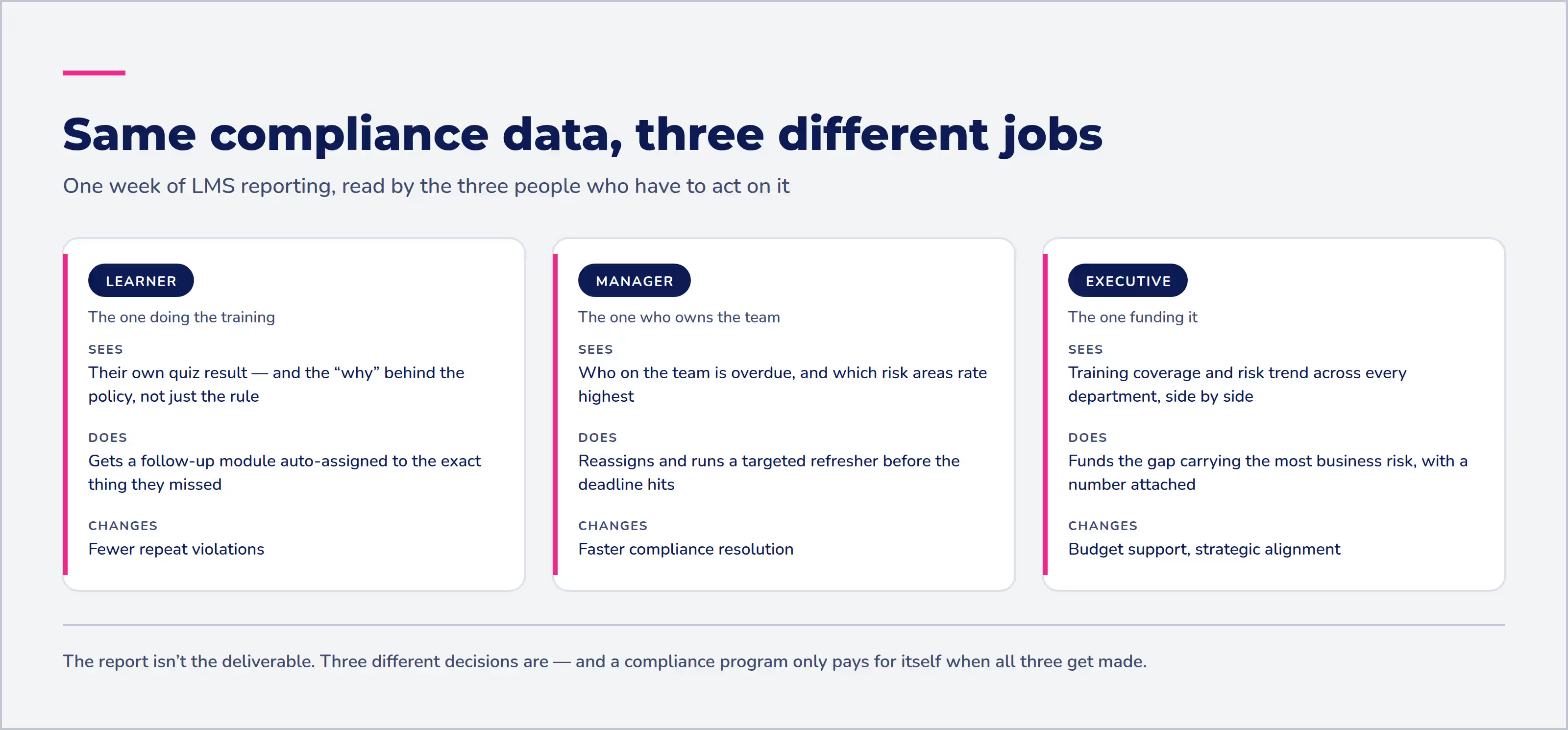
- One dataset, three jobs. Learners need the why, managers need who's overdue, executives need risk with a number on it.
- Annual reporting breaks at monitoring. Collect, analyze, act, and report survive a yearly cadence. Monitoring doesn't.
What are the types of compliance reports that drive training improvements?
Report type | What it captures | What to do with it |
|---|---|---|
Phishing simulation | Click-through rates, reporting rates, team-level vulnerabilities | Target security awareness training at the teams clicking most — fewer incidents, lower IT support costs, a stronger cyber insurance posture |
LMS completion and assessment | Completion rates, quiz scores, overdue training | Find the low-engagement departments and change the content or the delivery style — higher compliance rates, fewer audit penalties |
Risk rating | Departmental risk assessments, mitigation costs, inconsistent definitions | Standardize what “risk” means across teams and align training to one threshold — better cross-functional decisions, stronger audit outcomes |
Regulatory change tracking | Jurisdictional updates, policy shifts, audit triggers | Refresh or build training the moment the law moves — avoided fines, maintained certifications, less legal exposure |
Feedback and survey | Learner feedback, engagement scores, content relevance | Improve course design, add interactivity, adjust tone and length — higher uptake, lower re-training costs |
Five report types, and the training decision each one should trigger.
1. Phishing simulation reports
According to KnowBe4’s2025 Phishing by Industry Benchmarking Report, organizations that implemented ongoing security awareness training saw an 86% drop in phishing click rates, from 33.1% to just 4.1% over a period of 12 months.
Phishing simulation reports aren’t just IT’s problem—they’re a frontline defense strategy to keep your whole organization safer. They surface team-level vulnerabilities and shine the spotlight on opportunities for learning and development (L&D) experts to deliver targeted compliance training that sticks.
Phishing simulation is all about readiness and confidence. When your compliance program uses data to guide security awareness and inform new or different training, not just reduce risk—you’re building a culture of growth and vigilance.
Note: Training that’s not one-and-done can be more effective, leading to lasting behavior change and a reduction in vulnerability. A microlearning approach is queen.
2. LMS completion and assessment reports
Completion rates and quiz scores are good signals. These reports help you spot where your compliance program is falling flat and where you can better support your learners. Once you dig in, you’ll see working and what’s not.
The data you capture (both quantitative through numbers and qualitative through feedback) is how you can move from generic training to high-impact compliance learning that drives performance and protects your business.
3. Risk rating reports
Risk rating reports are designed to answer a critical question: “Are we training our people about the right risks, in the best ways, at the right times?”
If all the departments in your organization define risk differently, your compliance program is losing its focus. Risk rating reports can help standardize risk definitions across your organization, so your training aligns with actual, overarching business threats rather than assumptions or outdated information.
By capturing departmental risk assessments, mitigation costs, and inconsistencies, these reports allow L&D teams to prioritize training where it matters most. The result? Smarter decisions, fewer manual errors, and focused compliance reports that support true risk management.
An excellent risk rating report informs and sparks reflection, critical thinking, and reminds employees that managing risk is much more than just remembering rules. When today's training is aligned with today’s risks, your workforce becomes a proactive line of defense.
4. Regulatory change tracking reports
Regulatory updates don’t wait, and your training shouldn’t either. These reports ensure your compliance program evolves with the law, not behind it. Whether it’s a new workplace safety rule or a data privacy shift, tracking changes lets you respond fast, train smart, and stay audit ready. It’s not just about avoiding fines; it’s about protecting your reputation and staying ahead of risk.
For an example of an industry’s constant challenges with shifting regulations, check out our article on healthcare compliance training.
5. Feedback and survey reports
Your best source of insight? Your learners! Feedback and survey reports reveal what’s working for them, what’s not, and where your compliance training can improve. When you listen to learners and adjust accordingly, you build a compliance program that’s engaging and relevant.
As you’re designing feedback questions, here are three vital steps to crafting effective post-training surveys:
- Define the survey’s purpose to make your data meaningful and actionable.
- Identify the information you need from your survey participants to gather relevant data for your training goals.
- Make sure every question is relevant—be clear, concise, and brief.
Turning compliance reports into action
The right LMS turns compliance reporting from a reactive chore into actionable data. When you're choosing your LMS, look for automated workflows, real-time dashboards, and AI-powered insights. With this, you can turn data into decisions—faster, smarter, and with measurable impact.
If you’ve struggled to justify compliance training in your organization, read the white paper: The culture of compliance is more than just checking a box.
Compliance insights for learners
We’re talking performance, preference, and pace
Don’t just deliver generic compliance training content in a silo and hope it sticks. Ideally, your compliance training is a personalized experience that adapts to each learner’s performance, preferences, and pace.
Contextual learning—explaining the “why” behind each policy or regulation—helps learners retain information and apply it in real-world scenarios. The result? Compliance-based capability and confidence.
Using AI-driven logic, platforms like Absorb automatically assign follow-up modules based on quiz results, flag overdue training, and nudge learners with timely reminders. These nudges alone have been shown to increase completion rates.
Absorb also integrates feedback loops directly into the learning experience. Learners can rate content, suggest improvements, and flag confusion points, giving L&D teams real-time insight into what’s working and what’s not. You can use this data to adjust tone, format, and delivery, resulting in higher course satisfaction scores.
And while increased engagement is great, outcomes are what matter most. Personalized compliance journeys lead to:
- Higher retention
- Fewer repeat violations
- Improved audit readiness
- Reduced risk exposure
Does your compliance training offer the following?
- Targeted training: Assigns follow-ups based on quiz performance
- Gamification: Incentivizes learner engagement
- Contextual learning: Explains the “why” behind training
- Feedback loops: Improves content based on learner input
- Automated nudges: Reduces missed deadlines
Your LMS should be your partner in getting higher completion rates, better retention, and reducing risk.
Explore Absorb's learner experience
Compliance insights for managers
Make compliance a team sport, not a solo scramble.
Managers are culture-shapers! They need the right tools to lead with data, not guesswork. Absorb's Manager Experience gives managers real-time visibility into team training metrics, overdue compliance modules, and risk-priority areas—all in one intuitive dashboard.
Managers can assign region-specific training, track performance against KPIs, and lead refreshers that reinforce learning in context. By surfacing high-risk teams and low-engagement patterns, Absorb LMS helps managers focus their efforts on where they’ll have the greatest impact.
The results speak for themselves: organizations using Absorb’s manager dashboards report faster compliance resolution and fewer audit flags.
It is an easy-to-use platform with robust reporting and dashboards. Implementing robust reporting and dashboard features in Absorb LMS involved configuring custom reporting tools and dashboards to effectively track learner progress, performance, and engagement metrics.” —Verified reviewer
Equip your organization’s managers with the LMS that enables them to act on the real-time data their LMS delivers. (Because passive monitoring is so yesterday.)
Enable managers to coach and monitor using real-time data:
- Team dashboards: Visibility into training metrics
- Risk-based prioritization: Focus on high-risk teams
- Manager-led refreshers: Reinforce learning
- Performance alignment: Link training to KPIs
- Localized content: Assign region-specific training
Impact: Stronger compliance culture, fewer audit issues, improved accountability.
Compliance insights for executive stakeholders
Meaningful dashboards should enable meaningful decisions
Executives don’t need numbers—they need data delivered with clarity, context, and confidence. Absorb LMS delivers all three with reporting tools that turn compliance metrics into actionable strategy. Leaders can spot risk trends, monitor training coverage across departments, and track ROI in real time, making it easier to align learning initiatives with quarterly goals and enterprise-wide priorities.
With Absorb, executives can frame compliance gaps as business risks, quantify the cost of non-compliance, and justify training investments with hard numbers.
Cross-functional governance becomes easier too. Standardized reporting across departments ensures consistent definitions of risk, training coverage, and performance benchmarks—critical for audit readiness and strategic planning.
Translate compliance data into strategic decisions:
- Executive dashboards: Visualize risk trends and training coverage
- Business case framing: Show gaps as business risks
- ROI metrics: Quantify training impact
- Strategic planning: Inform quarterly goals
- Cross-functional governance: Standardize reporting
Impact: Increased leadership buy-in, budget support, strategic alignment.
Benefits of compliance reporting
Use your data as a growth lever
From proactive risk management to smarter training investments, there are a lot of reasons to consider which LMS can help you squeeze the most value out of your training. There are a lot of great systems out there to check out, including Absorb LMS.
According to a Forrester TEI study, organizations using Absorb saw a 490% ROI on enterprise learning and found:
- Proactive risk management
- Smarter training investments
- Improved audit readiness
- Higher employee engagement
- Stronger business performance
Visit Absorb’s website to download a copy of the report.
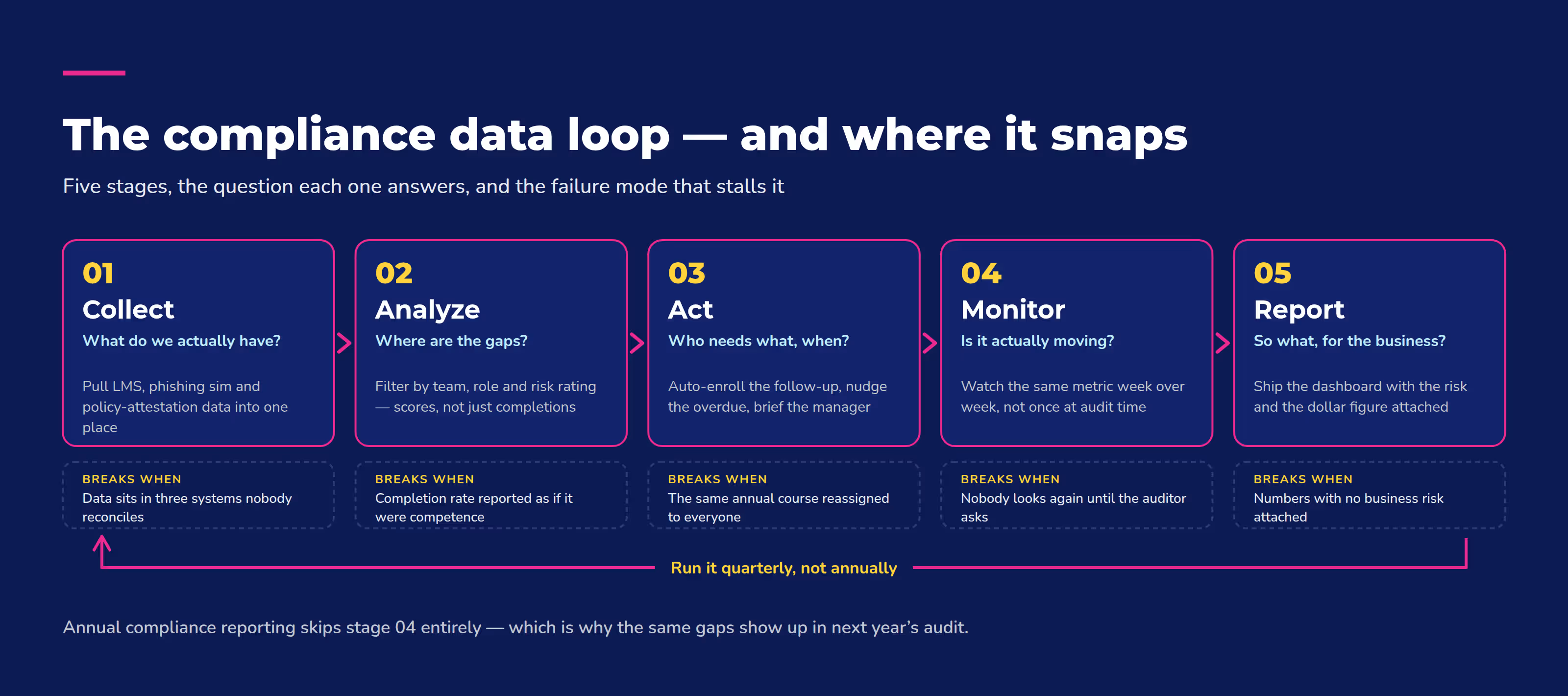
Compliance reporting process: From data to decisions
Make it easy
Absorb LMS streamlines every step of the compliance reporting process. In one platform, you’ll collect data, analyze results, act on insights, monitor progress, and end up with shareable dashboards.
- Collect: Use LMS and built-in security tools to gather data
- Analyze: Identify trends, gaps, and opportunities with customizable filters
- Act: Tailor training, automate enrollments, engage teams, align with goals
- Monitor: Track progress and adjust in real time
- Report: Share dashboards with stakeholders
Automated compliance reporting: Why it matters
Save your time for what matters most
There’s a lot of talk about AI in business. We’re all for systems that handle the tasks you don’t want to do and don’t have time for. Absorb LMS automates notifications, certificate delivery, renewals, and reporting—reducing your admin time and making sure your information is ready for audits.
Manual reporting is slow, error-prone, and reactive. Automated compliance reporting gives you more time back, along with:
- Real-time insights
- Consistent data formats
- Scalable monitoring
- Faster decision-making
The bottom line: Make your compliance program work harder (so you don’t have to)
Your compliance program isn’t just a safety net—it really can be a strategic lever. With the right tools, you can turn data into action, reduce risk, and drive real ROI for your organization.
