




Personalized corporate learning gives each employee training matched to their role and the skills they're missing, instead of the same course for everyone. ATD's 2026 research found that more than 80% of organizations personalize their eLearning content.
If you run learning and development (L&D) or training programs, you know personalized learning in corporate training usually starts with the easy version, tailoring by department. Building each person's missing skills, and showing that job performance improved, is harder.
What is personalized corporate learning?
Personalized corporate learning is workplace training that adapts content, sequence, pace, timing, and support to each employee's role, current skills, and goals. It uses rules, data, or AI to decide who gets what. Everyone works toward the same performance standard, but people take different routes to reach it.
One-size-fits-all training sends a 10-year veteran and a new hire through the same 45-minute module. Personalized learning lets the veteran prove what they know and move on, while the new hire gets the full walkthrough.
You'll also hear it called individualized, tailored, or customized learning. Adaptive learning is a narrower piece of the picture. It's software that adjusts difficulty in real time based on how someone answers.
Most L&D teams already tailor some content by role or audience. That's different from finding where each employee falls short and checking whether training improved their performance.
What can you personalize, and what should stay the same?
Keep the performance standard fixed for everyone, and change how each person gets there based on where they're starting.
Skills are the reason this matters. In the World Economic Forum's latest survey of more than 1,000 employers, 63% named missing skills a major barrier to business transformation through 2030.
5 things you can personalize
- Content: What someone learns, based on their role and the skill you're building.
- Path and sequence: The order they take it in. A new manager and a veteran manager shouldn't start at the same module.
- Pace: Pre-assessments let people test out of what they already know. Adaptive assessments keep difficulty in the sweet spot. Too hard and people get frustrated. Too easy and they tune out.
- Timing: What triggers the training. Day one, a promotion, a new tool rollout, or a dip in a performance number.
- Support: Manager check-ins, coaching, and practice that turn a course into a changed habit.
Format can vary too, when there's a practical reason. A frontline worker may need a five-minute mobile module with captions, so build for it.
What to keep standard
Keep required content the same for everyone. That includes compliance, safety, core policy, and anything tied to a certification. What you can personalize is the practice and reinforcement around it, like extra refreshers on the questions someone missed.
Managers connect all of this to the job, and they carry real weight. In 2015, Gallup found managers account for at least 70% of the variance in employee engagement scores across business units.
Rules-based vs. AI-recommended personalization
A personalized learning model can combine rules and AI. Rules assign training based on facts you already have, like role, location, tenure, or an assessment score. They're predictable and easy to audit.
AI recommends content and adapts practice based on skills and behavior data. It's more flexible, but it needs someone checking its work.
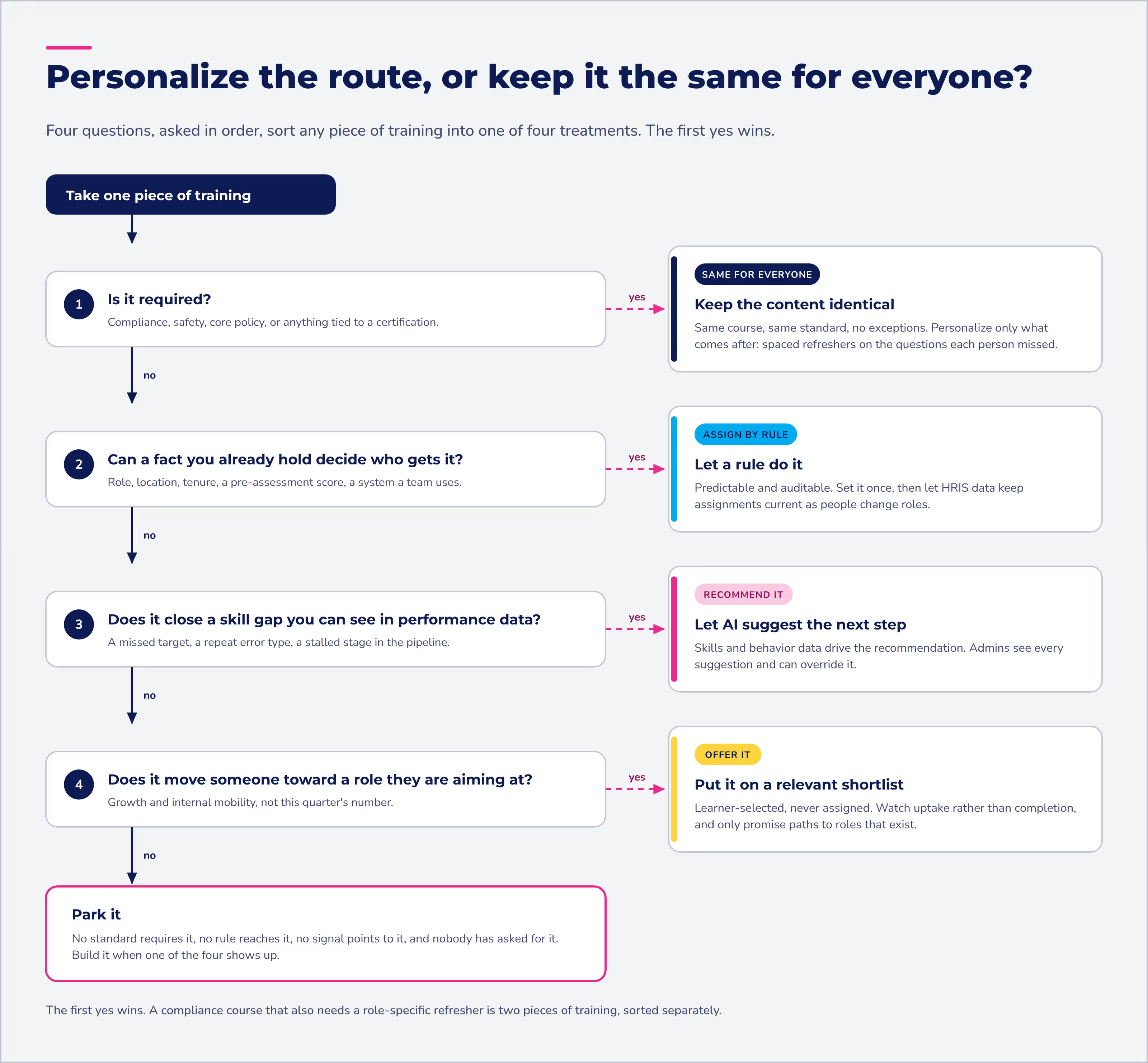
To sort any piece of training, ask four questions in order. The first yes decides how you handle it.
- Is it required? If it's compliance, safety, core policy, or tied to a certification, keep the content identical for everyone. Personalize only the refreshers that come after.
- Can a fact you already hold decide who gets it? Role, location, tenure, a pre-assessment score, or a system someone's team uses all count. Let a rule assign it, and let your HR system keep assignments current as people change roles.
- Does it close a skill gap you can see in performance data? A missed target, a repeat error, or deals stalling at one stage are good signs. Let AI recommend it, with admins able to see and override every suggestion.
- Does it move someone toward a role they're aiming for? Put it on a shortlist people choose from, and only promise paths to roles that exist.
If all four answers are no, park it until one of them changes. A compliance course that also needs a role-specific refresher counts as two pieces of training, sorted separately.
What does personalized learning look like in practice?
In practice, one person with one weak spot gets one activity, and you watch one number to see if it worked. Here are five personalized learning examples across common roles.
A service technician who needs to fix it on the first visit
Whirlpool replaced broad, generalized training for its frontline service network with personalized learning paths in Absorb LMS. It reports a 14% improvement in First Call Completion and an 8.2% increase in customer satisfaction. The case study doesn't say over what period, so treat it as one company's result.
A new frontline hire who already knows the basics
Someone joining your warehouse after three years at another one doesn't need inventory scanning 101. A pre-assessment lets them test out of the modules they've mastered and go straight to your site's procedures. Signal to watch: how long it takes them to get productive.
A sales rep losing deals at the pricing stage
When your CRM shows deals stalling at pricing, the rep gets a short negotiation refresher and a role-play to practice the conversation. Signal: conversion at that stage.
A first-time manager in the first 90 days
Instead of a generic leadership course, they get a coaching path for their first three months. It covers running one-on-ones, giving feedback, and handling the first tough conversation. Their own manager checks in along the way. Signal: their team's engagement and retention.
Everyone, on compliance
Every employee completes the same required course, no exceptions. Then each person gets spaced refreshers on the specific quiz questions they missed. Signal: assessment scores over time and incident trends.
Each example pairs a job-related shortfall with an activity and a performance signal.
What are the benefits of personalized learning for employees and the business?
The most immediate benefit is less wasted training time. People skip what they already know and spend their hours on what they don't.
New hires get productive sooner
When a new hire can test out of half the onboarding modules, they reach the job-specific material sooner. The logic is sound, but the size of the gain depends on your roles and content. Track it in your own program using the measurement steps below.
People can see what's in it for them
Adults don't learn for gold stars. They learn when training clearly helps them do the job, or get the next one. Personalization makes that connection obvious from the first module.
People remember more of what they learn
Spreading practice out over time is one of the best-supported techniques in learning research. The Association for Psychological Science rated spacing study sessions out over time as high utility, and a meta-analysis of 317 experiments backs it up.
It's why language apps ask for 10 minutes a day, not 10 hours on Saturday. Personalization makes "little and often" practical, because each person only revisits what they missed.
The research is promising, with a caveat
In education research, intelligent tutoring systems, a type of adaptive learning, raised test scores by a median of about 0.66 standard deviations across 50 controlled evaluations.
Workplace studies are thinner, so treat it as a reason to run your own test. Check whether your program reduces the job errors or ramp time you targeted.
It plays a small part in retention
Development matters to employees, but it's rarely the only reason they leave. Gallup found advancement, development, or career opportunities were the primary reason for 9% of U.S. voluntary leavers in 2024.
So personalized learning alone won't fix turnover. Paths toward internal moves help most when there are real roles to move into.
How does personalized learning support performance enablement?
Personalized learning is the part of performance enablement that reaches one person. It decides what this employee practices this week, based on what's getting in the way of their work right now.
We cover what performance enablement is, and how it differs from performance management, in a separate article. This section sticks to how personalization makes it work day to day.
A catalog-first program asks which courses to offer. A performance-first program starts from a signal, like a missed target, a spike in quality errors, or a new responsibility. Then it routes the right help to the people that signal points to.
That signal usually comes from a system you already run. Your CRM shows deals stalling at pricing. A quality log shows the same error twice in a month. Your HR system flags a promotion, a transfer, or a new tool. The LMS shows quiz questions a cohort keeps missing. After training, you compare results to the baseline and adjust the rule. In a catalog-first program, the completion report is where the work stops.
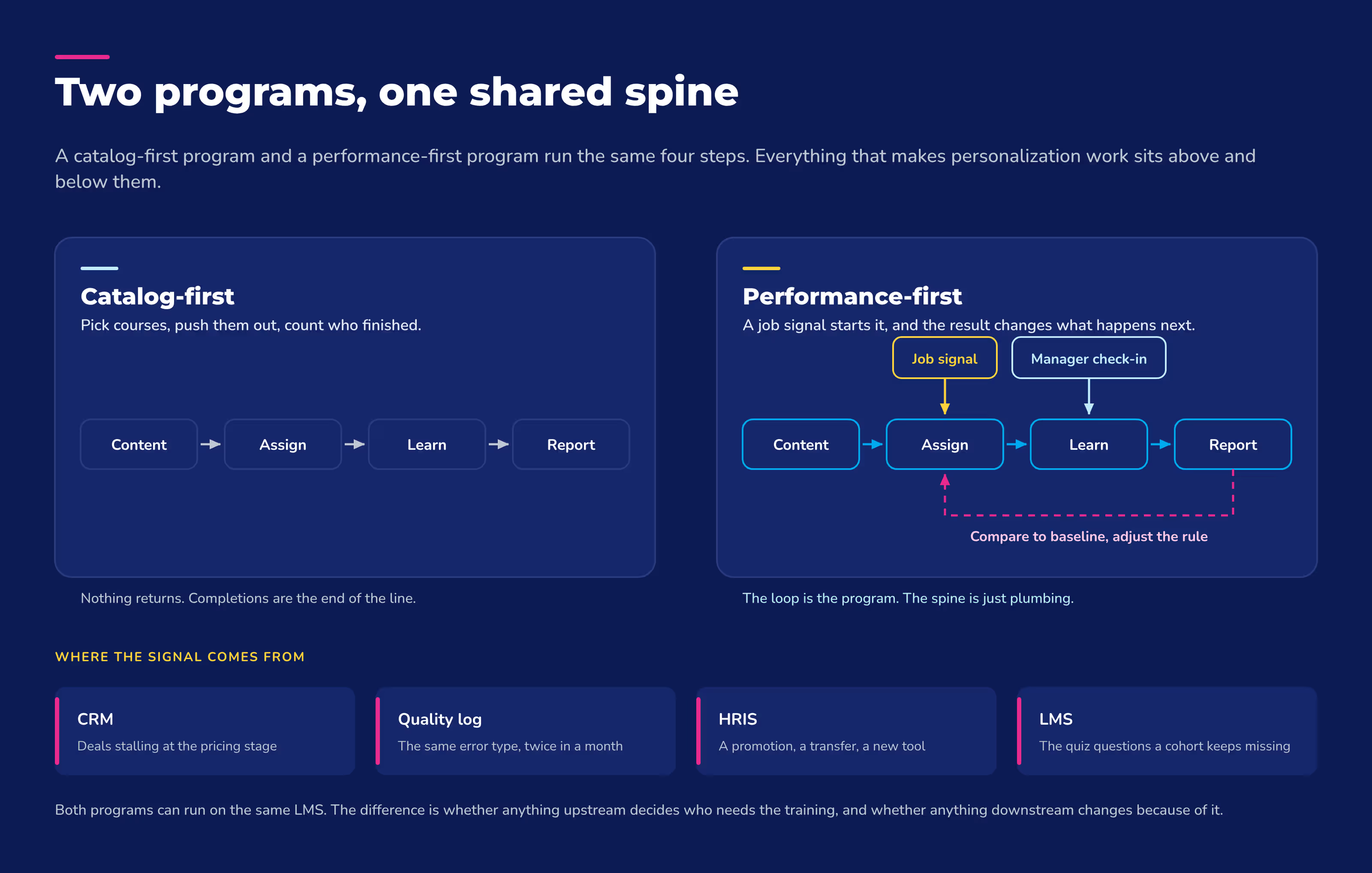
Managers make the connection stick. A short check-in to review progress, give feedback, and talk through what's hard keeps learning attached to the actual job. Without it, even well-targeted training becomes one more thing to complete.
How is AI changing personalized corporate learning, and where are its limits?
AI can make personalized corporate learning affordable at scale. It doesn't decide what good performance looks like. You still do.
Building individual development plans by hand takes staff time, which makes them hard to offer everyone.
Using AI for personalized learning can help by drafting plans, recommending relevant content, and producing variants. People stay responsible for reviewing what it suggests. Many teams have started on the content side. In ATD's 2026 research, about 65% of organizations use AI to create learning assets.
What AI adds
- Recommendations based on someone's skills, role, and history
- Adaptive practice and assessments that adjust difficulty as people answer
- AI coaching and role-play, so people can rehearse a tough conversation before it happens
- Faster content variants, so one course becomes versions for different roles or regions
Where AI falls short
AI is only as good as its data and the people overseeing it. NIST's AI Risk Management Framework lists traits of trustworthy AI that include being accountable and transparent, privacy-enhanced, and fair, with harmful bias managed. In personalized learning, watch for:
- Biased or incomplete data that skews recommendations
- Learners not knowing what data shapes their path
- Filter bubbles, where people only see more of what they already clicked
- Over-automation that cuts the manager out
AI doesn't replace instructional designers or managers. Designers set the standards and build the content AI draws from. Managers check whether recommendations make sense for the person in front of them.
How do you measure whether personalized learning is working?
Measure the problem you set out to fix, against a baseline. Counting completions isn't enough.
In ATD research, 84% of talent development functions say quantifying their impact is a challenge when reporting to senior leaders. A simple method helps:
- Pick one performance metric per program before launch, like ramp time, error rate, or quota attainment.
- Record a baseline for the people about to start.
- Compare results against a group that hasn't gone through it yet, or your last cohort.
- Track leading indicators, such as assessment gains, test-out rates, time saved, and what managers see on the job.
- Track lagging business metrics once enough time has passed.
- Adjust the rules or recommendations based on what you learn.
This mirrors the Kirkpatrick Model, which recommends starting with Level 4 results and tracking both leading and lagging indicators.
Completion rates still have a place. They tell you who showed up. They don't tell you who can do the job better.
For the long view, ask:
- Are the roles you targeted building the skills they lacked?
- Has participation in optional programs gone up?
- Has learner sentiment improved?
- Are more people moving into new internal roles?
- Is employee retention improving?
What should you look for in an LMS to personalize learning at scale?
An LMS can personalize learning at scale when it takes in people and skills data, assigns training automatically, adapts assessments, and reports on job performance.
When you compare platforms, check for:
- Data in: HR information system (HRIS) integration and skills profiles, so assignments reflect who people are today
- Assignment: Rules that assign training from the facts you hold, plus AI recommendations admins can see and override
- Pace: Pre-assessments and test-outs
- Support: Manager visibility into their team's progress
- Practice: AI coaching or role-play
- Reach: Mobile and frontline access, plus support for multiple locations, languages, and audiences
- Proof: Reporting tied to business key performance indicators (KPIs)
- Trust: Privacy controls and admin oversight of AI
Ask vendors these questions:
- What data can your system use to assign training automatically?
- Can admins see and override AI recommendations?
- Can learners test out, and how is that recorded?
- Can you show me a report that connects training to a business metric?
Some teams look at a learning experience platform (LXP) for personalization. LXPs typically focus on content discovery, while an LMS handles assignment, compliance, and reporting. Many personalized learning platforms and tools now do both, so compare them on the capabilities above.
You can connect your HRIS for employee data and automate training on your own rules. Absorb Skills delivers personalized learning paths built around the skills each person needs.
For practice and access, Absorb Aura coaches people in the tools they already use. Aura Rehearse, coming soon, will let them role-play scenarios built from your own training content and get feedback. The Absorb Frontline App reaches people who don't sit at a desk.
For proof, Absorb Analyze ties training to your organization's KPIs.
Frequently asked questions
What is another word for personalized learning?
Individualized, tailored, or customized learning. Adaptive learning is a related but narrower term for software that adjusts in real time.
Is personalized learning the same as adaptive learning?
No. Adaptive learning adjusts content or difficulty in real time based on how someone performs. Personalized learning is the broader approach, and adaptive tools are one way to deliver it.
What's the difference between customized corporate training and personalized learning?
Customized corporate training is content built for your company. Personalized learning means each person's route through that content is different. You can personalize off-the-shelf courses, too.
Does personalized learning work for frontline employees?
Yes, when you build it around how they work, with mobile access, short modules, and role-specific content. Whirlpool's service network is one example.
How do I start personalizing training with a small L&D team?
Start with one high-impact role. Add a pre-assessment so people can test out, use rules to assign the rest, and add AI recommendations once the basics work. That gives you a personalized corporate training program you can measure, then expand.
Does personalized learning fit into a corporate learning strategy?
Yes. It's how your corporate learning strategy reaches each individual employee.
Where should you start with personalized corporate learning?
Start small, and personalize to what people need on the job. Pick one role, one missing skill, and one job.


