


.jpg)


An organizational learning strategy is a deliberate, company-wide plan for how your organization creates, captures, and applies knowledge, so people get better at their jobs over time. It's different from a training calendar. A training calendar lists courses. A strategy sets the goals, the ownership, the budget, and the systems that make learning stick — and unlike the calendar, it has to survive contact with a skeptical CFO.
If you're an L&D or HR leader and your team runs a lot of training but still can't answer "did it change how we work," you might have activity without a strategy. Sometimes, a full calendar is mistaken for a plan. This guide covers what an organizational learning strategy is, why it's worth building one, its core elements, how to build one step by step, the barriers that derail most attempts, and how to know if yours is working.
What's an organizational learning strategy?
An organizational learning strategy is a company's deliberate plan for creating, capturing, and spreading knowledge, so employees and teams get measurably better over time. It sets who owns the effort, what gets measured, and which systems support it, instead of leaving learning to whatever training happens to land on the calendar.
To note, organizational learning strategy and organizational learning aren't quite the same thing. Organizational learning is the broader capacity. It answers how well your company learns from experience in general. Researchers have studied how organizations build that capacity since the early 1900s, which makes the field considerably older than the org chart you're currently trying to fix.
A few of these terms get used interchangeably at the worst possible moment, usually in a budget meeting where someone asks how this is different from the training calendar you already have. Here's the cheat sheet for that exact moment:
Term | What it means | How it differs from an organizational learning strategy |
L&D strategy | Training programs, curricula, and delivery | Training is one input to a strategy, not the whole plan. Two companies can run the exact same course calendar and still land in very different places. |
Knowledge management strategy | The systems for capturing and storing information: wikis, knowledge bases, documented processes | A knowledge management system without a strategy behind it is just a well-organized filing cabinet nobody opens. |
Learning organization | The outcome: a company built to keep learning and adapt, the concept researchers have described since Peter Senge's 1990 book, "The Fifth Discipline" | It's the destination. A strategy is how you get there. |
Learning culture | The mindset: whether people feel safe asking questions and sharing mistakes | It's the norms, not the plan. You can't put "learning culture" on an org chart. A strategy gives it budget, ownership, and structure, covered in the step-by-step section below. |
Researchers also separate tacit knowledge (what people know from experience but rarely write down) from explicit knowledge (what's documented and easy to share). A strategy that only captures explicit knowledge misses most of what your best people know.
Why an organizational learning strategy is mission critical
A deliberate organizational learning strategy builds capabilities faster and loses fewer people than treating learning as an afterthought. The numbers back that up.
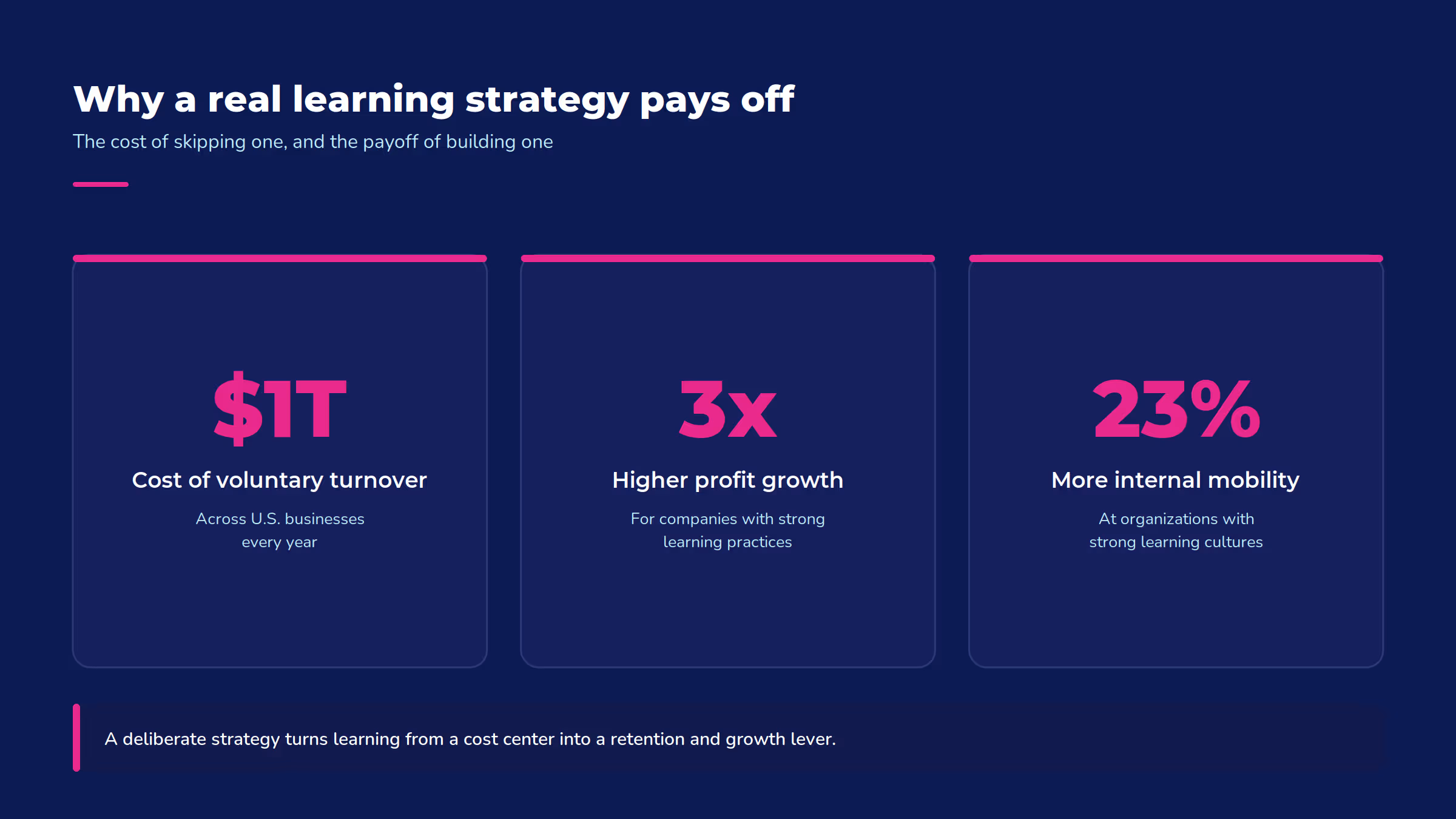
Let's start with the cost side. Voluntary turnover alone costs U.S. businesses roughly $1 trillion a year, and replacing a single employee typically runs half to two times their annual salary. Much of that turnover is preventable: 42% of employees who leave voluntarily say their manager or organization could have done something to keep them. Learning and growth opportunities are consistently one of the things that keeps people from walking out the door.
Now the return side. A long-running study of nearly 300 organizations found that companies with high-impact learning practices generated three times higher profit growth than their peers over a multi-year period. That's not a small edge. It's the kind of gap that shows up in board meetings, right before someone asks why your department isn't doing that.
This happens because a company decided learning was a business function worth managing on purpose, with a budget, an owner, and a way to measure progress, the same way it manages a sales pipeline or a product roadmap. That's the case for treating corporate learning strategies as core infrastructure.
The core elements of an organizational learning strategy
The elements of an organizational learning strategy are: alignment to business goals, clear governance, a knowledge-capture system, defined KPIs, dedicated budget, leadership sponsorship, and a culture that rewards sharing what you learn. Miss more than one or two of these, and the strategy tends to drift back into "just more training."
What each one looks like in practice, not just on a slide:
Element | What it does |
Alignment to business goals | Ties learning priorities to what the company is trying to achieve this year, not a generic skills wish list |
Governance | Names who owns the strategy, who approves spend, and who is accountable when it stalls |
Knowledge-capture system | Gives people a place to document what they learn, so it outlives any one employee |
KPIs and measurement | Defines what "working" looks like before you start, covered in more detail later in this guide |
Budget | Protects the strategy from being the first thing cut when priorities shift |
Leadership sponsorship | Signals that learning is a business priority, not an HR side project |
Culture that rewards sharing | Makes people willing to document mistakes and lessons, not just wins |
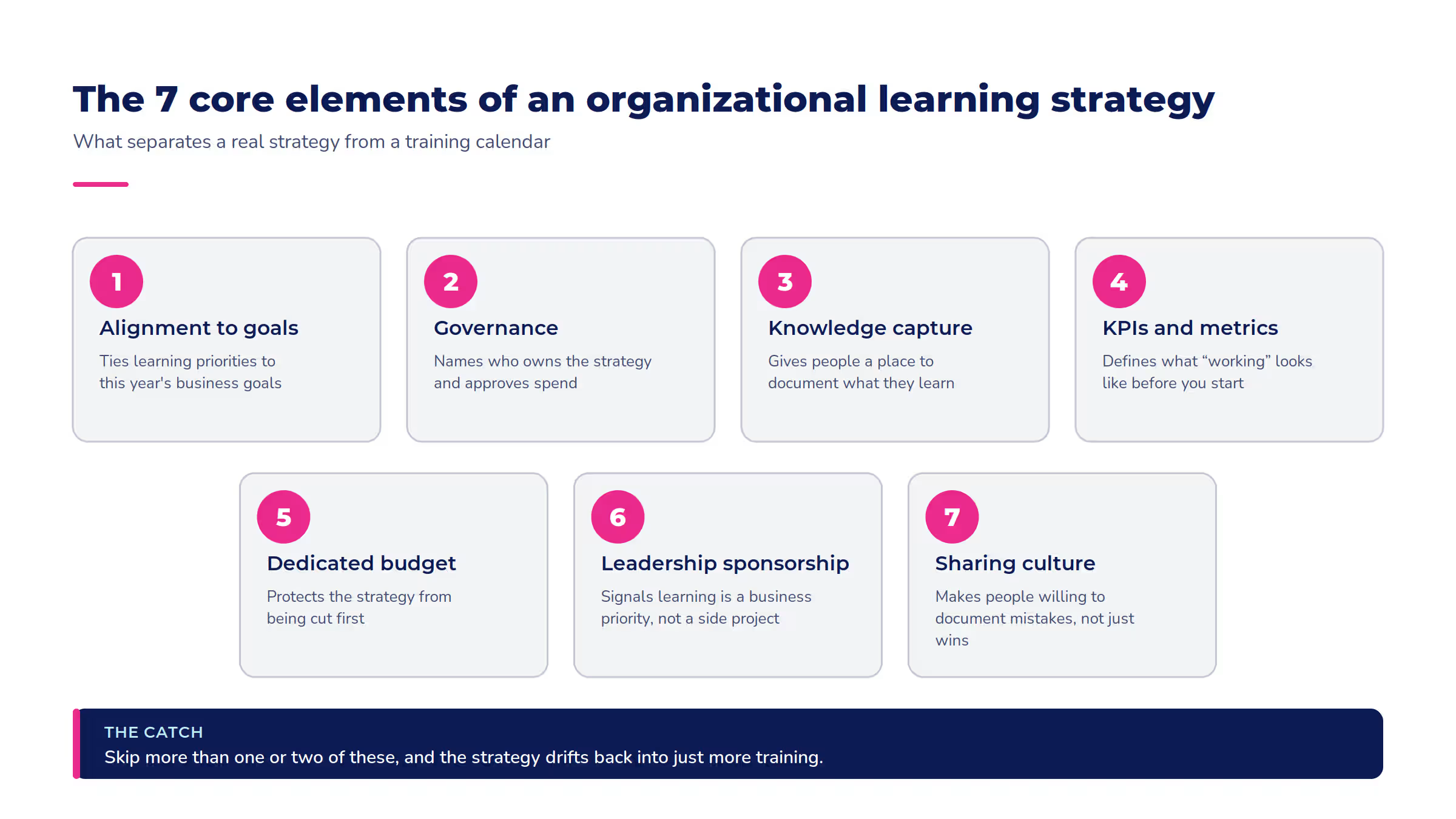
Pull any one of these out, and the other six start to wobble. A knowledge-capture system without governance becomes an unused wiki. Budget without leadership sponsorship gets reallocated the first time the company needs to cut costs.
Building all seven at once isn't realistic for most teams, though. The step-by-step section below covers how to sequence them.
How to build an organizational learning strategy, step by step
Build an organizational learning strategy by assessing where you stand today, then working through five more steps that turn that assessment into a working system: align to business goals, choose your knowledge-capture systems, define governance, build the learning-culture layer, pilot, and roll out.
- Assess where you are now. Before building anything, figure out what's happening today. Where does knowledge live: in people's heads, in scattered documents, in a system nobody updates? Talk to a few managers about what slows their teams down when someone leaves or a process changes. This tells you which elements from the list above need the most work.
- Align the strategy to specific business goals. Pick one or two business priorities this year, like faster onboarding, fewer support escalations, or better internal mobility, and build the strategy around those instead of learning for its own sake. A strategy tied to a metric leadership already tracks is much easier to fund and defend.
- Choose the systems that will support it. You need a way to deliver training, capture what people learn, and see whether it's working — ideally in one system instead of three disconnected tools duct-taped together. This is where your learning management system does more than host courses. An Absorb LMS knowledge base can hold what your team documents as they go, and built-in reporting can show you who is actually applying what they learned, not just who clicked "complete."
- Define ownership and governance. Name one person or team accountable for the strategy, and set a simple approval process for spend and new initiatives. Skip this step, and the strategy becomes everyone's job, which in practice means it's no one's.
- Build the learning-culture layer. This is where a learning culture, the norms and behaviors from the definitions section above, gets built deliberately instead of hoped for. Ask managers to model sharing their own mistakes. Make space in team meetings for someone to walk through a lesson learned. Hybrid and remote teams need more intention here: build in async ways to share knowledge, like a short recorded walkthrough or a written retro, since people won't stumble into a hallway conversation the way they might in an office.
- Pilot before you roll out company-wide. Run the strategy with one team or one business goal first. Measure what happens, fix what's broken, and use that pilot as proof when you expand.
One Absorb customer, ITRS, put several of these steps into practice at once. The company needed to shift a geographically dispersed workforce onto an OKR framework, so it built structured learning into onboarding and ongoing development, using its LMS to deliver nearly 30 live workshops alongside self-paced eLearning. The result: a 95% completion rate on OKR training, and more than 95% of employees with active, business-aligned goals. That's steps two, three, and six above working together: a business-tied goal, one system doing the delivery and tracking, and a measured rollout instead of a one-time training push.
The scale changes with company size, even when the steps don't. A mid-size company might run all six steps with one part-time owner and a single pilot team. A larger enterprise usually needs a governance committee of several people, a phased rollout across business units, and more structured support to help people adjust, to get consistent adoption across a bigger, more dispersed workforce.
Common barriers to organizational learning (and how to get past them)
The biggest barriers to organizational learning are resistance to change, weak leadership buy-in, no dedicated budget or owner, and difficulty proving it's working. Each one has a specific, practical fix.
Resistance to change.
Middle managers usually feel this first — they're the ones explaining the new process to a skeptical team on a Monday morning. Prosci's long-running change management benchmarking research, which surveys thousands of change leaders worldwide, consistently finds that sponsorship quality is the single biggest driver of whether a change effort succeeds, and that most organizations don't adequately prepare managers to lead people through it. Train your managers on how to lead people through the change, not just brief them on what it is.
Lack of leadership buy-in.
If executives treat the strategy as an HR initiative rather than a business one, it won't survive the next budget review. Fix: tie the strategy to a metric leadership already cares about, and get a visible executive sponsor before you launch, not after something goes wrong.
No dedicated budget or ownership.
A strategy with no line item and no named owner rarely gets past the planning stage. It becomes the thing everyone nods along to in the kickoff meeting and nobody mentions again — until someone asks about it eighteen months later and nobody remembers who owns it. Fix: treat governance and budget as part of the initial build, not something you'll figure out later.
Difficulty proving it's working.
Ask most L&D teams what training accomplished last quarter, and you'll get a completion rate, not an answer about whether anyone works differently now. Define your KPIs before you launch, not after leadership asks for a readout you can't give them. The next section covers what to measure.
How to measure whether your organizational learning strategy is working
Measure your organizational learning strategy with a small, specific set of metrics: knowledge retention and application, internal mobility, time-to-competency, and engagement with your knowledge-sharing systems, not just completion rates or satisfaction scores.
Knowledge retention and application: Are people using what they learned weeks later, not just passing a quiz right after a course? This is the clearest signal that learning stuck.
Internal mobility: Are employees moving into new roles or taking on stretch projects because they've built the skills to do so? Organizations with strong learning cultures see 23% more internal mobility than those without, and a rising rate on your own team is a strong sign your strategy is building real capability, not just checking boxes.
Time-to-competency: How long does it take someone to get fully productive in a new role or after a process change? A shorter timeline usually means your knowledge-capture and onboarding systems are earning their keep, not gathering dust in a folder nobody opens.
Engagement with knowledge-sharing systems: Are people contributing to and pulling from your knowledge base, or does it sit unused? Low usage is often the first sign a strategy is losing steam.
An LMS with built-in analytics makes several of these easier to track in practice, like seeing which knowledge-base content gets used most after a course instead of guessing. You don't need an elaborate dashboard to measure organizational learning success: a handful of consistent signals, tracked over time, tells you what you need to know.
Frequently asked questions
What does a real-world example of a learning organization look like?
A learning organization treats knowledge sharing as a normal part of how work gets done, not a separate initiative. One example: a company that builds retros into every project, documents what worked and what didn't in a shared system, and expects managers to reference those lessons the next time a similar project starts. It's less a program you can point to on a slide and more a habit nobody has to be reminded to do.
What is the difference between an organizational learning strategy and a learning culture?
A learning culture is the mindset: whether people feel safe sharing mistakes and trying new things. An organizational learning strategy is the plan that builds and supports that mindset on purpose, with ownership, budget, and specific practices behind it. You need both. A strategy without a supportive culture is a policy nobody follows, and a culture without a strategy tends to stay informal and fragile — one good manager away from disappearing.
How long does it take to see results from an organizational learning strategy?
Most companies see early signals, like better engagement with knowledge-sharing systems or faster onboarding for a pilot team, within a quarter or two of a focused pilot. Company-wide, measurable shifts in metrics like internal mobility or time-to-competency usually take longer, often two to four quarters, since those numbers move slowly by nature.
Building a strategy that lasts
An organizational learning strategy only works when you treat it like any other business strategy: a clear goal, an owner, a budget, and a way to know if it's working. It's not a label you put on your existing training calendar. Start with an honest assessment of where knowledge lives in your company today, align the effort to one business goal leadership already cares about, and pilot before you scale.
The systems you choose matter here too. If answering "did this work?" takes a special project every time, you have the wrong system. An LMS that combines training delivery, a knowledge base, and reporting in one place, like Absorb LMS, makes it easier to see whether your strategy is changing how people work, not just whether they finished a course.
See how Absorb LMS supports this in practice
You can start step one of this guide today with no new software: assessing where knowledge already lives in your company. When you're ready to put the knowledge base, reporting, and governance pieces in place, we'll show you how Absorb LMS handles it.



.avif)