




Scenario-based learning puts people in realistic situations where they have to make decisions, without the real-world fallout of getting those decisions wrong.
It's one of the fastest-growing training methods in corporate learning. 69% of organizations now use simulations or scenario-based learning, according to ATD's 2025 State of the Industry report.
This article is for anyone who leads training, compliance, or customer education. It covers whether scenario-based learning belongs in your program and how to build it.
What is scenario-based learning?
Scenario-based learning is a training method that puts learners in a hypothetical, realistic situation and asks them to make decisions the way they would on the job. Instead of memorizing information, they apply it: choosing a response, seeing the result, and adjusting.
It's kind of like a flight simulator.
Pilots don't only learn to handle engine failure by reading about it. They sit in a pretend cockpit, watch the warning light come on, and pull the right lever. If they get it wrong, nobody gets hurt. They just run it again.
Traditional training tells you what to do. Scenario-based learning makes you do it, or something close enough that the skill transfers.
It's a form of active learning. You're doing the thinking, not just receiving it.
You'll also see it called scenario-based training or scenario-based eLearning. All three terms are interchangeable. “Scenario-based eLearning” just tends to show up more in the context of digital courses or authoring tools, like Articulate or Adobe Captivate.
What is a scenario-based approach?
A scenario-based approach is the basic idea behind the method — building learning around realistic situations and decisions, not just handing people facts. Scenario-based learning is the umbrella technique and program built from that idea.
You'll also see scenario-based approaches used outside corporate training, in fields like medical education and emergency response training.
How does scenario-based learning compare to problem-based and case-based learning?
Scenario-based learning gives you a defined situation with immediate feedback on your choices. Problem-based learning hands you an open-ended problem to work through on your own. Case-based learning sits in between: you analyze a case instead of living inside it or charting your own path through it.
All three fall under active, experience-driven training. But they work differently, and mixing them up means picking the wrong tool for the job.
Use this framework from the University of Queensland's Institute for Teaching and Learning Innovation to understand the differences:
Method | How it works | Best for |
Scenario-based learning | Interactive, simulated situation; learners see the result of choices in real time | Practicing a specific decision or skill, like a compliance judgment call |
Case-based learning | Analyzing a real or realistic case to work out a solution | Building problem-solving skills |
Problem-based learning | Open-ended problem; learners define their own learning objectives | Longer, self-directed projects with no set path |
For compliance training, scenario-based learning is usually the better fit. Compliance decisions are specific, and they come up again and again, so practicing the exact judgment call pays off.
Problem-based learning's open-ended structure works better for a longer project, like designing a new onboarding process, than for a single high-stakes decision.
Why scenario-based learning works
Scenario-based learning closes the gap between knowing something and being able to do it. A large review of 65 training studies backs this up: learners trained with simulation-based methods showed 9% higher retention, 20% higher self-efficacy (confidence in handling the situation), and 11–14% higher knowledge scores than learners in comparison training.
A 2025 study in PLoS One followed medical students training for forensic clinical work. Over 80% of the group trained with scenario-based simulation reported gains in classroom knowledge, problem-solving skills, and confidence — compared to fewer than 32% of students in traditional instruction.
Those gains show up in three areas:
- Retention: learners remember decisions they made more than facts they read.
- Engagement: a realistic situation holds attention in a way a slide deck doesn't.
- Decision-making skill: practicing a judgment call under safe conditions builds the same skill you need under real conditions.
Note: these numbers are for well-designed scenarios. A rushed or poorly scoped scenario won't deliver these results on its own.
The 3 building blocks of a scenario-based learning experience
Every effective scenario-based learning experience has three parts.
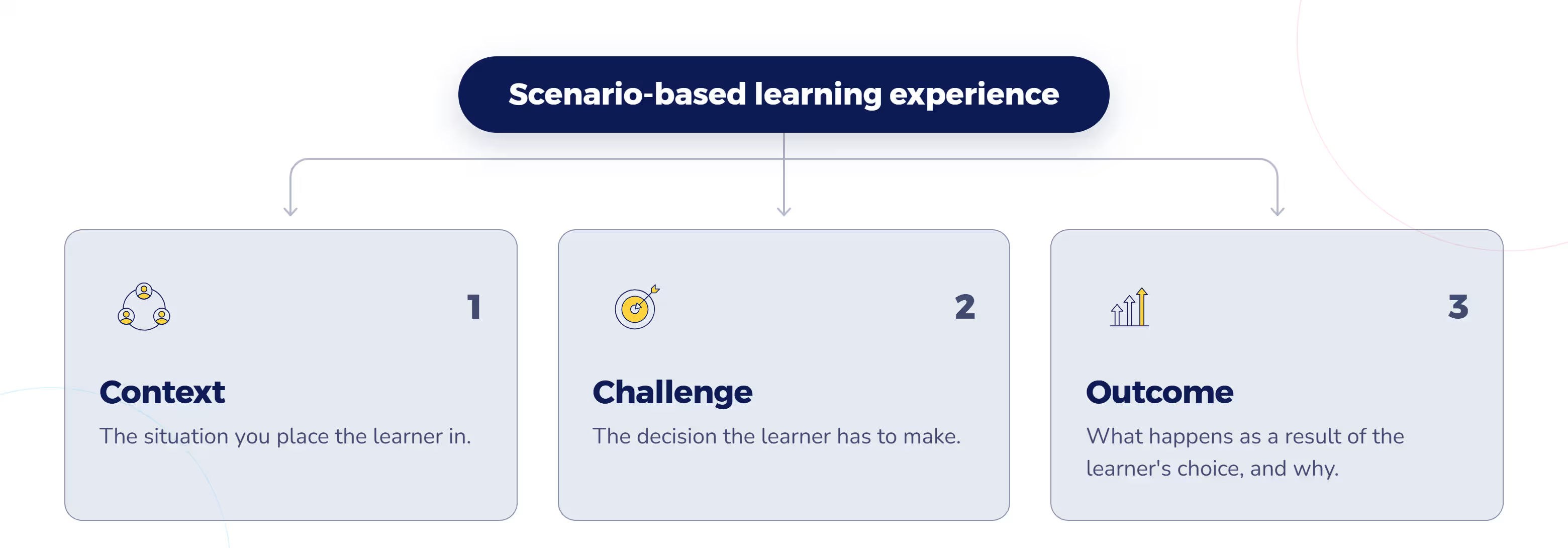
Context
The situation you place the learner in. This needs to be specific, not vague or generic. A customer service scenario should feel like an actual call, not a vague description of "handling a customer."
Challenge
The decision the learner has to make. This is where the learning happens. The challenge should carry real stakes within the scenario, even if the scenario removes the real risk.
Outcome
What happens as a result of the learner's choice, and why. A learner who escalates a customer complaint too early should see what that choice costs. A learner who handles it well should see what that choice earns just as clearly.
Example: new-manager training. The context is a direct report missing deadlines. The challenge is deciding how to address it in a one-on-one conversation. The outcome shows how the employee responds based on the approach chosen.
Leave out any one part, and the scenario falls apart.
Scenario-based learning formats
Scenario-based learning isn't just one format. It's a family of related techniques, and picking the wrong one for the job is a common reason programs underperform.
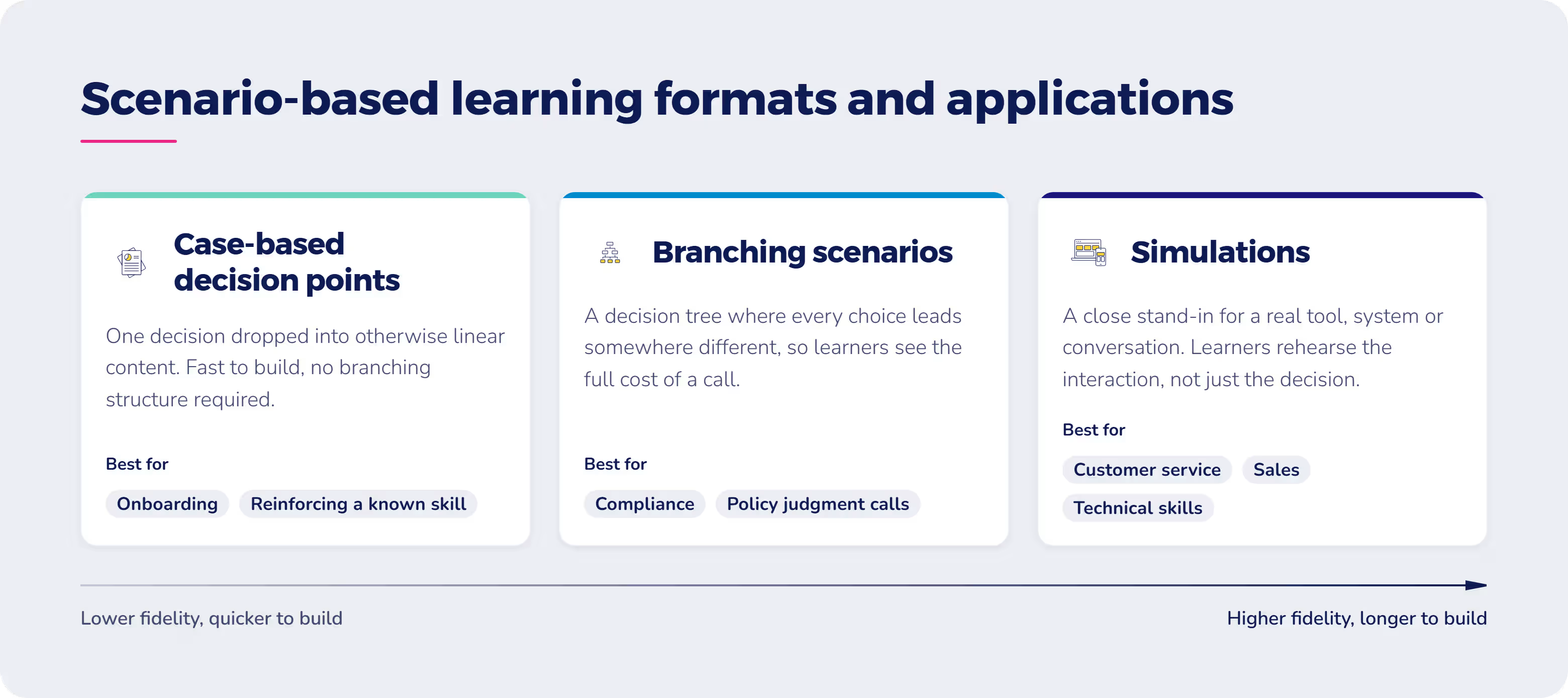
Branching scenarios
Decision-tree style content where each choice leads to a different path and consequence. Researchers who study branching-scenario design describe two main structures: linear branching follows a controlled path toward one goal, while multiple-ending branching mirrors a real case with more than one valid outcome.
Branching scenarios are strongest for compliance and policy-application training. You want learners to see the full range of what a real decision could cost them.
Simulations
Higher-fidelity settings that mimic a real tool, system, or interaction, often using AI roleplay software. Simulations work best for customer-service, sales, and technical-skill practice, where the learner needs to rehearse an interaction, not just a decision.
Case-based decision points
Shorter, single-decision scenarios placed inside linear content. They work for onboarding, and for backing up something a learner already knows, without the time it takes to build a full branching structure.
Each format also takes more time and effort to build as it gets more realistic. Branching scenarios take longer to build well than case-based decision points. Match the format to your team's actual bandwidth, not just the use case. Otherwise, you'll end up with an ambitious scenario that never ships.
Scenario-based learning examples by use case
Scenario-based learning looks different depending on the use case. But the pattern stays the same: a realistic situation, a decision, and a consequence that teaches the lesson.
Compliance training
A branching scenario puts a shift supervisor in a tough spot. A coworker reports that a colleague has been falsifying safety inspection logs on the loading dock. The supervisor has to decide how to respond in the moment, and how to document it in the incident management system. One path shows what happens if they get it wrong, including the legal exposure that creates for the company.
Customer service and soft skills
In a live chat queue for a subscription software company, a Tier 1 support rep meets a customer whose renewal auto-billed at the wrong tier. The rep has to choose how to open the conversation, how to handle an angry response, and when to offer a resolution. Each choice gets scored against the team's average handle-time target, and the customer's tone shifts based on what the rep picks.
Onboarding
A case-based decision point drops a new hire into a common early-tenure situation. Their manager sends a direct message on a Friday afternoon, asking for a status update on a project they haven't started yet. The learner picks a response and sees how it affects their manager's confidence in them, then gets a short explanation of what worked and what didn't.
Rolling out scenario-based learning for compliance training usually starts with your highest-risk policy area. Build one scenario there, see how learners respond, and expand from that starting point.
How to design a scenario-based learning experience
To create your own scenario-based learning experience, follow these four steps:
- Define the objective: name the exact decision or skill you want students to learn.
- Choose the right format: branching scenarios for policy decisions, simulations for interactions, case-based decision points for quicker reinforcement.
- Write realistic decision points: base them on situations your team actually encounters.
- Build in feedback: every choice needs a clear outcome, plus a short explanation of why.
What separates an effective scenario from one that falls flat usually comes down to being specific.
A scenario with vague stakes and obvious "right" answers doesn't ask learners to think. A good scenario has real stakes and choices that aren't obviously wrong. Its branching reflects how a real decision plays out, not fake choices dressed up to look interactive.
For example, a weak scenario asks: "Do you follow safety protocol, or ignore it?" Nobody picks ignore it.
A strong scenario asks: "Following protocol means missing a deadline your manager cares about — what do you do?"
You don't need special software or tools to get started. If you don’t have a dedicated LMS that includes course authoring, try sketching your first scenario in a document or slide deck.
Using AI to build scenario-based learning
AI tools can meaningfully speed up development. Per Absorb's AI in learning report, teams use AI to co-develop scenario-based compliance training "in hours, not weeks."
In one example from the report, a sales team fed deal transcripts and its sales method into an AI tool. Within a few hours, they had a realistic branching-dialogue scenario, complete with a trainer guide and quiz questions.
That speed comes with a limit, though. AI-generated scenarios still need human review for accuracy, tone, and realistic stakes before they go live.
Start with lower-stakes content before using AI on high-stakes compliance or safety training. Build a review layer in.
ATD's 2025 research found that nearly two-thirds of instructional designers adopted AI tools in the past year, and 70% say it improves course-design quality. But 20% still don't use it, mainly because they don't trust AI-generated content — a fair call for anything going in front of learners without a human checking it first.
Use AI to draft scenario text and create new versions fast, not to replace the designer's judgment.
When scenario-based learning isn't the right fit
Skip it for simple factual or reference content, like where to find a form or what a policy number is. There's no decision to practice, so a scenario adds complexity without value.
Skip it for very low-stakes procedures where a mistake costs nothing and someone catches it immediately. The investment only pays off when the decision actually matters.
And be honest about your team's bandwidth. A poorly built scenario is worse than a good traditional module — unclear stakes, unrealistic choices, and thin feedback undo the whole point.
If you don't have the time or expertise to build one well, don't force it. A clear explainer or checklist will serve learners better than a rushed simulation.
How an LMS helps with scenario-based training
Building one good scenario is a design problem. Scaling it across an organization is a delivery and tracking problem. That's where an LMS comes in.
A modern LMS lets you import branching content built with standards like SCORM and xAPI. That's what makes scenarios built in a dedicated authoring tool play correctly once you assign them to learners.
Per the ADL Initiative's xAPI-SCORM specification, SCORM exists to make courseware work with learning management systems. xAPI does more: it tracks learners as they "perform work tasks, produce work outputs, communicate, collaborate, and engage in just about any other online activity."
In practice, broader tracking lets an LMS capture the specific paths and decisions a learner makes inside a branching scenario — not just whether they finished it.
Tracking matters for two reasons.
First, you see completion and decision-path data, not just a checkmark. Second, for compliance training, that data becomes your audit trail. You get proof of who completed what, when, and what choices they made.
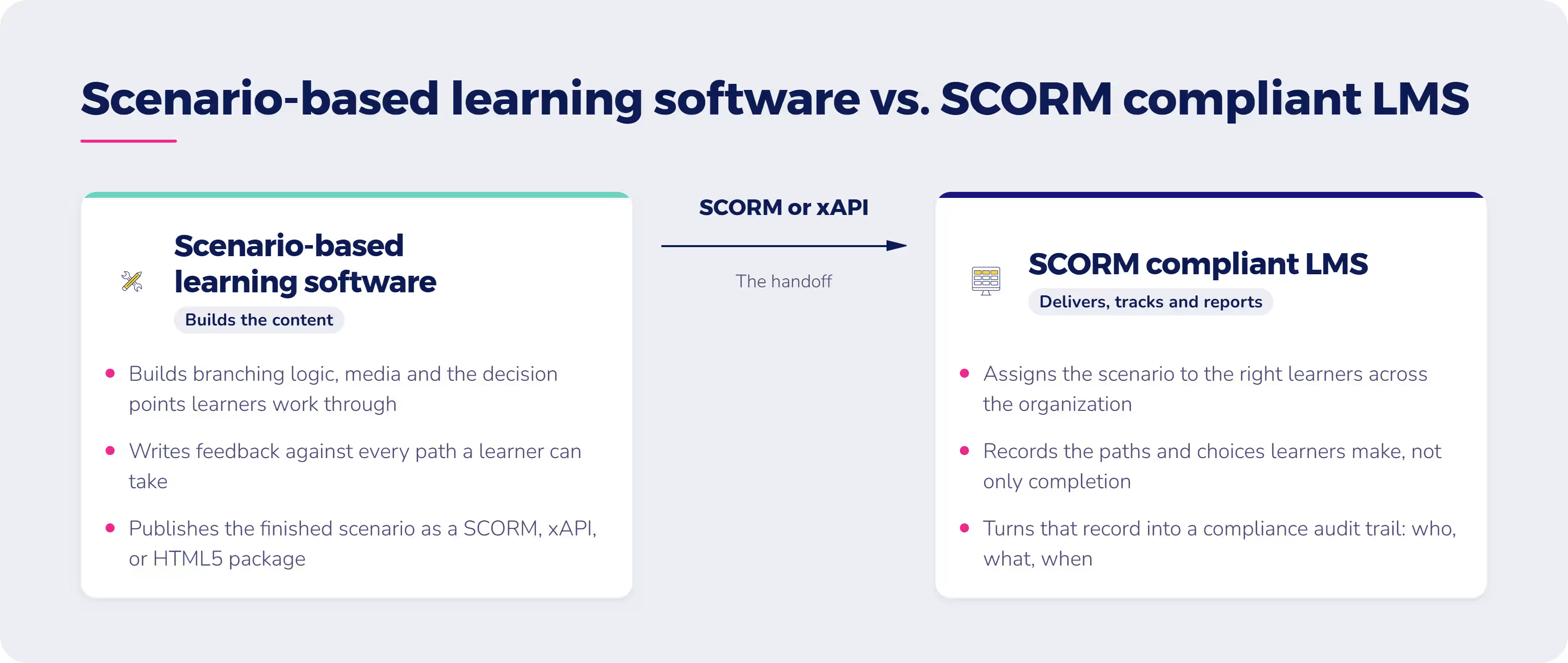
Standalone scenario-based learning software builds content. Most tools also let you publish and run it directly in a browser or as a basic package. They’re good for one-off courses.
Many SCORM compliant LMS tools (including Absorb) include course authoring. But they also track, assign, and report on your scenarios once they're live, at whatever scale you need. So, they’re better for mid-size or enterprise organizations who want to use scenario-based learning approaches and track that they worked.
Absorb's upcoming Aura Rehearse feature is built around exactly this idea:
"With Aura Rehearse (coming soon), managers get a transcript and a per-criterion score instead of a completion checkbox, compliance teams can demonstrate practiced competency rather than consumed content, and Absorb moves from proving that training happened to proving it worked." - Chris Ball, Technical Product Manager Absorb Software
Ready to try scenario-based learning in your program?
Scenario-based learning works because it lets people practice making decisions before they have to make them in real life. But the format you choose matters. So does the thought you put into designing your questions and feedback.
Start small:
- Pick one use case and its matching format, like simulations for interactions or branching scenarios for policy decisions
- Pick a scenario based on a situation your team actually runs into
- Map it out in a deck: the context, decision points, and outcomes
- Get feedback from learners or a trusted colleague
Once you're ready to scale scenario-based learning across your organization, choose Absorb LMS to deliver your program. It not only helps with course authoring at scale; it gives you the tracking, reporting, and compliance audit trail to prove it’s working.
%20(1).avif)

.avif)
_cardimg.avif)