.jpg)
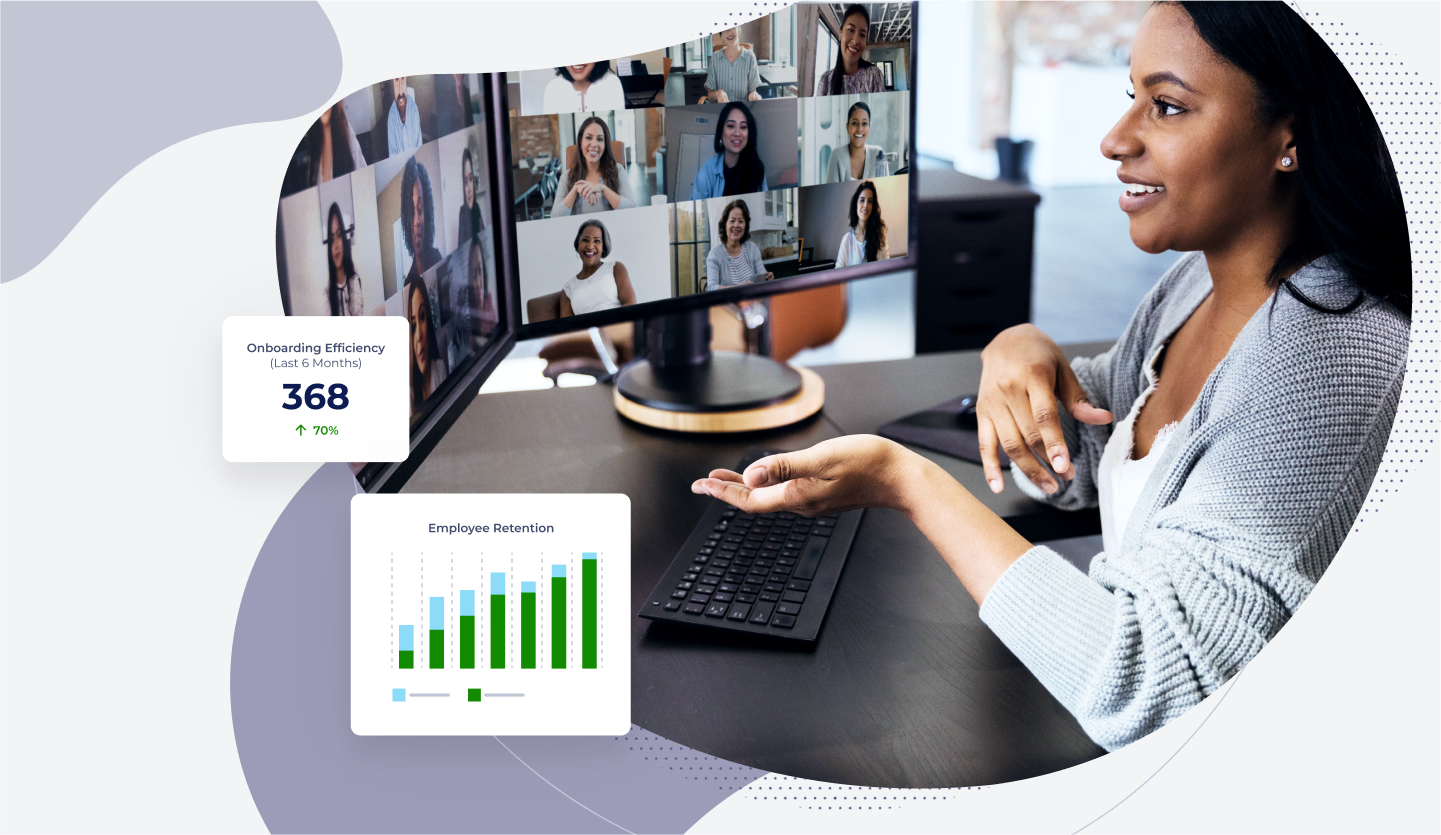

The first stage of the employee learning journey: Onboarding!
"You never get a second chance to make a first impression." This principle applies equally to both employers and employees. With the right process, relevant content, and a Learning Management System (LMS), the onboarding process can be streamlined and effective, leaving a lasting positive impression on new hires.
The beginning of an employment relationship is a critical period. According to a 2022 study by SHRM new employees have about 90 days to prove themselves in a new job. The research also found that the faster new hires feel welcome and prepared for their roles, the faster they will be able to contribute to the company's mission, emphasizing the importance of effective onboarding facilitated seamlessly through a comprehensive LMS. It is the employer’s responsibility to ensure that the new hire is set up for success in their first 90 days.
The most important question in onboarding isn't just what does this person need to know, it's how is this process going to make them feel? The first weeks aren’t just about knowledge transfer — they shape how a new employee feels about their decision to join. New hires come in energized and wanting to contribute. A thoughtful onboarding experience protects that momentum; a fragmented one erodes it. If onboarding squanders that momentum in the first week, you're already playing catch-up with that person's engagement.
—Devan Graham, Senior Human Resources Business Partner, Absorb
The impact of onboarding
Research from SHRM's 2026 Recruiting Benchmarking Report found that most companies still don't consistently measure whether their new hires turn out to be good hires. That gap matters for onboarding too. If you're not tracking quality of hire, you can't prove your onboarding is working, either. Onboarding is the phase that determines a company's "time to value," and an LMS can speed that process up.
A good onboarding experience, supported by a robust LMS, makes employees feel more welcome, secure in their jobs, and capable of thriving. It introduces the company's culture, integrates new hires into a cohesive group, and provides an opportunity to build lasting relationships.
Moreover, the onboarding process also tackles risk and compliance by training employees on policies, procedures, and legal requirements, tasks that can be automated and tracked in an LMS. According to the Society for Human Resource Management (SHRM), an effective onboarding experience, often facilitated by a user-friendly LMS, ensures that 69% of employees stick with a company for three years.
Employee expectations during onboarding
Research from the SHRM Foundation identifies four things new employees need to successfully integrate into an organization: clarity about their role and performance expectations, an understanding of company culture and unwritten norms, connections with colleagues and key stakeholders, and a grasp of policies and procedures — the faster these are established, the sooner new hires can begin contributing.
Business expectations during onboarding
From a business perspective, onboarding is a strategic process that aims to provide new hires with a positive impression, welcome them, integrate them, and equip them with all the information they need to work independently and confidently. An LMS plays a significant role in achieving these objectives.
Overcoming onboarding challenges with LMS solutions
However, challenges often emerge during the onboarding process, such as information overload, lack of direction, and inconsistent experiences across teams.
Information overload or underload: Balancing the amount of information to be delivered is crucial. Too much can lead to overload and poor retention, while too little can leave employees feeling lost. An LMS can provide solutions to these challenges by facilitating microlearning, offering on-demand courses, and providing a user-friendly platform with clear navigation.
Lack of direction: An intuitive LMS empowers learners to communicate and collaborate with each other, providing tailored recommendations of what courses to take next. It guides employees to where they need to go next and helps them discover where they left off.
Different experiences across teams: An LMS can ensure consistency in the onboarding process across different teams and locations by creating a standardized program with consistent messaging, training materials, and delivery methods. Personalized, role-specific training can be delivered while maintaining the overall quality of the onboarding experience.
Harnessing the power of an LMS for onboarding
The strategic importance of streamlined effective, and engaging onboarding is well-documented. With research indicating that well-executed onboarding can significantly enhance employee retention, productivity, and time to value, the spotlight falls on HR-Human Resource leaders to ensure this critical phase is managed proficiently. And it is here that a Learning Management System (LMS) can prove to be an invaluable tool.
HR leaders want to create an environment that sets new hires up for success right from their first interaction with the organization. By harnessing the power of LMS, it's possible to create a winning onboarding experience that not only benefits the employee but also significantly contributes to the organization's success.
A comprehensive LMS can help balance the amount of information delivered, provide clear direction, and ensure consistency in the onboarding process across different teams and locations.
Ready to try Absorb for yourself?
See how Absorb LMS can help you better grow your business through learning. We've worked with thousands of people who need to deliver training. Your job is tough enough, let's get you started on the right track.